
PERU · FOREIGN PLAYERS
Key Facts
- —The country Peru: world’s third-largest copper miner; GDP about US$335 billion (2025).
- —What happened Foreign direct investment rose to US$10.4 billion in 2025 from US$6.7 billion.
- —China COSCO owns 60% of Chancay port; Chinese firms own Lima’s power distributors.
- —United States Major Non-NATO Ally; joined the Shield of the Americas in 2026.
- —Mine owners Freeport, MMG, Anglo American, BHP, Glencore, Teck, Mitsubishi, Grupo México.
- —Still open Whether Peru adopts investment screening under the Shield of the Americas.
Copper, gas and a Chinese-run Pacific port make Peru a place where Washington and Beijing compete for influence.
Peru foreign investment sits in a few big bets: copper mines, Camisea gas, Lima’s power grids and the Chancay port. Companies from China, the United States, Mexico, Europe, Canada and Japan control most of them.
This guide explains who the foreign players in Peru are, what they bring and what they want, as of October 2026. It also covers lenders, donors, security partners and the Peruvians who live abroad.
Peru Foreign Investment in Numbers
Foreign direct investment into Peru reached US$10.4 billion in 2025, according to World Bank data, up from US$6.7 billion in 2024. Peru’s whole economy was worth about US$335 billion in 2025, slightly less than Chile’s US$357 billion.
The legal starting point is Article 63 of the 1993 Constitution. It says national and foreign investment are subject to the same conditions, and that production and foreign trade are free.
Mining is the magnet. The US Geological Survey estimates that Peru mined 2.7 million tonnes of copper in 2025, third behind Chile and Congo.
Peru also ranked second in the world for silver, behind Mexico, and second for zinc, behind China. Those three metals explain why so many large foreign stakes sit in the Andes.
Most of the copper sails to China. In July 2026, 74.3% of Peru’s copper exports went to Chinese buyers, INEI, the national statistics office, reported.
For a closer look at the mines themselves, see the Peru copper mining explainer.

China: The Port, the Mines and Lima’s Power
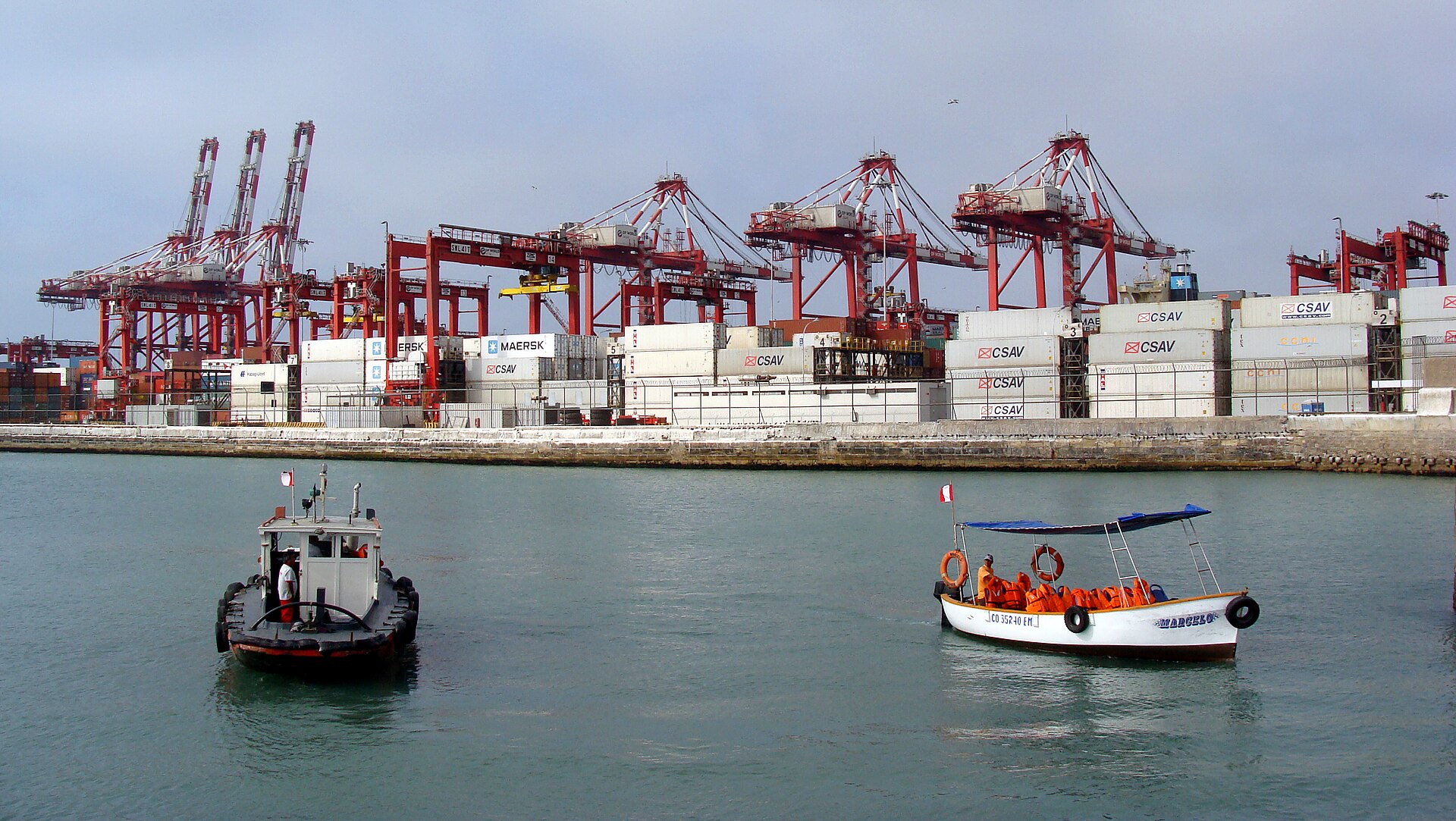
China’s most visible asset is Chancay, a deep-water port north of Lima. COSCO Shipping Ports, the Hong Kong-listed port arm of China’s COSCO Shipping group, owns 60% of the terminal company.
The port opened in November 2024, and COSCO lists its capacity at 1 million containers a year, measured in twenty-foot units (TEU). It handled 295,000 TEU from January to August 2026, up 51.6% on a year earlier.
Citing Peruvian customs data, COSCO says Chinese goods made up 75% of imports through Chancay by origin, and cars made up 27%. Trade through the port totalled about US$2.34 billion in 2025.
Plans for state land near the terminal are covered in this report on 1,211 hectares near Chancay.
In copper, Hong Kong-listed MMG owns 62.5% of Las Bambas, which produced 109,192 tonnes of copper in the second quarter of 2026. Its Chinese partners are Guoxin International (22.5%) and CITIC Metal (15%).
Las Bambas generated US$4.45 billion in revenue in 2025, MMG reported. Chinalco, a Chinese metals group, runs the Toromocho copper mine through its Peruvian unit.
Chinese capital also keeps Lima’s lights on. In April 2020, US-based Sempra sold its 83.6% of Luz del Sur, southern Lima’s distributor, plus a services firm, for US$3.59 billion.
The buyer was an affiliate of China Yangtze Power International, based in Hong Kong.
In June 2024, Italy’s Enel sold its Lima distribution business, now Pluz Energía Perú, to China Southern Power Grid International. The price for its 83.15% stake and a services unit was about US$3.1 billion.
A Peru–China free trade agreement has been in force since 1 March 2010. The two countries signed an upgrade protocol in Lima on 14 November 2024, and Peru ratified it in July 2026.
Beijing’s interest is plain from the trade data: secure copper supply and a Pacific gateway for Chinese goods, from cars to electronics.
The wider strategic contest is covered in the Peru geopolitics explainer.
The United States: Trade, Mines, Gas and Security
The United States is the older partner. The US–Peru Trade Promotion Agreement, a free trade deal, entered into force on 1 February 2009, according to the US Trade Representative.
US Census Bureau data show the United States exported US$12.1 billion of goods to Peru in 2025 and imported US$10.7 billion. Counting services, the State Department puts 2025 two-way trade at US$29 billion, with a US surplus of US$3.3 billion.
US miner Freeport-McMoRan owns 55.08% of Cerro Verde, a copper mine about 20 miles southwest of Arequipa. Japan’s Sumitomo Metal Mining holds 21% and Peru’s Buenaventura 19.58%.
Southern Peru Copper, a Grupo México subsidiary, runs large copper operations in the south and is developing the Tía María project. Its parent, Southern Copper, trades in New York.
In gas, US firm Hunt Oil holds 25.2% of the Camisea fields, Peru’s largest natural gas source. It also owns half of Peru LNG, which it describes as South America’s first and only LNG plant.
Security ties tightened in 2026 under President Keiko Fujimori, leader of the conservative Fuerza Popular party, who took office on 28 July. Secretary of State Marco Rubio visited Lima on 9 and 10 September.
Rubio welcomed Peru’s decision to join the Shield of the Americas, a US-led regional security initiative against drug-trafficking networks. He also cited Peru’s recent designation as a Major Non-NATO Ally and its purchase of F-16 Block 70 fighter jets.
Washington announced a US$35 million package including two King Air aircraft for Peru’s navy. It also plans US$20 million in military financing for the F-16s.
The two governments are also discussing US Army Corps of Engineers investment at the naval base in Callao, Lima’s main port.
Under Peru’s Constitution, foreign troops may enter the country only with the consent of Congress. The congressional debate on the initiative is tracked in this report on the Shield of the Americas hearing.
Washington’s stated aims are to fight drug-trafficking networks, secure critical minerals and present itself as a trusted partner for infrastructure. The Shield declaration also commits members to explore investment screening and trusted suppliers for digital networks.
Europe, Canada, Japan and Australia in the Mines
Antamina, a large copper and zinc mine in the Ancash region, shows how mixed the ownership can be. Its four shareholders come from four different home markets.
- BHP (33.75%): Australian mining group.
- Glencore (33.75%): Swiss-based commodity producer and trader.
- Teck (22.5%): Canadian mining company.
- Mitsubishi (10%): Japanese trading and investment house.
London-listed Anglo American runs Quellaveco, a copper mine in southern Peru that started production in mid-2022. Japanese capital mostly arrives as minority stakes, through Mitsubishi at Antamina and Sumitomo Metal Mining at Cerro Verde.
Spain’s ties are older and more personal. King Felipe VI attended Fujimori’s inauguration, and Spain hosts 15.4% of Peruvian emigrants, according to INEI’s 2022 report.
What these groups want is predictable rules: stable taxes, timely permits and roads kept open to the mines. The guide to who runs Peru’s economy maps the domestic side of that bargain.
Lenders and Donors: IMF, World Bank and Aid
Peru’s most recent IMF arrangement was a precautionary Flexible Credit Line. It expired on 26 May 2024, and Peru told the IMF it would not seek a successor.
The IMF still reviews Peru’s economy each year. Its board concluded the most recent published review, known as an Article IV consultation, on 5 June 2025.
The World Bank lists 14 active Peru projects with about US$2.8 billion in commitments, as of October 2026. The largest are contingent credit lines Peru can draw in a crisis, including two of US$750 million each.
Aid is small next to investment, but it shapes public data and services. UNHCR, the UN refugee agency, has backed INEI surveys of Venezuelan migrants since 2018.
UNICEF presented a study on indigenous and Afro-Peruvian children, built on INEI data, in September 2026. Germany’s GIZ works with Migraciones, Peru’s migration authority, on migration research.
South Korea’s statistics ministry and the Inter-American Development Bank back a 2026 project to modernise INEI’s systems. In September 2026, Rubio announced a planned US$6.5 million satellite internet project for rural southern Peru.
Peru has also tightened control of foreign-funded groups. Law 32301, published on 15 April 2025, requires organisations using international cooperation money to register projects and spending with APCI.
APCI is the state cooperation agency attached to the foreign ministry. The law makes using such funds to back legal action against the Peruvian state a very serious infraction.
The Diaspora and Remittances
Money also flows the other way. INEI counted 3.31 million Peruvians who left between 1990 and 2020 and had not returned, about 10.1% of the projected 2020 population.
The United States hosts the largest share, 30.2%, followed by Spain, Argentina, Chile and Italy, according to INEI’s 2022 report. In the US, the biggest clusters are in New Jersey, New York and Miami.
Peruvians abroad sent home US$5.37 billion in 2025, up 11.7% on 2024, the central bank (BCRP) reported. That equals about 1.6% of GDP, and the United States is the largest source.
What It Means for US Readers
For investors, Freeport-McMoRan and Southern Copper offer direct exposure to Peruvian copper, and Hunt Oil ties a US company to Peru’s gas. Their fortunes depend on permits, protests and copper prices that track Chinese demand.
For trade, Peru is a surplus market for US exporters, whose sales there rose 17% in the first half of 2026. The guide to investing in Peru as a foreigner covers the practical rules.
For policy, Peru is now a formal US security partner while China controls its newest port and Lima’s grids. That mix makes Peru a test of how far the Shield of the Americas reaches into investment.
For travellers, the US State Department rates Peru at Level 2, exercise increased caution. Families with relatives in Peru are part of the biggest remittance corridor into the country.
What Is Not Known
It is not known whether Peru will create a formal investment-screening system; the Shield declaration only says members will explore one. No official Chinese response to Peru’s Shield membership was found.
The terms and cost of any US Army Corps of Engineers work at Callao have not been published. A country-by-country breakdown of 2025 investment flows was not available from official sources at the time of writing.
INEI’s latest published emigration count covers 1990 to 2020, so the size of the diaspora after the pandemic is not officially known. MINCETUR, the trade ministry, said in August 2026 that the upgraded China trade deal would take effect soon, without giving a date.
Frequently Asked Questions
Who are the biggest foreign investors in Peru?
Mining groups lead, including Freeport-McMoRan, Southern Copper, MMG, Anglo American, BHP, Glencore, Teck and Mitsubishi. Chinese firms also control the Chancay port and Lima’s two main electricity distributors.
Does China own the Chancay port?
COSCO Shipping Ports, part of China’s COSCO Shipping group, owns 60% of the terminal company. The port opened in November 2024, and three-quarters of its imports in 2026 came from China.
Is Peru a US ally?
Yes. Peru holds Major Non-NATO Ally status and joined the US-led Shield of the Americas security initiative in 2026.
Does Peru borrow from the IMF?
Peru let its precautionary IMF credit line expire on 26 May 2024 and did not request a new one. The IMF still reviews its economy, most recently in June 2025.
How much money do Peruvians abroad send home?
Remittances reached US$5.37 billion in 2025, up 11.7% from 2024, according to the central bank. The United States was the largest source.
Are foreign investors treated the same as Peruvians?
Article 63 of the Constitution says national and foreign investment are subject to the same conditions. Large projects still need environmental and water permits from Peruvian authorities.
Are there US troops in Peru?
Foreign troops may enter Peru only with the consent of Congress. US cooperation centres on training, aircraft transfers and vetted police units working with US agencies.
Sources: INEI, 2025 census first results; INEI, exports July 2026; INEI, emigration report 2022; Constitution of Peru; Law 32301, El Peruano; MINCETUR, Peru-China FTA; MINCETUR, upgrade protocol ratification; Andina, inauguration; USGS, copper 2026; USGS, silver 2026; USGS, zinc 2026; World Bank, FDI inflows; World Bank, GDP; World Bank, Peru projects; IMF, FCL exit; IMF, 2025 Article IV; US Census Bureau, trade with Peru; USTR, Peru TPA; US Embassy Lima, Rubio visit; US Embassy Lima, Shield of the Americas statement; COSCO Shipping Ports, Chancay update; COSCO Shipping Ports, overseas terminals; MMG, Las Bambas; MMG, 2025 results; Chinalco Peru; Sempra, SEC filing 2020; Enel, sale of Peru distribution 2024; Freeport-McMoRan, South America; Antamina, shareholders; Anglo American, copper; Southern Peru; Hunt Oil, Peru; INEI, UNHCR meeting; INEI, UNICEF study; INEI, Korea partnership; Migraciones, GIZ research; Forbes Peru, BCRP remittances (all accessed 7 October 2026).
This article was produced by The Rio Times’ automated newsroom system. How we use AI · Report an error · Editorial responsibility: Matthias Camenzind, Editor-in-Chief