
BRAZIL MARKETS · CURRENCY
Key Facts
- The scenario Brent oil at US$60 would take the dollar from R$5.46 to R$5.31 by year-end.
- Not the base case Morgan Stanley calls it an alternative path, not its main forecast.
- Why it matters A weaker dollar and cheaper oil would ease pressure on Brazilian stocks, bonds and US-listed Brazilian shares.
- What to watch US inflation data on Tuesday 10 November; Brazil’s inflation on Thursday 12 November.
- Prediction markets Kalshi, a US-regulated exchange, gives 93% odds that Brent ends November above US$78 (9 November, 11:45 a.m. ET).
Morgan Stanley says Brazil’s real could climb to R$5.31 per US dollar by year-end. That happens only if oil falls to US$60 a barrel and the dollar weakens worldwide.
Cheaper oil usually hurts an oil exporter, yet Morgan Stanley argues it could help Brazil’s economy and its currency. The US bank puts the real‘s possible gain against the dollar at about 2.7% by the end of 2026 if the price of Brent crude, the global oil benchmark, falls to US$60.
That would pull the dollar from R$5.46 to R$5.31, in the view of the bank’s global strategists. They treat it as a scenario, not as their main forecast.
What Does Morgan Stanley Expect?
In a global research note, the bank’s strategists say the US midterm elections raised the odds of a negotiated deal between the United States and Iran. That is the trigger for their alternative path, with Brent at US$60.
In that world the DXY, an index that tracks the dollar against major currencies, would slide from about 102.3 to 98.7. Long-term US interest rates would fall to about 4.5%.
The real would then be among the emerging-market currencies with room to gain, though not among the biggest winners.
In Plain English
Brent is the oil price most of the world uses as its yardstick. The real is Brazil’s currency, quoted here in reais per US dollar.
Why Would Cheaper Oil Not Hurt the Real?
Brazil sells more oil than it buys, so lower prices should cut its export income. The strategists say the real now reacts less to oil than in earlier cycles.
Worries about the government’s budget move the currency more today. A calmer world, with lower oil and inflation, could offset part of that fiscal risk.
Brazil’s high interest rates also support the real. The policy rate, the Selic, stands at 13.75%, far above US rates, and that gap can make up for lost oil revenue.
Live Market IntelligenceBrazil — Live Market Board
Rio Times · Live Market Intelligence
Brazil — Live Market Board
+0.54%
169,405.74
+0.54%
71,393.57
+0.43%
10,596.74
+0.57%
2,848,945
—
2,489.73
+0.18%
| Instrument | Last | Change | YoY | Prev. | High | Low | Volume |
|---|---|---|---|---|---|---|---|
| IBOV | 169,405.74 | +0.54% | +9.79% | 168,498.45 | 170,544 | 168,498 | — |
| USD/BRL | 5.52 | +0.21% | +3.52% | 5.51 | 5.53 | 5.49 | — |
| SELIC | 13.75% | — | — | — | — | — | |
| PETR4 | 45.18 | -0.26% | +39.62% | 45.30 | 45.39 | 44.29 | 16,592,300 |
| VALE3 | 65.67 | +2.55% | +0.61% | 64.04 | 65.85 | 64.74 | 8,426,500 |
| ITUB4 | 41.09 | +1.38% | +4.68% | 40.53 | 41.37 | 40.89 | 5,785,300 |
| BBDC4 | 14.46 | +1.83% | -24.32% | 14.20 | 14.58 | 14.34 | 19,371,400 |
| BBAS3 | 16.98 | -0.88% | -25.37% | 17.13 | 17.39 | 16.91 | 12,913,400 |
| B3SA3 | 14.54 | +1.04% | +10.90% | 14.39 | 14.66 | 14.32 | 7,608,600 |
| ABEV3 | 15.48 | +0.00% | +17.45% | 15.48 | 15.68 | 15.38 | 6,682,600 |
| WEGE3 | 50.11 | +3.98% | +10.43% | 48.19 | 50.32 | 48.26 | 8,701,400 |
| PRIO3 | 59.22 | -2.08% | +50.96% | 60.48 | 59.45 | 56.90 | 4,503,800 |
| SUZB3 | 53.62 | +0.41% | +14.65% | 53.40 | 53.69 | 52.30 | 5,010,400 |
| RENT3 | 30.77 | +1.58% | -26.81% | 30.29 | 30.89 | 30.00 | 5,480,000 |
| AZZA3 | 14.98 | +1.49% | -46.77% | 14.76 | 15.32 | 14.84 | 1,359,500 |
| CSNA3 | 4.50 | +2.04% | -45.60% | 4.41 | 4.79 | 4.46 | 17,043,800 |
| GGBR4 | 24.90 | +3.11% | +30.37% | 24.15 | 25.11 | 24.17 | 13,367,700 |
| ENEV3 | 27.22 | +1.42% | +40.67% | 26.84 | 27.29 | 26.90 | 3,809,200 |
Where Does the Real Stand Now?
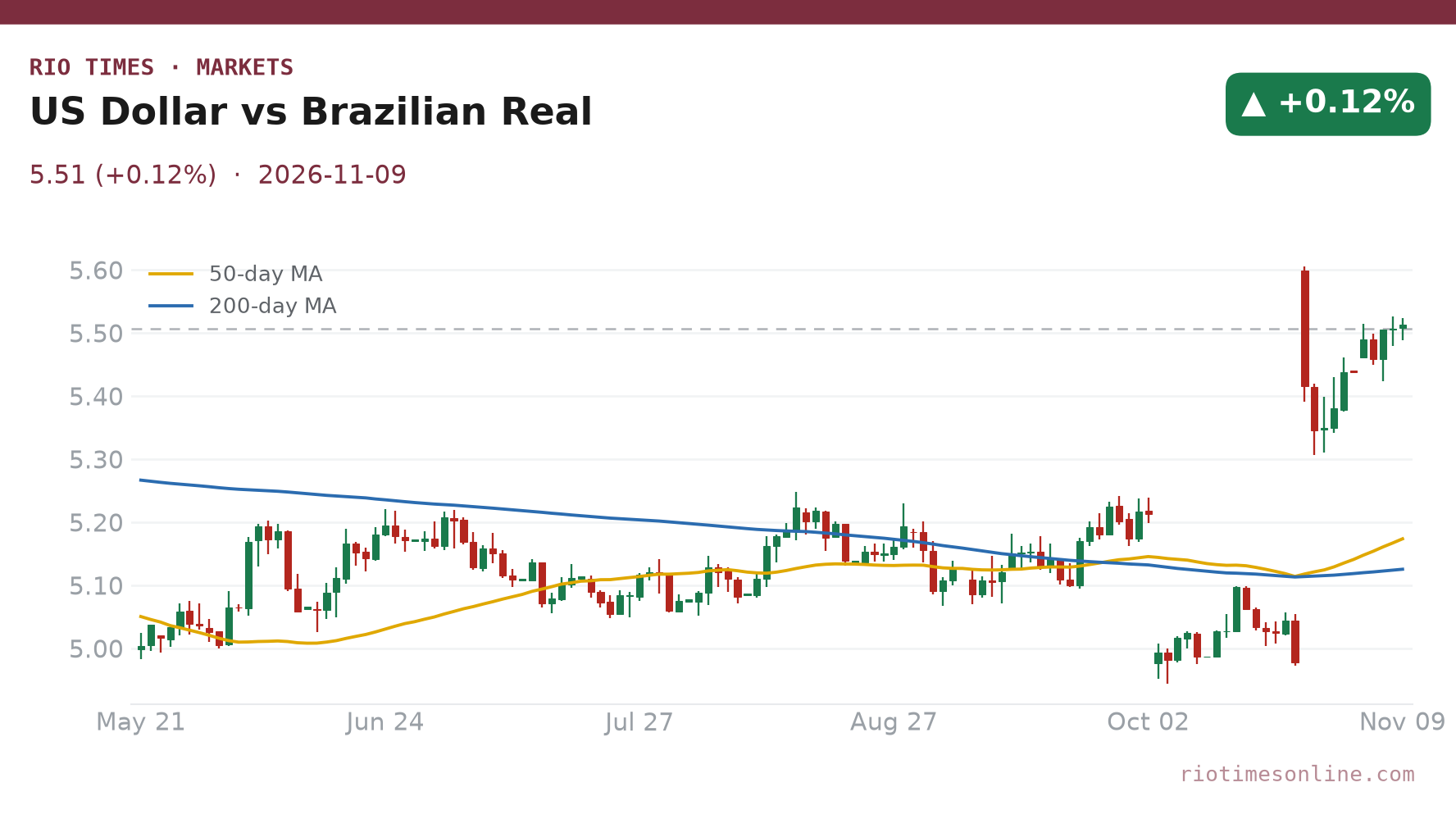
RT, a market data provider, shows the dollar at R$5.51 on Monday 9 November. It closed at R$4.98 on Friday 23 October and jumped to R$5.42 on Monday 26 October, the first trading day after the 25 October presidential runoff.
The bank’s R$5.46 sits a few cents below Monday’s rate. From R$5.51, R$5.31 needs a fall of about 3.6% in the dollar, a little below its R$5.35 close on 27 and 28 October.
What It Means for US Readers
US investors who hold Brazilian stocks or bonds earn in reais, so a stronger real lifts their dollar returns. Oil producers such as Petrobras, the state-controlled company listed in New York as PBR, would face lower revenue at US$60 Brent.
Travellers and expats also feel it. At R$5.31 a US$100 note buys R$531, instead of R$551 at Monday’s rate.
What Prediction Markets Say
Kalshi, an exchange regulated in the US by the CFTC (the federal commodities regulator), shows 93% odds that Brent settles above US$78 on 30 November and about 60% above US$88. About 103,500 contracts have traded on that market, as of Monday 9 November, 11:45 a.m. ET.
US$60 looks distant for November. These prices are bets, not polls.
Why we show this: prediction markets turn real-money bets into a live probability that moves within minutes of the news, which is why investors, campaigns and newsrooms in the United States now follow them closely. We show them next to polls and official results, never instead of them.
What Is Not Known
We could not read the full Morgan Stanley note, so the figures come from published summaries that agree with each other. Nobody knows whether talks between the United States and Iran will produce a deal.
What to Watch Next
Tuesday 10 November, 8:30 a.m. ET: US consumer prices for October. A hotter reading would lift the dollar and work against the bank’s scenario.
Thursday 12 November, 7:00 a.m. ET: Brazil’s IPCA inflation index, from the statistics agency IBGE.
Frequently Asked Questions
Will Brazil’s real rise to R$5.31 per dollar?
Only in Morgan Stanley’s alternative scenario, where Brent oil falls to US$60 and the dollar weakens worldwide. The bank does not treat it as its main forecast.
How does the oil price affect the real?
Less than in past cycles, the bank says. Brazil exports oil, but the real now follows worries about the government budget more closely.
Sources: Morgan Stanley global research note on oil, the dollar and emerging-market currencies (as summarised on 9 November 2026); RT, USD/BRL daily data to 9 November 2026; Kalshi, Brent crude markets (accessed 9 November 2026, 11:45 a.m. ET); Banco Central do Brasil, Selic policy rate.
This article was produced by The Rio Times’ automated AI newsroom. Editorial responsibility: Matthias Camenzind, Publisher and Editor-in-Chief. The Rio Times also runs Ask Rio Times, which answers from 100,000+ of our own articles, the daily Latin America Power Map, and prediction-market odds on elections and markets.. How we use AI · Report an error
LatAm Markets: Live Signals → — real-time movers, turnover leaders and FX across Latin America.
Brazil runoff, Sunday, October 25: Brazil runoff: date, poll closing times and when results start. Latest: Brazil runoff polls, Flávio 51%, Lula 49%.