Key Facts
- The S&P/BMV IPC, Mexico’s main stock index, closed at 66,384, a gain of 0.21% on the session, though it remains 7.3% below its 52-week high.
- The Mexican peso strengthened, with the dollar dipping 0.25% to close at 17.48 pesos, pushing the currency further from its 52-week low.
- Grupo Financiero Banorte was a standout, surging 1.7% with $58 million in turnover and helping lift the broader financial sector.
- Cemex was the heaviest weight, with its CPO shares falling 1.6% on $22 million in volume, making it the session’s most notable laggard.
- Trading was cautious and low on drama, with the S&P 500 virtually flat and investors in Mexico focusing on domestic consumer and banking names.
Today’s Focus
Mexico’s S&P/BMV IPC — the benchmark index of the country’s 35-or-so most valuable listed companies — ticked 0.21% higher to finish Friday’s session at 66,384, a quiet drift rather than a conviction rally. The peso also had a gentle day, firming 0.25% against the dollar to settle at 17.48, leaving it within striking distance of its strongest level of the past year.
Banks provided the muscle. Shares of Grupo Financiero Banorte — one of Mexico’s largest financial groups — jumped 1.7% on heavy turnover of $58 million, while regional lender Banco del Bajío added 2.4%. The moves suggest domestic investors were quietly positioning for an economic landscape where borrowing costs and loan demand could shift, even though Banxico, the central bank, gave no fresh signal that day.
On the losing side, heavy-materials giant Cemex was the biggest drag among widely traded names, its CPO shares sliding 1.6%. The airport operator ASUR also slipped 0.7%. With the US S&P 500 essentially unmoved — up a whisper at 0.05% — Mexico’s board lacked a forceful external push, leaving local stock picking to drive the modestly positive session.
What matters today. A gentle, domestically led uptick with banks powering the session while global cues gave almost nothing away.

01 The session in one read
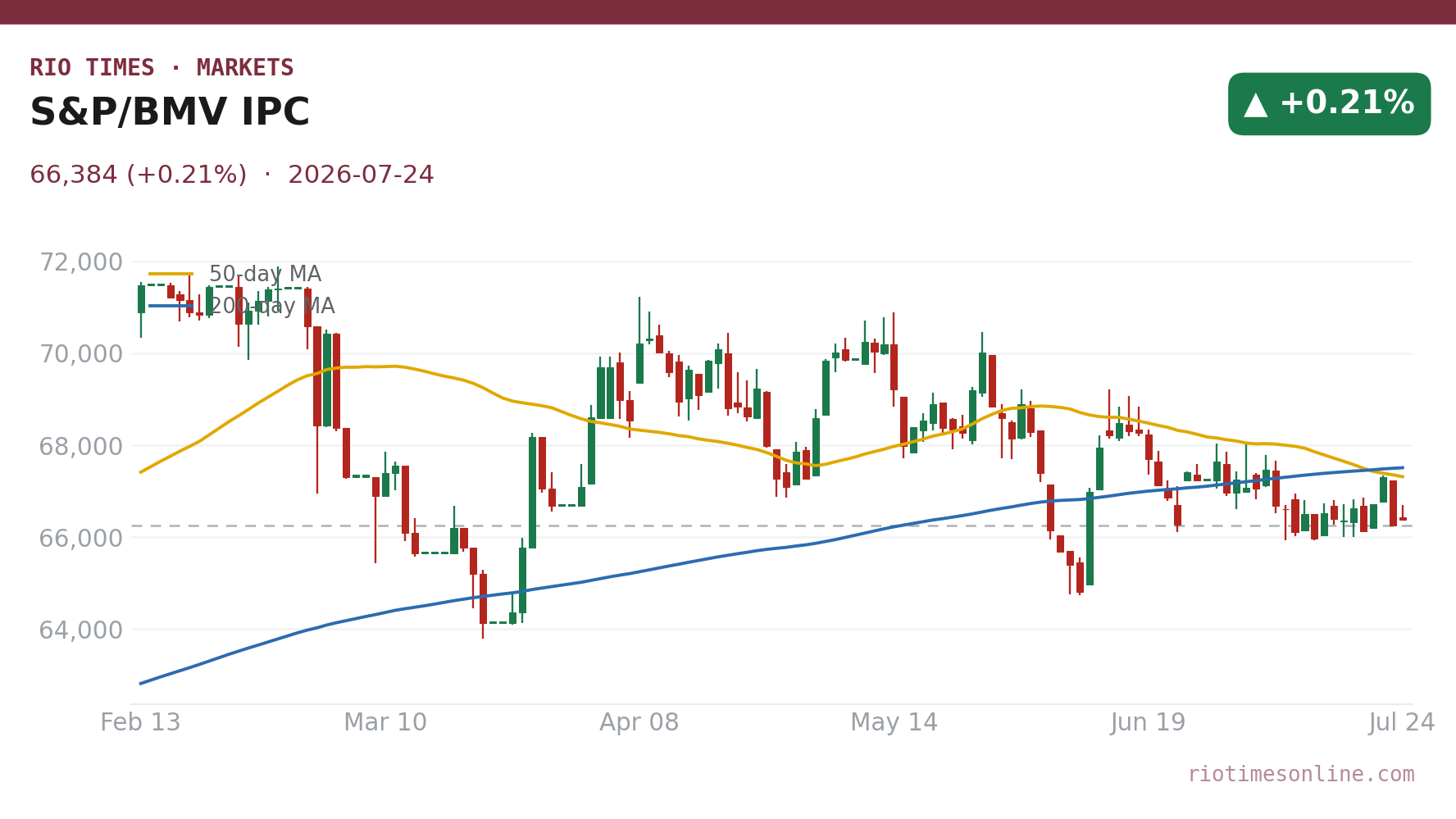
The S&P/BMV IPC, Mexico’s principal stock benchmark, strung together a mild gain on Friday, closing at 66,384 — a rise of 0.21% that nudged the index away from the lower reaches of its 52-week range. The Mexican peso, which is often the first thing foreign traders check each morning, also improved, firming 0.25% so that one US dollar bought 17.48 pesos by the closing bell.
It was a session without a commanding global script. In New York, the S&P 500 was practically glued to its opening level, ending a hair higher at 7,412. Without a strong push from the US tape — which heavily influences Mexican stocks through trade, remittances and investor flows — traders in Mexico City looked inward, concentrating their fire on a handful of financial and consumer names.
Grupo Financiero Banorte led that charge, its shares rising 1.7% on a substantial $58 million worth of trading. The regional bank Banco del Bajío also climbed 2.4%. The day’s heaviest dent came from the construction-materials heavyweight Cemex, whose widely held CPO shares — a format that bundles ordinary and dividend-preference shares into one tradable unit — lost 1.6%, making it the clear laggard among the most-traded names.
Friday’s session was less a shift in conviction and more a calm resolution of a mid-summer week. The volumes in the most-traded names were respectable but not exuberant, and the mixed performance among heavyweights — Banorte rising, Cemex falling — shows a market lacking a single, unifying narrative. The peso’s gentle strengthening is consistent with a broader, slow burn of confidence in the currency, but the index remains more than 7% below its 52-week high of 71,601, a reminder that the market has not fully recovered its footing. The key variable to watch is whether financial-sector buying can broaden into the industrials and materials stocks that were heavy on Friday.
02 The day’s numbers
| Measure | Level | Change | Read |
|---|---|---|---|
| S&P/BMV IPC | 66,384 | +0.21% | 7.3% below its 52‑week high of 71,601 |
| 52‑week range | 60,569 – 71,601 | — | Mid‑range, closer to the floor than the ceiling |
| USD/MXN (the peso) | 17.48 per dollar | −0.25% | 6.7% below its 52‑week high; near the stronger end of the 17.13–18.74 range |
| Key technical level | 66,000 (round‑number support) | — | The index closed above it, holding a psychologically important line |
The IPC is the capitalisation-weighted barometer of the Bolsa Mexicana de Valores, or Mexican stock exchange, and it tracks around 35 of the country’s most liquid companies across all sectors. Friday’s close of 66,384 placed it well above the 52‑week low of 60,569 — a trough that was last tested during spells of intense risk-off sentiment — but still a significant 7.3% below the 52‑week high of 71,601.
The currency had a quietly constructive session. The dollar’s 0.25% decline against the peso took USD/MXN to 17.48, a level that inches closer to the peso’s strongest point of the past year at 17.13. When the peso strengthens — meaning the USD/MXN number gets smaller — it tends to act as a modest headwind for Mexico’s big exporters, but it can also signal confidence among international investors who hold local assets. Rio Times · Live Market Intelligence
Live Market IntelligenceMexico — Live Market Board
Mexico — Live Market Board
Instrument Last Change YoY Prev. High Low Volume
IPC MEX
63,507.11
-1.11%
+12.17%
64,216.98
66,121
65,405
108,886,187
USD/MXN
17.06
-0.24%
-8.58%
17.10
17.08
17.01
—
WALMEX
48.07
-0.62%
-14.38%
48.37
48.65
48.02
10,781,446
GMEXICO
223.28
+0.35%
+73.59%
222.50
226.18
222.17
1,325,556
FEMSA
201.19
-0.24%
+25.67%
201.67
206.71
199.56
750,706
CEMEX
19.32
+0.89%
+19.10%
19.15
19.35
19.04
14,327,054
GFNORTE
193.98
+1.18%
+14.36%
191.71
195.79
191.83
1,579,115
BIMBO
60.98
-0.96%
+11.89%
61.57
61.46
60.29
1,048,115
TELEVISA
9.71
+0.21%
+12.78%
9.69
9.75
9.60
577,851
AMX
19.80
-0.95%
+12.53%
19.99
20.05
19.70
58,058,525
GAP
366.23
+0.43%
-21.21%
364.68
370.85
362.82
226,946
ASUR
275.04
+1.25%
-15.28%
271.64
275.08
271.31
15,451
OMA
233.50
+0.62%
-6.48%
232.06
235.00
230.62
555,693
KOF
188.04
+0.86%
+18.94%
186.44
188.56
185.52
425,273
GRUMA
252.90
+0.11%
-21.85%
252.61
254.74
250.36
90,048
KIMBER
39.74
+0.43%
+8.85%
39.57
40.09
39.33
490,551
AMX ADR
23.38
-0.23%
+22.25%
23.43
23.49
23.06
1,347,445
03 Why it moved — a domestic stock-picker’s market
The heart of Friday’s move was not a macroeconomic jolt but a rotation toward financial and consumer stocks. Banorte’s 1.7% jump was the splashiest signal, and it arrived alongside a 1.7% advance for Walmex, the Mexican unit of the world’s largest retailer. Together, these two names suggested that local money was betting on resilient domestic spending and a banking sector that can earn its way even in a cautious rate environment.
There was no Banxico decision or speech on Friday to give traders a fresh steer. The central bank’s benchmark interest rate has been on a gradual path of normalisation in recent years, and the market’s focus has quietly shifted from “when will they cut?” to “how will bank earnings and consumer credit fare if rates stabilise?” That thinking appeared to lift mid-tier financial names such as Banco del Bajío, which rose 2.4%, and the upscale retailer La Comer, which added 2.3%.
The drag came from the infrastructure and materials corner. Cemex, whose CPO shares are among the most internationally recognised Mexican stocks, fell 1.6% on $22 million in turnover — not a panic, but enough to signal that investors were lightening up on a name sensitive to both global construction cycles and a stronger peso. Airport group ASUR, which operates several south‑eastern Mexican airports, slipped 0.7%, and real‑estate developer Vesta also shed 1.0%.
04 The day’s movers
| Driver | Level / Move | Change | Note |
|---|---|---|---|
| Cemex (CX) | Most‑traded global line | −0.5% | $964m turnover on the international CX line; the local CEMEXCPO fell a sharper 1.6% |
| Banorte (GFNORTEO) | Leading financial gain | +1.7% | $58m volume; strong bid for Mexico’s third‑largest bank by loans |
| Walmex (WALMEX) | Consumer staple anchor | +1.7% | $45m traded; a steady beneficiary of domestic‑spending resilience |
| Regional bank Bajío (BBAJIOO) | Sector tailwind | +2.4% | Caught the bank rally alongside Banorte; smaller turnover |
| ASUR (airport operator) | Infrastructure laggard | −0.7% | Part of a broader softness in construction and transport names |
Turnover tables can mislead unless we distinguish between local shares and internationally traded lines. The $964 million number attached to CX is the US‑listed flow in Cemex’s American Depositary Receipts, and its −0.5% move reflects a blend of the local shares and the currency effect. The local series, CEMEXCPO, dropped a more decisive 1.6%, making it the worst of the heavily traded domestic names.
The day’s steeper — but less liquid — gainers included the conglomerate Regional, up 3.5%, and the packaging company Lab, which rose 3.2%. On the downside beyond Cemex, the bakery group Bimbo lost 1.3% and the real‑estate trust FIBRAPL14 retreated 0.9%. The pattern was clear: traders favoured financials and domestic-facing retail over exporters and heavy industry.
05 The regional scoreboard
| Index | Country | Change |
|---|---|---|
| S&P/BMV IPC | Mexico | +0.21% |
| Ibovespa (Brazil) | Brazil | — |
| IPSA | Chile | — |
| COLCAP | Colombia | −0.38% |
| S&P/BVL General | Peru | — |
The verified regional move on July 24 was Mexico’s gentle uptick of 0.21%. Live data for Brazil’s Ibovespa, Chile’s IPSA, Colombia’s COLCAP and Peru’s S&P/BVL General are not shown in this scan, so they are marked with a dash. Readers can consult the live market board above for those countries’ closing levels and session moves as they become available.
In recent sessions tracked by The Rio Times, the broader regional story has featured a Brazilian market navigating its own easing cycle — the Selic, Brazil’s benchmark rate, began a series of cuts in early 2026 — and an Andean bloc still absorbing higher Colombian rates. Mexico, meanwhile, is carving its own middle path, with a currency that looks firm and an equity board that is trading more on company-level stories than on a powerful macroeconomic tide.
06 The technical picture
The IPC’s close at 66,384 left it perched just above the round‑number 66,000 level, a psychologically significant line that served as a floor during Friday’s session. Because the index is still 7.3% below its 52‑week high of 71,601, it has not yet entered a zone where traders broadly worry about an overbought market.
In currency terms, the peso’s drift lower in USD/MXN — from about 17.52 toward 17.48 — kept the pair inside a well-defined channel that has prevailed since early 2026. Technicians would note that the exchange rate’s 52‑week band between 17.13 and 18.74 places the current level much closer to the strong end of the range, a configuration that, if sustained, often coincides with a stable-to-positive backdrop for Mexican financial assets.
07 What to watch
- Banxico’s rate path: Any new inflation or growth data could shift expectations for the central bank’s next move, directly affecting bank and retailer shares.
- Cemex and the construction cycle: The 1.6% drop raises the question of whether the cement giant is flagging genuine demand softness or just a currency squeeze; its next update will be closely read.
- US consumer data: With Walmex and other domestic plays outperforming, the health of the Mexican consumer — and the remittances that feed it — remains a critical undercurrent.
- Peso strength near 17.13: If USD/MXN tests the 52‑week low, it could become a headwind for Mexican exporters, particularly industrial and auto names.
Background: Vesta Rides Nearshoring to a Stronger Second Quarter.
Background: Televisa Second Quarter: $28M Loss as Sky Bleeds, ViX Grows.
More: Mexico news in English, every day from The Rio Times.
Frequently Asked Questions
What is the S&P/BMV IPC?
It is Mexico’s main stock index, tracking roughly 35 of the largest and most‑traded companies listed on the Bolsa Mexicana de Valores, weighted by their size.
What does USD/MXN 17.48 mean?
It means one US dollar buys 17.48 Mexican pesos. A lower number signals a stronger peso, which can hurt exporters’ profits but may also reflect investor confidence.
Why did Banorte lead the session?
Banorte, along with other banks and retailers, rallied as domestic investors focused on financial-sector strength and consumer resilience, with no disruptive macro news to change the tone.
Is a 0.21% move a big deal?
It is a fairly flat session by equity standards, but the internal composition — banks up, materials down — tells a richer story about where money is quietly rotating in Latin America’s second‑largest market.
This article was produced by The Rio Times’ automated newsroom system. How we use AI · Report an error
In depth
LatAm Markets: Live Signals → — real-time movers, turnover leaders and FX across Latin America.
Read More from The Rio Times