Mexico Stocks Rise 1.71% to Six-Month High | Mexico Market Report, Nov 4
Key Facts
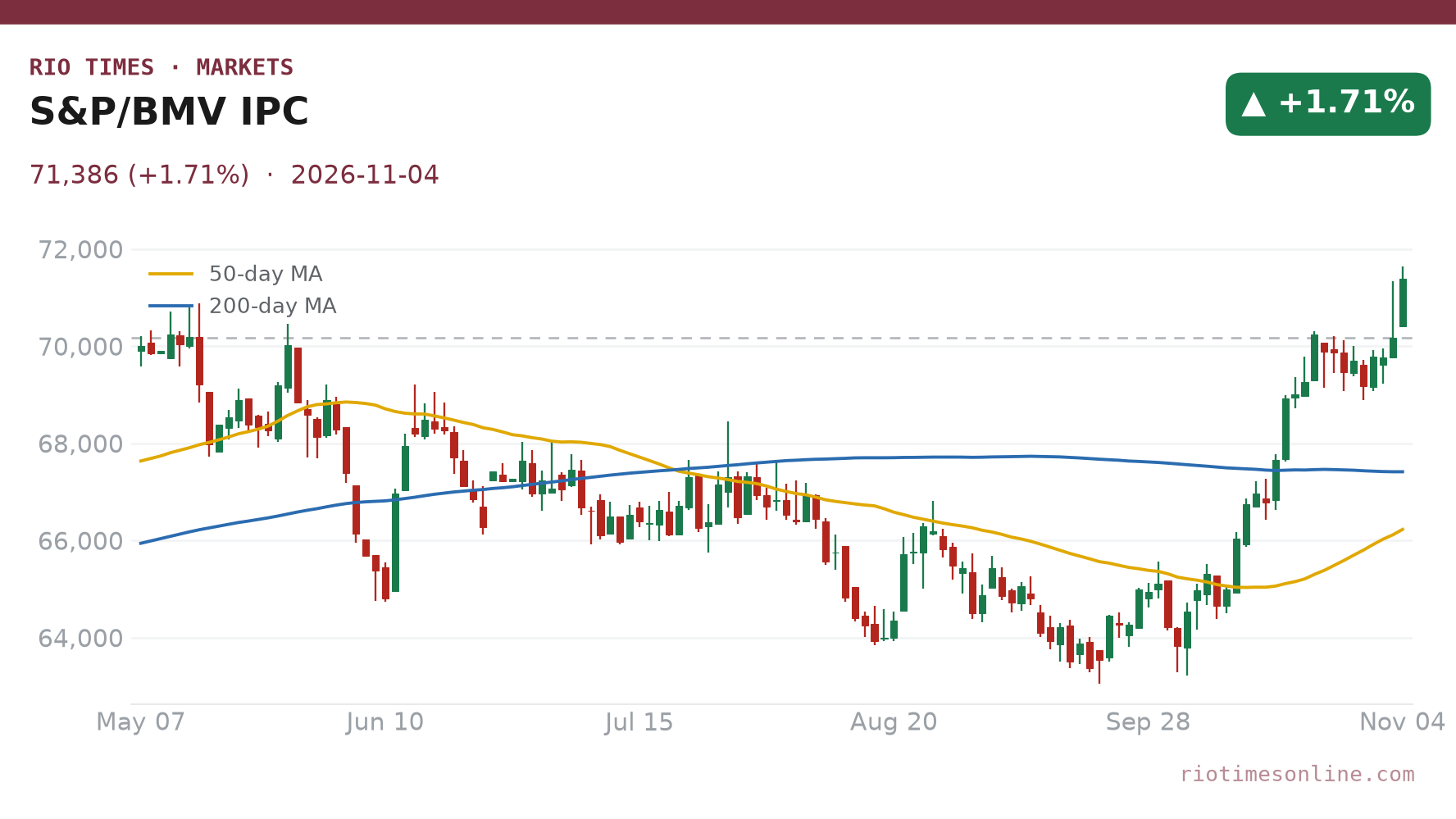
- Mexico’s main share index, the S&P/BMV IPC, closed at 71,386, up 1.71% on the session and its highest close in at least six months.
- The index now sits just 0.3% below its 12-month high of 71,601, set on 11 February, and 15.8% above its 12-month low of 61,672 from 20 November 2025.
- The peso strengthened to 18.62 per US dollar the dollar fell 1.12% on the session, so each dollar now buys fewer pesos.
- Relief after the US midterm elections did most of the work as the Dow Jones, a main US share index, jumped 3.03% and the US dollar index slipped 0.37%.
- Walmex, the Mexican arm of Walmart, led the big names with a 4.3% gain while Banorte, a major bank, fell 2.4% on US$100m of trading, the busiest stock of the day.
Today’s Focus
Mexico’s stock market just reached a level it has not closed at in at least six months. The S&P/BMV IPC, the country’s benchmark index of its biggest listed companies, finished at 71,386 — up 1.71% on the session.
The exchange was shut on Monday 2 November for the Day of the Dead holiday, and trading resumed on Tuesday. Wednesday’s jump built on that restart and left the index 0.3% below its 12-month high of 71,601.
The peso rose too. The dollar slid to 18.62 pesos, down 1.12% on the day, as investors worldwide relaxed after the US midterm elections and the dollar and US borrowing costs eased.
What matters today. Mexican shares and the peso rose together on a global relief move, so the next test is whether the index can clear 71,601 without that tailwind.

01 The session in one read
Think of the IPC as a basket of Mexico’s largest listed companies — a single number that says whether the country’s big businesses are worth more or less than yesterday. On Wednesday it closed at 71,386, up 1.71%.
The exchange was closed on Monday 2 November for the Day of the Dead, so there was no session and no report that day. Trading resumed on Tuesday, and Wednesday’s move is measured against that last session.
The headline is not the daily gain alone. The close is the highest in at least six months, and the index has climbed 9.30% over 20 sessions, which is a very fast month.
The peso told the same story. The dollar fell 1.12% to 18.62 pesos, so Mexico’s currency strengthened on the day.
The evidence points to a broad, global risk-on day more than a Mexico-specific story. US shares rose, the VIX fear gauge fell sharply, the dollar weakened and US 10-year borrowing costs eased, and every one of those moves helps emerging markets.
Mexico also did something its neighbours did not: it led from the big domestic names such as Walmex while the busiest stock, Banorte, fell. The index has risen strongly over the month, so the variable to watch is whether the 71,601 high gives way on a day when the dollar is not falling.
02 The day’s numbers
| Measure | Level | Change | Read |
|---|---|---|---|
| S&P/BMV IPC close | 71,386 | +1.71% | Highest close in at least six months |
| Session range | — | — | Intraday high and low not in the scan |
| US dollar vs peso (USD/MXN) | 18.62 | −1.12% | Peso stronger; fewer pesos per dollar |
| 52-week positioning, IPC | 0.3% below 71,601 high | — | 15.8% above the 61,672 low |
| 52-week positioning, dollar | 1.4% below 18.87 high | — | 10.1% above the 16.88 low |
| Key technical level | 71,601 | — | 12-month high, set 11 February |
Read the table as a story about distance. The index is a hair from its yearly peak, while the dollar is still well above its September low of 16.88 pesos.
That second line matters. The peso has been weak for two months, so Wednesday’s gain is a bounce within a weaker trend rather than a full recovery. Rio Times · Live Market Intelligence
Live Market IntelligenceMexico — Live Market Board
Mexico — Live Market Board
Instrument Last Change YoY Prev. High Low Volume
IPC MEX
71,385.90
+1.71%
+12.74%
70,184.33
70,008
69,383
49,372,306
USD/MXN
18.69
+0.62%
+1.45%
18.57
18.69
18.54
—
WALMEX
49.53
-1.51%
-19.45%
50.29
50.54
49.44
2,069,310
GMEXICO
231.81
+1.57%
+50.31%
228.22
233.41
228.50
1,952,754
FEMSA
232.97
+0.18%
+32.20%
232.54
234.49
230.40
277,092
CEMEX
19.60
+3.48%
+14.42%
18.94
19.63
18.95
9,927,197
GFNORTE
214.68
+0.29%
+24.39%
214.07
215.30
212.24
5,714,524
BIMBO
64.27
+1.56%
+3.36%
63.28
64.60
62.11
988,269
TELEVISA
8.33
-1.77%
-9.16%
8.48
8.52
8.31
1,277,288
AMX
22.47
-0.27%
+7.56%
22.53
22.74
22.39
7,217,012
GAP
418.59
+0.34%
+5.26%
417.18
423.09
413.53
190,130
ASUR
249.54
-1.02%
-18.40%
252.11
253.66
248.64
24,784
OMA
229.76
+0.06%
-3.04%
229.62
231.99
227.86
119,261
KOF
213.92
-0.39%
+31.99%
214.75
216.94
211.01
518,660
GRUMA
245.16
-0.93%
-22.90%
247.46
248.39
245.00
101,929
KIMBER
37.80
+0.13%
+7.64%
37.75
38.38
37.80
2,154,177
AMX ADR
24.01
-0.70%
+5.59%
24.18
24.37
23.99
1,024,581
03 Why it moved — US election relief and a softer dollar
The first cause, and the heaviest, was relief after the US midterm elections. Democrats won control of both houses of the US Congress, and investors read that as a check on White House policy, which matters enormously for an export economy tied to US trade.
The US evidence fits: the Dow Jones, a main index of big US companies, rose 3.03%, and the S&P 500 rose 1.58%. The VIX, Wall Street’s fear gauge, dropped 20.26% to 16.61. Confidence: medium-high, because the timing is clear but the market’s own reasoning is an interpretation.
The second cause was a softer dollar and cheaper US borrowing. The US dollar index, which tracks the dollar against a basket of major currencies, fell 0.37% to 101.49. The US 10-year Treasury yield, the benchmark price of borrowing, slipped 5 basis points to 4.90%. Confidence: high.
The third cause is company-specific. Walmex gained 4.3% while Banorte lost 2.4%. We found no confirmed company news behind Banorte’s fall, so treat the stock moves as market-driven. Confidence: medium.
One driver disagreed. A US oil-price fund fell 8.07% on the session, a move that would normally unsettle oil-linked markets, yet Mexican shares rose. The best-supported reading, at medium confidence, is that investors cared more about lower borrowing costs and election relief than about crude.
Mexico’s finance ministry also reported a deficit of 222.34 billion pesos (about US$11.9 billion at 18.62 per dollar) for September alone, and 968.5 billion pesos (about US$52 billion) for January to September. The deficit keeps building through the year, which investors watch because it shapes sentiment on the peso and on government bonds.
04 The day’s movers
| Driver | Level / Move | Change | Note |
|---|---|---|---|
| Banorte (GFNORTEO) | Most traded, US$100m | −2.4% | Bank; tax worry for 2027 |
| Grupo México (GMEXICOB) | US$87m traded | +0.8% | Copper miner and railway group |
| América Móvil (AMXB) | US$59m traded | −0.4% | Telecoms group; flat-ish |
| Walmex (WALMEX) | US$53m traded | +4.3% | Walmart’s Mexican arm; best large cap |
| Femsa (FEMSAUBD) | US$47m traded | +1.0% | Owner of the Oxxo store chain |
| Cemex (CEMEXCPO) | US$46m traded | +1.7% | Cement maker |
| Volaris (VOLARA) | Top gainer | +5.8% | Budget airline |
| Alpek (ALPEKA) | Top loser | −3.8% | Petrochemicals producer |
| NAFTRACISHRS | US$43m traded | +0.9% | Cross-listed fund tracking the market, not a company |
The leaders were a mix of consumer and mining names: Walmex, Volaris, Cuervo (tequila, up 5.7%), Peñoles (a silver and gold miner, up 5.5%) and Gruma (tortillas, up 3.5%). Banorte was the heavyweight that moved against the tide.
Banorte’s fall alone, on the busiest turnover of the day, took a visible bite out of the index gain. Without it, the rally would have looked even stronger.
05 The regional scoreboard
| Index | Country | Change |
|---|---|---|
| S&P/BMV IPC | Mexico | +1.71% |
| Ibovespa | Brazil | +1.23% |
| IPSA | Chile | +2.52% |
| BVL | Peru | +1.88% |
| COLCAP | Colombia | −0.84% |
Most of the region joined in, with Chile’s IPSA leading and Brazil’s Ibovespa, its main stock index, also higher. Colombia went the other way. The live market board above carries all the closes.
Currencies also firmed against the dollar: the Chilean peso (USD/CLP 965.6, −1.58%) and the Brazilian real (USD/BRL 5.4594, −0.56%) strengthened alongside Mexico’s peso. For a Mexican saver, a stronger peso lowers the cost of imports and holidays abroad.
06 The technical picture
The big resistance is the 12-month high at 71,601, which is only 0.3% above Wednesday’s close. A close above it would mean the index has reached a new yearly high.
Support starts at the round number of 70,000 and then stretches a long way down to the 12-month low of 61,672 from 20 November 2025. The index is 15.8% above that low.
For the peso, the line to watch is the dollar’s 12-month high of 18.87 pesos, set on 29 October. A move back toward it would signal that Wednesday’s peso gain has faded.
RT’s own history, which is not a forecast, gives a measured reminder. The IPC has risen 9.30% in 20 sessions, and in the 19 earlier cases since 2007 with a move at least that large, it was higher 20 sessions later in 11 of 19 (58%). The median change was +0.5%, and the worst was −12.9%.
For Latin America, a stronger Mexican peso and a firmer IPC lift the value of Mexican holdings in portfolios from Sao Paulo to Santiago. Chile’s IPSA rose even more, and a falling dollar eases debt bills across the region.
07 What to watch
- Banxico decision: Mexico’s central bank announces its interest rate decision on Thursday 5 November; the previous rate was 6.5%, and the peso is sensitive to any hint on future cuts.
- The 71,601 ceiling: A close above the 12-month high would confirm a new yearly high; failure there would make Wednesday look like a one-day relief rally.
- The peso’s 18.87 line: The dollar’s 12-month high of 18.87 pesos is the level that would show the peso’s bounce has failed.
- US data: Weekly US jobless claims on Thursday could move US yields and the dollar again.
Background: Mexico Stocks Rise 0.52% as Peso Weakens.
Background: Mexico Stocks Fall 0.12% as Peso Gains.
Frequently Asked Questions
Did the Mexican stock market trade on Monday 2 November?
No. The exchange was closed for the Day of the Dead holiday. Trading resumed on Tuesday.
What is the S&P/BMV IPC?
It is the main index of Mexico’s biggest listed companies, a single number showing whether the country’s large businesses are worth more or less than before.
Why did the peso get stronger?
The dollar weakened worldwide and US borrowing costs eased after the US midterm elections, so the dollar fell 1.12% against the peso to 18.62.
Is the rally likely to continue?
History is not a forecast. In 19 earlier cases with a 20-session gain this large, the index was higher 20 sessions later in 11, with a median of +0.5%.
Market data: The Rio Times; exchange figures from BMV
This article was produced by The Rio Times’ automated newsroom system. How we use AI · Report an error · Editorial responsibility: Matthias Camenzind, Editor-in-Chief
In depth
LatAm Markets: Live Signals → — real-time movers, turnover leaders and FX across Latin America.
Get The Rio Times delivered to your inbox — market intelligence, daily briefs, and breaking analysis across Latin America.
Start for US$1