Mexico Stocks Edge Up 0.3% on Rate Cut | Mexico Market Report, Nov 5
Key Facts
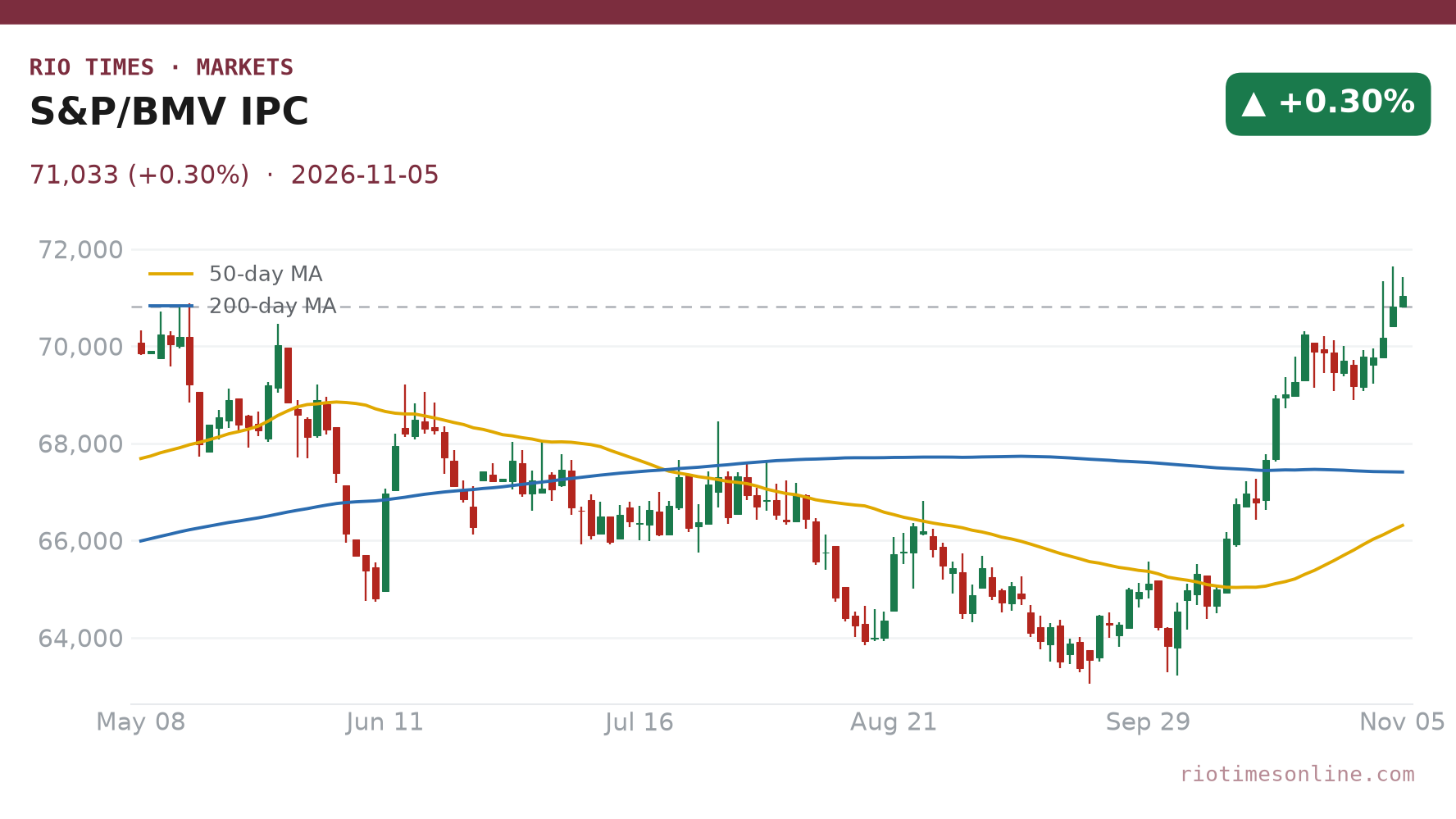
- Mexico’s S&P/BMV IPC closed at 71,033, up 0.30%, its highest close in at least six months and its third straight gain
- The peso weakened as the dollar rose 0.73% to 18.76 pesos, after Banxico, Mexico’s central bank, surprised markets by cutting interest rates
- Wall Street sank, with the S&P 500 down 4.36% to 7,354 and the VIX fear gauge up 69.66% to 28.18, yet Mexico held its ground
- The index sits 0.8% below its 12-month high of 71,601, set on 11 February, and 15.2% above its 12-month low of 61,672
- Banorte, a bank, and Walmex, Walmart’s Mexican arm, led the heavyweights, up 2.4% and 2.2% on US$81m and US$38m of turnover, while mining and rail group Grupo México fell 2.8% on US$115m and petrochemicals maker Alpek dropped 9.0%
- Prediction markets: Polymarket, where users bet real money, puts 92.0% on no change at Banxico’s December meeting and 7.0% on another 25-basis-point cut (US$18,921 traded, 7:59 p.m. ET, 5 November).
Today’s Focus
Mexico’s main stock index, the S&P/BMV IPC, closed at 71,033 on Thursday 5 November, up 0.30%. It was the highest close in at least six months, and the third gain in a row.
The calm was striking. The S&P 500 fell 4.36% the same day and Wall Street’s fear gauge, the VIX, jumped 69.66% to 28.18.
The main local reason was a surprise from Banxico, the Bank of Mexico. It cut its benchmark interest rate when the economic calendar had pointed to no change, and cheaper money tends to lift shares of banks, retailers and consumer brands.
The price was a softer peso: the dollar rose 0.73% to 18.76 pesos. Every other major Latin American index we track fell.
What matters today. Mexico’s stock market rose on its own local story — a rate cut — while Wall Street and the rest of Latin America fell, but a weaker peso is the bill for that cut.

01 The session in one read
Think of Thursday as a house with one lit window on a dark street. Mexico’s S&P/BMV IPC, the benchmark of the country’s largest listed companies, rose 0.30% to 71,033 while almost everything around it fell.
That close is the highest in at least six months, and it extends a run of three gains in a row. Over the last 5 sessions the index has risen 2.68%, and over 20 sessions it is up 9.87%.
The peso did not share the party. The dollar rose 0.73% to 18.76 pesos, which means each peso buys slightly less than the day before.
The best-supported reading is that cheaper borrowing and a weaker peso did more for Mexican shares than a US selloff did against them. Evidence: the winners were domestic names such as Chedraui, Bimbo and Banorte, while the loser Grupo México, a miner, is more tied to global trade and sentiment.
We are less sure how much of this is lasting. A rise of one-third of one per cent on a day when US stocks fell 4.36% can also reflect investors who bought Mexico after Wednesday’s rally and simply did not sell. The variable to watch is whether the dollar keeps climbing towards its 12-month peak of 18.87 pesos.
02 The day’s numbers
| Measure | Level | Change | Read |
|---|---|---|---|
| S&P/BMV IPC | 71,033 | +0.30% | Highest close in at least six months; third straight gain |
| Session range | — | — | Not available in our scan |
| USD/MXN (pesos per dollar) | 18.76 | +0.73% | Peso weaker after the surprise rate cut |
| IPC vs 12-month range | 61,672 to 71,601 | — | 0.8% below the high, 15.2% above the low |
| Peso vs 12-month range | 16.89 to 18.87 | — | 0.6% below the weakest point, 11.1% above the strongest |
| Key technical level | 71,601 | — | The 12-month high from 11 February |
The table tells a simple story: the index is pressing against the ceiling of its year, and the peso is leaning towards the floor of its year. Both are close to their extremes at once, which is unusual.
The 71,601 mark is the one to remember. A close above it would give the IPC a new 12-month high, and only 0.8% separates today’s close from it. Mexico’s gross fixed investment (company spending on machinery and buildings) for August was also due on the day; the result was not yet in the RT economic calendar when we wrote this. Rio Times · Live Market Intelligence
Live Market IntelligenceMexico — Live Market Board
Mexico — Live Market Board
Instrument Last Change YoY Prev. High Low Volume
IPC MEX
71,033.20
+0.30%
+12.16%
70,819.80
71,422
70,331
182,333,478
USD/MXN
18.73
+0.57%
+0.77%
18.62
18.79
18.71
—
WALMEX
53.68
+2.40%
-13.79%
52.42
53.70
52.25
10,650,036
GMEXICO
219.00
-2.76%
+38.57%
225.21
228.63
218.00
6,807,399
FEMSA
241.46
+0.14%
+38.22%
241.12
244.71
240.00
2,393,928
CEMEX
20.20
-1.17%
+5.71%
20.44
20.65
19.78
31,958,139
GFNORTE
211.28
+2.50%
+19.25%
206.13
212.44
206.14
5,588,759
BIMBO
69.60
+3.46%
+5.97%
67.27
69.95
67.00
2,528,860
TELEVISA
8.80
+2.68%
-15.23%
8.57
8.99
8.36
9,306,930
AMX
23.59
+1.42%
+10.68%
23.26
23.83
23.35
25,525,498
GAP
440.78
+1.91%
+9.19%
432.50
444.99
430.80
809,855
ASUR
264.42
-0.44%
-14.17%
265.59
267.53
259.80
27,324
OMA
256.01
+1.73%
+3.02%
251.66
256.41
249.41
974,665
KOF
215.58
-0.63%
+30.64%
216.95
221.04
213.51
1,204,412
GRUMA
256.38
+0.87%
-20.67%
254.18
260.96
253.51
554,416
KIMBER
39.49
+2.97%
+12.67%
38.35
39.62
38.40
5,091,956
AMX ADR
25.11
+0.32%
+10.57%
25.03
25.39
24.90
3,327,508
03 Why it moved — a surprise Banxico rate cut
First cause, and the heaviest: Banxico, the Bank of Mexico, cut its benchmark interest rate when the economic calendar had pointed to no change. The move narrowed the gap between Mexican and US interest rates to 224 basis points, a basis point being one-hundredth of a percentage point; the full decision is published at https://www.banxico.org.mx. Confidence: high that it mattered, medium on how much.
Why would a cut lift shares? Lower rates make loans cheaper for shoppers and companies and make bank deposits less attractive, so money drifts towards stocks. It also explains why the dollar rose: a smaller rate gap makes holding pesos less rewarding for global investors.
Second cause: carry-over relief from the US midterm elections. The IPC rallied strongly on Wednesday after Democrats won both chambers of Congress, and Thursday’s calm suggests few investors wanted to sell those gains. Confidence: medium.
Third, and least certain: the usual drivers disagreed with the move. The S&P 500 fell 4.36% and the VIX rose 69.66%, which normally drags Mexico down; the US dollar index was flat at 101.565, and the US 10-year Treasury yield, the benchmark for borrowing costs, eased 4 basis points to 4.85%. Our best explanation is that Mexico was treated as a domestic-rate story that day. Confidence: medium.
Oil was a minor player: a US oil fund rose 1.93%, but it is down 11.88% over five sessions. For a voice from the market, a Citi survey of Mexican analysts taken on 20 October expected growth to improve into year-end but also a weaker peso, inflation of 3.90% and caution from Banxico — a mix that fits Thursday’s pattern.
04 The day’s movers
| Driver | Level / Move | Change | Note |
|---|---|---|---|
| Grupo México | US$115m turnover | −2.8% | Busiest stock of the day; mining and rail group |
| Banorte (GFNORTEO) | US$81m turnover | +2.4% | Bank that benefits when lending demand improves |
| América Móvil (AMXB) | US$50m turnover | +1.6% | Telecoms giant |
| Arca Continental (AC) | US$44m turnover | +1.9% | Coca-Cola bottler |
| Cemex | US$44m turnover | −1.2% | Cement maker |
| Femsa | US$40m turnover | +0.2% | Owner of Oxxo stores; flat |
| Walmex | US$38m turnover | +2.2% | Walmart’s Mexican arm |
| Chedraui | Top gainer | +7.4% | Supermarket chain |
| Alpek | Top loser | −9.0% | Petrochemicals producer |
Turnover is the amount of money that changed hands, and it shows where conviction sat. Banorte drew US$81m and rose 2.4%, a clean vote that cheaper money helps banks and borrowers.
The shoppers’ names did well: Chedraui rose 7.4%, Bimbo (bread and snacks) 3.4%, Televisa 3.3%, Kimberly-Clark de México 2.9% and the Mexican exchange operator Bolsa 2.7%. Alpek fell 9.0%, the sharpest drop on the board, and Cemex slipped 1.2%; the airport operators were not among the scan’s standout movers.
05 The regional scoreboard
| Index | Country | Change |
|---|---|---|
| Ibovespa | Brazil | −0.82% |
| IPSA | Chile | −1.52% |
| COLCAP | Colombia | −0.88% |
| Merval | Argentina | −4.1% |
Mexico was the only one of the major Latin American markets to rise; all five regional indices above fell. The live market board above this article carries the closes for every market.
The pattern reaches into currencies. The Brazilian real weakened, with the dollar up 0.81% to 5.5032 reais, and the Chilean peso weakened with the dollar up 1.23% to 978.36. The Colombian peso strengthened, with the dollar down 0.71% to 3,227, and the Argentine peso barely moved, with the dollar down 0.16% to 1,545.
For a Mexican saver or a traveller buying dollars, the lesson is blunt: a 0.73% move looks small, but the dollar is up 10.1% against the peso over 60 sessions. A foreign investor holding Mexican shares gains from the stock rise but loses some of it to the weaker peso.
06 The technical picture
Resistance, the ceiling, is 71,601, the 12-month high set on 11 February. Support, the floor, starts at the round number of 70,000, with the 12-month low of 61,672 from 20 November 2025 far below.
History offers a calm word. Over 20 sessions the IPC has risen 9.9%, and in the 18 earlier cases in our own records since 2007 with a move at least that large, it was higher 20 sessions later in 12 of 18 cases, or 67%. The median was +0.5%, the worst −12.9% and the best +13.5% — history is not a forecast.
For the peso, the line to watch is 18.87 per dollar, the weakest level in 12 months, hit on 29 October and now only 0.6% away. The 12-month strong point of 16.89 was reached on 4 September.
07 What to watch
- IPC ceiling: A close above 71,601 would mark a new 12-month high; a slide below 70,000 would break the nearest support.
- Peso weak point: The dollar at 18.87 pesos is the 12-month peak, 0.6% above Thursday’s level; a break would show the rate cut is costing the currency.
- US jobs report: US non-farm payrolls are due Friday 6 November (consensus 65, previous 29) and could restart Wall Street’s swings.
- Currency positioning: Friday 6 November brings the weekly report on speculators’ bets on the peso, which shows whether traders are leaning against it.
Background: Mexico Stocks Rise 1.71% to Six-Month High.
Background: Mexico Stocks Rise 0.52% as Peso Weakens.
What Prediction Markets Say
Polymarket, a prediction market where users bet real money, shows a 92.0% chance that Banxico, Mexico’s central bank, leaves its interest rate unchanged in December and a 7.0% chance of another 25-basis-point cut, with US$18,921 traded. Prices were read at 7:59 p.m. ET on 5 November 2026.
These are bets, not forecasts.
Why we show this: prediction markets turn real-money bets into a live probability that moves within minutes of the news, which is why investors, campaigns and newsrooms in the United States now follow them closely. We show them next to polls and official results, never instead of them.
Frequently Asked Questions
How did the Mexico stock market close?
The S&P/BMV IPC closed at 71,033, up 0.30%, the highest close in at least six months. It sits 0.8% below its 12-month high of 71,601.
Why did the peso weaken?
The dollar rose 0.73% to 18.76 pesos after Banxico, the central bank, surprised by cutting its benchmark rate. A lower rate makes holding pesos less rewarding for foreign investors.
Why did Mexican shares rise when Wall Street fell?
Cheaper money helps banks and consumer companies, and Mexican shares had rallied on US election relief the day before. The S&P 500 fell 4.36%, so Mexico’s rise was a local story.
Which Mexican stocks moved most?
Chedraui led the gainers with +7.4% and Alpek led the losers with −9.0%. Grupo México was the busiest stock, falling 2.8% on US$115m of turnover.
Market data: The Rio Times; exchange figures from BMV
This article was produced by The Rio Times’ automated newsroom system. How we use AI · Report an error · Editorial responsibility: Matthias Camenzind, Editor-in-Chief
In depth
LatAm Markets: Live Signals → — real-time movers, turnover leaders and FX across Latin America.
Get The Rio Times delivered to your inbox — market intelligence, daily briefs, and breaking analysis across Latin America.
Start for US$1