Maduro’s Self-Proclamation as President and Its Initial Repercussions
In latest developments, María Corina Machado, leading the Venezuelan opposition, has also proclaimed their victory, attributing their claims to alleged fraud in Maduro’s re-election.
Machado asserts that opposition candidate Edmundo González won over Maduro, backed by voting records.
Specifically, she stated, “We have 73.20% of the voting records, indicating Edmundo González as our elected president.”
According to her, the counts were González at 6,275,180 votes and Maduro at 2,759,256.
Moreover, González reiterated these assertions, highlighting the incontrovertible nature of their victory and its historic significance.
He advocated for a nonviolent reaction to the alleged fraud, emphasizing, “The premature announcement of unaudited results breaches the electoral process.”
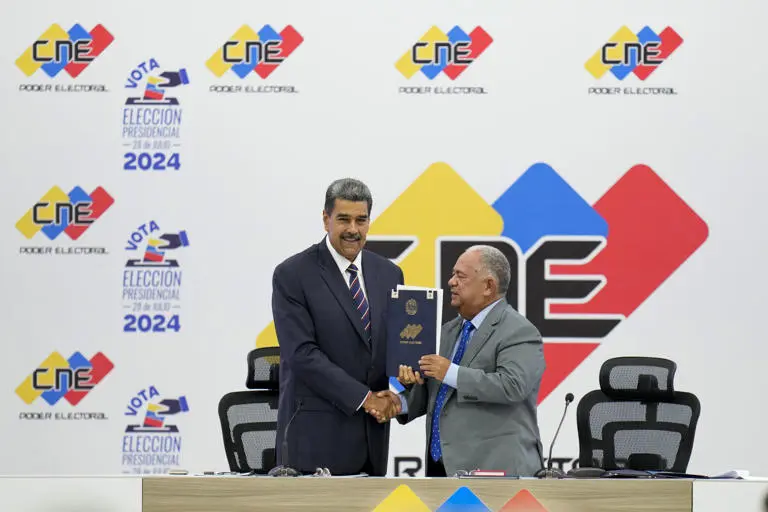
Despite this, the National Electoral Council (CNE), under government control, certified Maduro as the winner, attributing to him 51.2% of the vote against 44% for González.
The remaining candidates garnered 4.6%, with a voter turnout of 59%. Maduro declared his presidency less than 24 hours post-polls, contravening a prior pledge to release the voting records.
Significantly, the Carter Center, acting as an international observer, stressed the necessity of disclosing the voting records to validate election transparency.
Although they urged this transparency, Maduro, along with CNE President Elvis Amoroso, assumed the presidency.
Internationally, Brazil, led by special foreign policy advisor Celso Amorim, is withholding judgment pending official results from the CNE.
Brazil stresses the importance of transparency but remains neutral regarding any fraud narrative.
Amorim pointed out the situation’s complexity and Brazil’s commitment to aiding Venezuela’s political normalization.
Meanwhile, Peru responded to the controversial election by expelling Venezuelan diplomats, citing the regime’s arbitrary actions.
Hosting numerous Venezuelan migrants, Peru recalled its ambassador and is liaising with other Latin American nations concerning the election’s legitimacy.
Maduro’s Self-Proclamation as President and Its Initial Repercussions
Foreign Minister Javier Gonzalez-Olaoechea indicated that Peru might cut diplomatic ties with Venezuela.
Additionally, Panama recalled its diplomatic staff from Venezuela, demanding a thorough audit of the voting records and the electoral system.
The Dominican Republic also expressed their doubts clearly, voicing concerns over the election’s legitimacy.
In retaliation, Venezuela suspended this morning air connections with Panama and the Dominican Republic.
Additionially, the Venezuelan government demanded Argentina, Chile, Costa Rica, Peru, Panama, the Dominican Republic, and Uruguay withdraw their diplomats.
Protests
Expectedly, both opposition and ruling party supporters are poised to protest the results.
María Corina Machado has urged peaceful demonstrations, while ruling party lawmaker Jorge Rodriguez called for government supporters to march to the presidential palace.
Already, the country is witnessing clashes, with reports of violence and repression by security forces and paramilitary groups.
This contested election underscores Venezuela’s profound political rifts and the ongoing battle for democratic governance.
More: Venezuela news in English, every day from The Rio Times.
This article was produced by The Rio Times’ automated newsroom system. How we use AI · Report an error
In depth
Read More from The Rio Times