Ecuador El Niño Floods: Seven Rivers Burst Their Banks in Esmeraldas Province
ENVIRONMENT · ECUADOR
Key Facts
- —The country Ecuador, which uses the US dollar. Esmeraldas is its northernmost Pacific coast province, on the border with Colombia.
- —What happened At 07:00 on 30 September, the national risk agency listed eight rivers over their banks, seven of them in Esmeraldas province (El Comercio, Primicias).
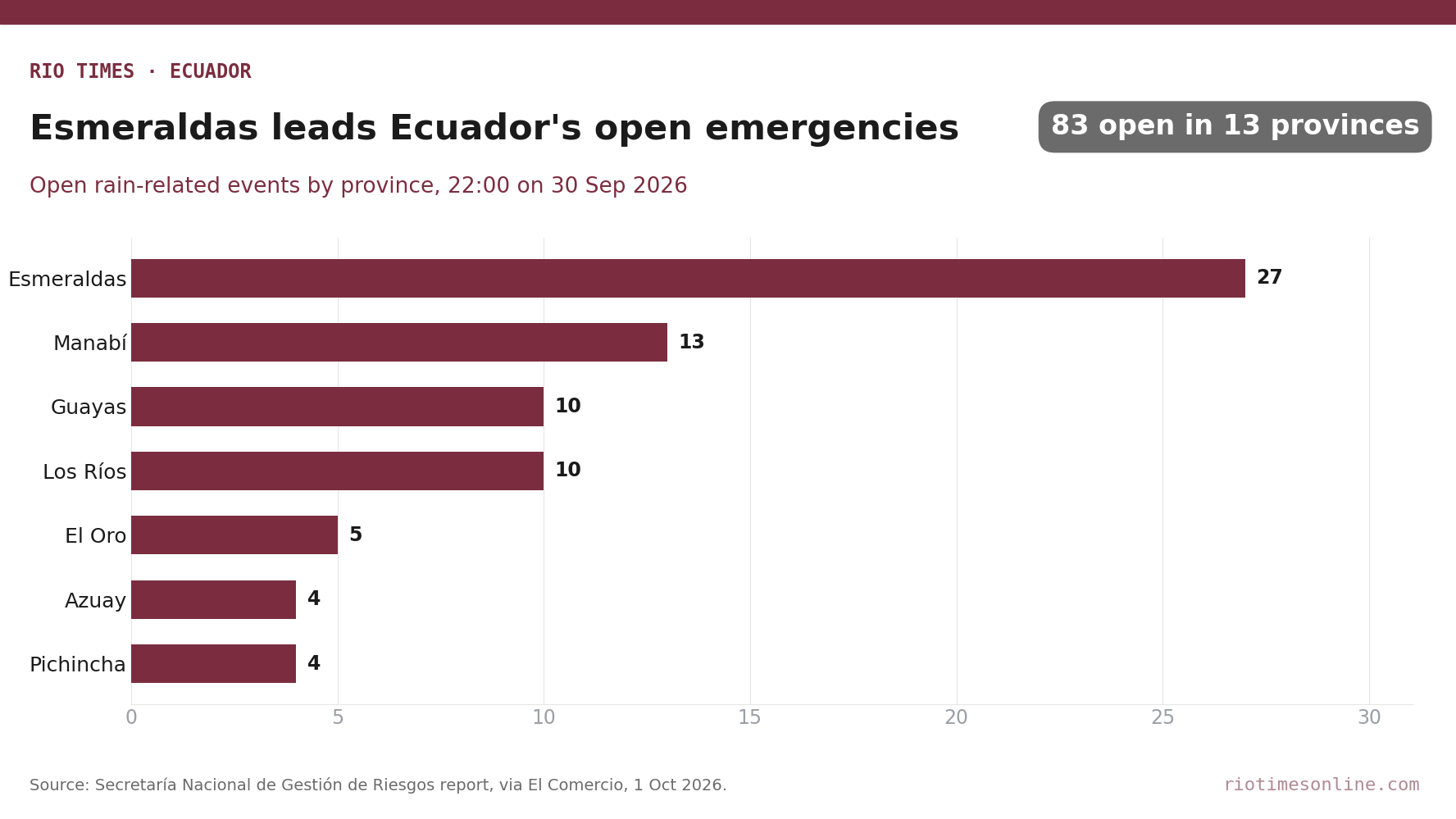
- —The numbers By 22:00 on 30 September, Esmeraldas held 27 of Ecuador’s 83 open rain-related emergencies, the agency reported, according to El Comercio.
- —What it means for you Expect flooded roads and access limits around Quinindé and Eloy Alfaro. Check risk agency and Inamhi (weather service) bulletins before travelling on the coast.
- —Still open Whether these rains are El Niño itself is debated: Peru’s El Niño panel says yes, a Guayaquil scientist says not fully (29 Sep–1 Oct).
The Ecuador El Niño floods hit Esmeraldas hardest this week. By 07:00 on Wednesday 30 September, seven rivers in the northern coastal province had burst their banks.
That was seven of eight overflowing rivers nationwide, per the National Risk Management Secretariat (SNGR), El Comercio and Primicias reported. By Thursday morning the agency listed no river still over its banks.

Where the rivers overflowed
Four of the seven Esmeraldas rivers were in Quinindé canton: the El Calvario, Viche, Cube and Herrera. The Canuto and Sucio rose in Muisne, and the Esmeraldas River flooded Isla Luis Vargas Torres.
The eighth river was the El Chorrón in Naranjito, Guayas province. Both outlets cite the same SNGR monitoring report, timed at 07:00 on 30 September.
Families in Quinindé and on the island
The SNGR estimated that about 358 families in Quinindé were exposed to the flooding, El Comercio and Primicias reported. Access to Cube was restricted by standing water.
On Isla Luis Vargas Torres, Primicias found water receding by mid-morning on Wednesday. About 600 families live there without sewers, relying on septic pits that spill when the river rises.
Residents told Primicias they want landfill and dredging rather than emergency kits. Their complaint is that the same flooding returns every rainy season.
How the state is responding
SNGR head Carolina Lozano said her agency is delivering humanitarian aid to affected families, El Comercio reported. The Esmeraldas municipality sent teams to register households on the island.
The government declared a national red alert for El Niño on 29 August. By 23:00 on 30 September, the SNGR had logged 176 rain-related events since then, 83 open and 93 closed.
Esmeraldas led the open cases with 27, ahead of Manabí with 13. The report also listed flooding in five Eloy Alfaro communities, including Telembí and San José de Cayapas.
About 1,500 people are affected in Eloy Alfaro canton, Primicias reported. Its emergency operations committee (COE) has declared a local state of emergency.
Is it El Niño?
Primicias describes the heavy rains as linked to El Niño. In El Comercio, a spokesperson for Peru’s official El Niño study commission, Enfen, linked them to rapid sea warming.
Rina Gabriel Valverde said surface water off Ecuador reached 26 to 28°C, against a usual 21 to 24°C. Enfen rates that warming as “extraordinary”, its highest category.
Franklin Ormaza, a researcher at Espol, a polytechnic university in Guayaquil, is more cautious. He told El Universo the September rains do not yet fully correspond to El Niño.
He pointed instead to the equinox season change and a warm Pacific, and said four conditions are still not fully in place. Our earlier report covered El Niño Brings Record Heat to Peru, Rain Warnings to Ecuador.
What Is Not Yet Known
No official count of displaced people or damaged homes in Esmeraldas has been published. It is also unclear how long the red alert will stay in force.
Forecasters disagree on when a full El Niño will form and how strong it will be. For background on the country, see Ecuador Explained: The Country, the Security Crisis, the Economy and What to Watch.
Sources: El Comercio (30 Sep 2026); El Comercio, citing Secretaría Nacional de Gestión de Riesgos (1 Oct 2026); El Comercio, Enfen interview (29 Sep 2026); Primicias (30 Sep 2026); El Universo (1 Oct 2026).
Read More from The Rio Times