Dominican Republic begins construction of fence to limit immigration from Haiti
RIO DE JANEIRO, BRAZIL – The Dominican Republic on Sunday began constructing a border fence that will span about half of its border with Haiti. The project is primarily aimed at limiting immigration from the neighboring country.
The work was inaugurated by President Luis Abinader on the banks of the Masacre River in the town of Dajabón (northwest), the island’s main border crossing, in a ceremony full of patriotic symbolism that was also attended by the military leadership and representatives of political parties of all stripes.
In a speech, Abinader stressed that the fence would allow for a “drastic reduction in irregular migration” and control bilateral trade, combat drug trafficking, illegal arms trafficking, and vehicle theft.

Since Abinader announced the construction of the fence a year ago, Haitian authorities have said they are not opposed to the project because it is a sovereign Dominican decision.
A “SMART” FENCE
The 160-kilometer fence will cover about half of the 391-kilometer north-south border and will be built mainly in populated areas.
Authorities had already assumed that it would not be necessary to erect the fence in the most mountainous areas, where the terrain presents an insurmountable obstacle to migrants and smugglers.
The fence will be equipped with high-resolution cameras, infrared, and other advanced surveillance technologies, which has led authorities to describe it as “smart.”
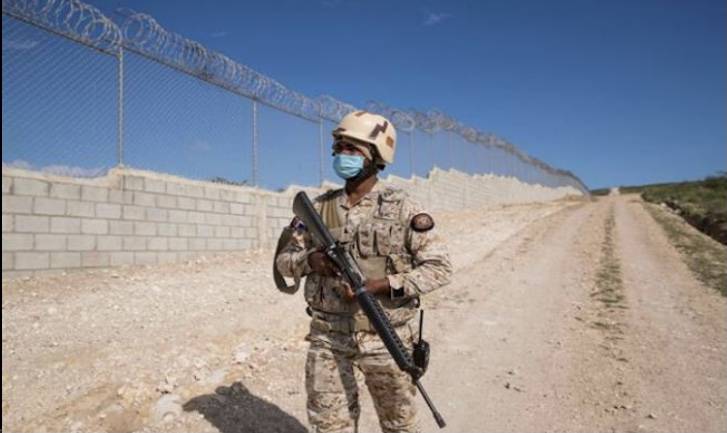
In the first phase, to be carried out over the next seven to nine months, 54 kilometers of fence will be built, consisting of a concrete wall at the base and a four-meter-high metal fence topped by an accordion, a metal barbed wire.
The cost of the construction work in this section is 1.75 billion pesos (about US$30 million), excluding the technical installations, which will be awarded through a tender process in the first half of this year.
The second phase of the works is being prepared for the second half of the year, according to Abinader.
The project will include the 23 kilometers of the existing simple fence built between 2019 and 2021 without much notice from the authorities near the borders of Elías Piña and Jimaní, the other two main official crossings with Haiti.
TIGHTENING IMMIGRATION MEASURES.
The new fence is another step in the policy of tightening migration measures taken by the Dominican Republic in recent months against Haiti, justified by authorities due to the worsening crisis in the neighboring country.
In his speech, Abinader stressed that Haiti is experiencing severe political instability and a “galloping economic and food crisis” but reiterated that the Dominican Republic “cannot be the solution” to these problems.
Among other measures, the Dominican Republic has stepped up deportations of Haitians in recent months, including hundreds of pregnant women who have been arrested while visiting doctors. The UN has criticized this practice.
Last September, the Dominican government set a three-month deadline for companies employing undocumented Haitians to regularize their situation, but no punitive measures against employers have been announced.
The sectors most affected are agriculture and construction, where business associations estimate that 90% of workers are Haitian.
In addition, Abinader announced today that starting this Monday; biometric data will be collected from border crossers to facilitate the identification of foreigners.
During the event, only the Bishop of Mao-Montecristi, Diómedes Espinal, expressed sympathy for the situation of Haitian immigrants but supported the construction of the fence.
“Let’s not build walls that hinder solidarity, trade relations, fraternity, and the good we can do for other poorer and needier brothers and sisters,” warned the religious.
More: Latin America news in English, every day from The Rio Times.
Editorial responsibility: Matthias Camenzind, Editor-in-Chief · Editorial standards · Report an error
Haiti
- What Is Happening in Haiti?
- What Is Happening in Haiti?
- Haiti Gang Crisis Explained 2026 Gangs and the UN Force
- Haiti’s 13 December Vote, What US Travellers Need to Know