Brazil’s Government Seeks Clarification from 11 Countries on Oil Spill Source
RIO DE JANEIRO, BRAZIL – A briefing on progress was provided by the Navy’s naval operations coordinator, Squadron Admiral Leonardo Puntel, in an interview with journalists on Saturday, October 26th.

The investigation conducted by the Navy works on the theory that the culprit was probably a tanker. The initial investigation analyzed 1,500 vessels and narrowed the scope to 30 vessels from 11 countries.
The report has not detailed which nations would be included in this group, but said that the request asks for details from governments in order to determine if they are aware of any accident involving a ship flying their flag.
The 30 ships are among those that crossed the Northeast coast in the period, identified by maritime system communications. According to Puntel, the investigators estimate that the leak occurred in August, as the oil reached the beaches at the end of that month.
The admiral did not rule out the possibility that the incident was caused by unregistered vessels, called “dark ships”. In this case, however, the investigation will be more complex and will involve other sources of information, such as the examination of satellite images.
Puntel stated that it is not possible to say that the vessel was Venezuelan, although the research by Petrobras would have identified the oil as coming from that country.
“A Navy report stated that the oil was not Brazilian. The Petrobras report went further because it has oil samples from other countries. It is from Venezuelan oil fields. We don’t know about the ship”, he commented.
Slicks
Fernanda Pirilo, general coordinator of environmental emergencies at the Brazilian Institute for the Environment and Renewable Natural Resources (IBAMA), said at the press conference that there is no new oil on the beaches.
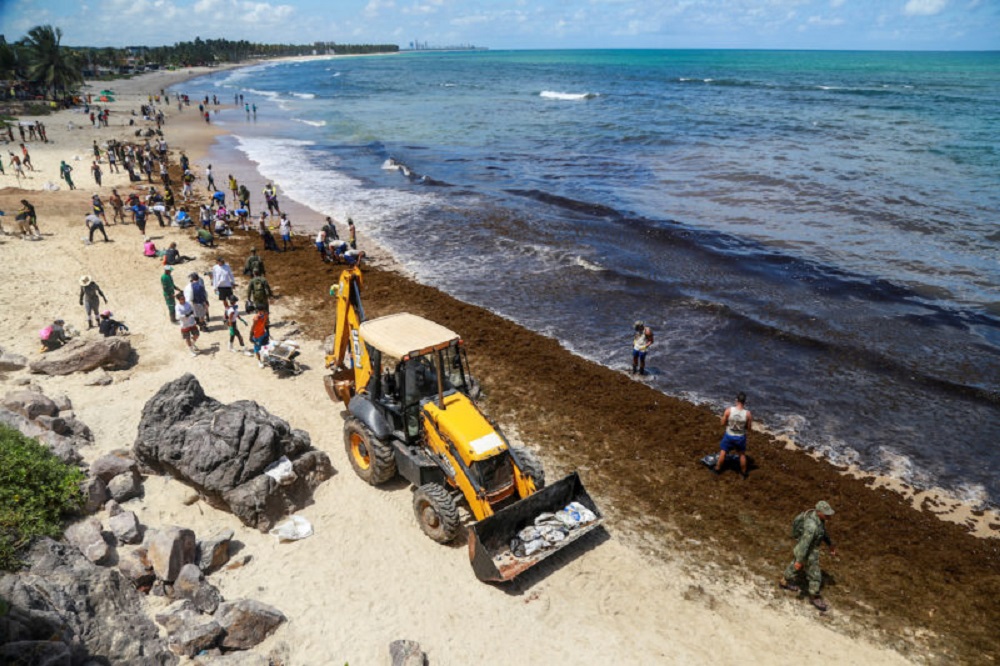
“There is no more new oil coming in, but some beaches still have traces of oil, we have the points identified in which there is still residual oil, most in the states of Pernambuco and Bahia,” she said.
Commander Leonardo Puntel added that despite the difficulty in monitoring the evolution of slicks, given that they travel underwater with ocean currents, the study conducted by the bodies involved in the monitoring group found that there was a decrease in quantity.
“The oil slicks had different patterns. In early September and October, it was quiet, there were no large amounts. There was a period last week in which there was an increase in the amount of oil in Bahia, Sergipe, Alagoas, and southern Pernambuco. And this amount has now begun to decrease,” he observed.
IBAMA’s coordinator advised the locals not to come into contact with the substance. The bathing conditions at each beach are assessed by the health bodies in the states and municipalities and should be checked together with these bodies.
Brasília
The group of federal bodies in charge of coordinating the activities moved its base to Brasília. During this week, several federal government authorities were in Pernambuco. The Navy commander reported that local coordination still remains in place in Recife and Salvador.
IBAMA’s environmental emergency coordinator added that the change facilitates the group’s actions since it brings its members closer to the country’s political decision-making center. Questioned by journalists, she denied any difficulties in the dialogue between organizations and the executive branch or the state administrations.
Source: Agência Brasil
More: Brazil news in English, every day from The Rio Times.
This article was drafted with automated assistance and reviewed before publication. How we use AI · Report an error
Read More from The Rio Times