The decade of emerging markets has begun: Morgan Stanley IM
By Selkuc Gokoluk
Emerging-market stocks will be among this decade’s winners, according to Morgan Stanley Investment Management.
Like other investor groups, the manager is pulling money out of US stocks and increasing its exposure to developing markets, said Jitania Kandhari, deputy chief investment officer and director of macroeconomic research for emerging markets at Morgan Stanley IM.
Kandhari, in turn, said that stocks in developing countries have attractive valuations and that there are economies poised for higher growth than the US, including India.

“Every decade there is a new market leader. In the 2010s, it was US stocks and mega-cap tech,” Kandhari said in a phone interview. “The leaders of this decade can clearly be international and emerging market stocks.”
Morgan Stanley IM has US$1.3 trillion in assets under management.
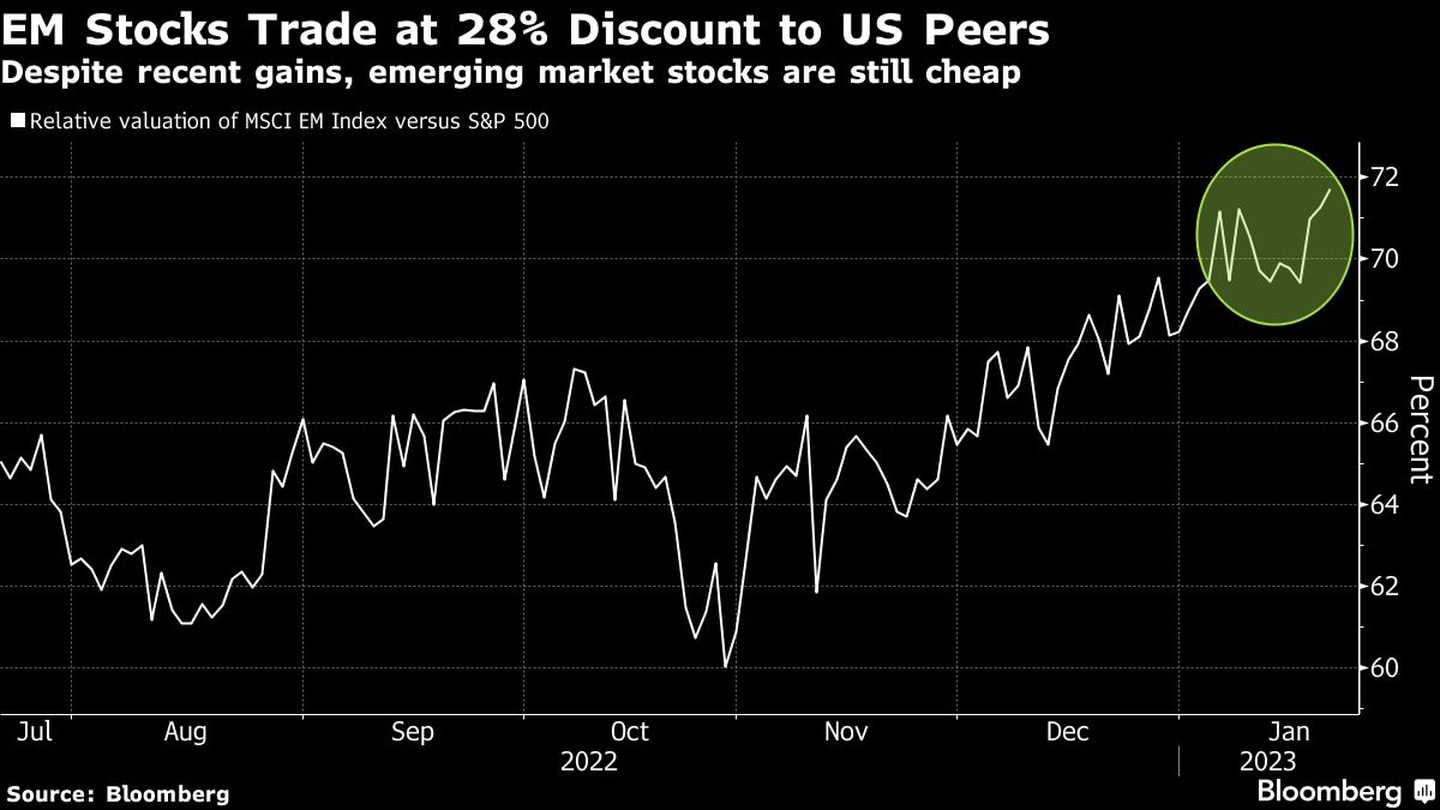
The asset class has had a strong start to the year. The MSCI Emerging Markets Index is up 8.6% compared with a 4.7% rise for US stocks.
The gains come as China’s withdrawal from its strict Zero Covid policy brightens the economic outlook, while investors position for an end to sharp interest rate hikes by central banks.
Many also continue to view US stocks as expensive, and those in emerging markets are trading at a discount of nearly 30%.
There is a growing disconnect between the shrinking US share of the global economy and the size of its market capitalization, Kandhari said.
Coupled with funding allocations to emerging markets that are well below historical averages and cheap currencies, that gives them plenty of room to outperform, she said.
“What really drives this asset class is the growth differential, and that emerging markets growth differential is improving relative to the US,” she said.
GROWTH ESTIMATES
Emerging economies are expected to expand 4.1% in 2023 and 4.4% in 2024 on average, according to Bloomberg estimates.
Those multiples are higher than the estimates for the US, at 0.5% and 1.2%, respectively.
The comments from Morgan Stanley IM underscore a market theme that has been gaining prominence as investors and strategists steer clear of US stocks as they approach those of the rest of the world.
Developing markets bond and stock funds had inflows of US$12.7 billion in the week to Jan. 18, the biggest addition on record, while US stocks had US$5.8 billion in outflows, according to a Bank of America Corp (BAC) note, citing data from EPFR Global.
ASSET ALLOCATION
Kandhari advises against following benchmark weightings in indices, particularly when it comes to China, and being selective among emerging markets.
“China is a big part of the index, 30%, and we don’t think it’s a bigger part of the growth in the index,” she said, citing challenges for the country, including overly indebted sectors of the economy and changing world supply chains.
“You really have to actively go in to invest in other countries that look promising and stay away from the benchmark weights.”
India, on the other hand, is a favorite and one of the biggest overweights in its fund.
“Everything that doesn’t work for China works for India,” Kandhari said.
It has a growing population and lower debt than China, while China is “in the eye of a deglobalization storm” that is driving supply chain diversion and benefiting other emerging markets including Indonesia, Thailand, Vietnam and Mexico.
And while things may not be easy in all developing nations, that won’t affect the broader stock story in the same way that emerging market debt crises have in the past, she said.
With the collaboration of Srinivasan Sivabalan
With information from Bloomberg
More: Brazil news in English, every day from The Rio Times.
Editorial responsibility: Matthias Camenzind, Editor-in-Chief · Editorial standards · Report an error
Brazil runoff, Sunday, October 25: Brazil runoff date. Latest: Brazil runoff polls, Flávio 51%, Lula 49%.