Brazil Markets: Ibovespa and the Real, September 18, 2026
Key Facts
- The Ibovespa closed at 185,992 points, up 0.24%, on turnover of R$18.6 billion, about US$3.6 billion, after falling as much as 1.24% during the session.
- The selling began with a welfare announcement, a 15% rise in the Bolsa Família floor published in an extra edition of the official gazette.
- Traders reversed course by the close, reading the measure as election positioning rather than a durable change in the fiscal path.
- Yduqs led the index with a 3.07% gain, ahead of Santander Brasil at 2.52% and Vale at 2.07% on a firm day for mining shares.
- CSN Mineração was the worst performer, down 5.59%, followed by Cury at 5.15% and Marcopolo at 5.08% after a broker downgrade.
- The dollar ended at R$5.1289, down 0.48%, leaving the real firmer in a week when Brazil cut rates and the United States raised them.
Today’s Focus
Thursday was a session in two halves and the second half won. The Ibovespa fell more than one percent in the morning and closed up 0.24% at 185,992 points.
What moved it down was a welfare decision. The government published a 15% rise in the Bolsa Família minimum payment in an extra edition of the official gazette.
The floor goes from R$600 to R$691, roughly US$117 to US$134, from 1 October. That is seventeen days before the first round of the presidential election on 4 October.
The programme reaches 19.3 million families. It costs R$5.8 billion, about US$1.13 billion, this year, and R$22.7 billion or some US$4.42 billion a year from 2027.
Investors initially read that as fiscal loosening and sold. By the close they had decided it was election arithmetic, and local outlets summed the day up as the election trade beating fiscal fear.
What matters today. Whether the market keeps separating pre-election spending from the structural fiscal path. That distinction is what turned Thursday’s loss into a gain.

| Instrument | Level | Session |
|---|---|---|
| Ibovespa (Brazil) | 185,992.03 | +0.24% |
| S&P 500 (US) | 7,637.76 | +1.14% |
| Nasdaq Composite (US) | 26,418 | +1.69% |
| VIX (US volatility) | 15.44 | -12.82% |
| USD/BRL | 5.1289 | -0.48% |
| Gold (per ounce) | US$4,346.42 | +1.74% |
| Silver (per ounce) | US$65.43 | +3.44% |
| Oil fund (USO) | US$155.31 | -0.55% |
Thursday, 17 September 2026 close. Brent and gold in US dollars.
01 The session in one read
The index spent the morning pricing a welfare rise as a fiscal risk and the afternoon pricing it as a campaign move. Nothing in the underlying arithmetic changed between the two.
Turnover reached R$18.6 billion, about US$3.6 billion, which is a normal rather than a heavy day. The recovery was broad rather than driven by a single heavyweight.
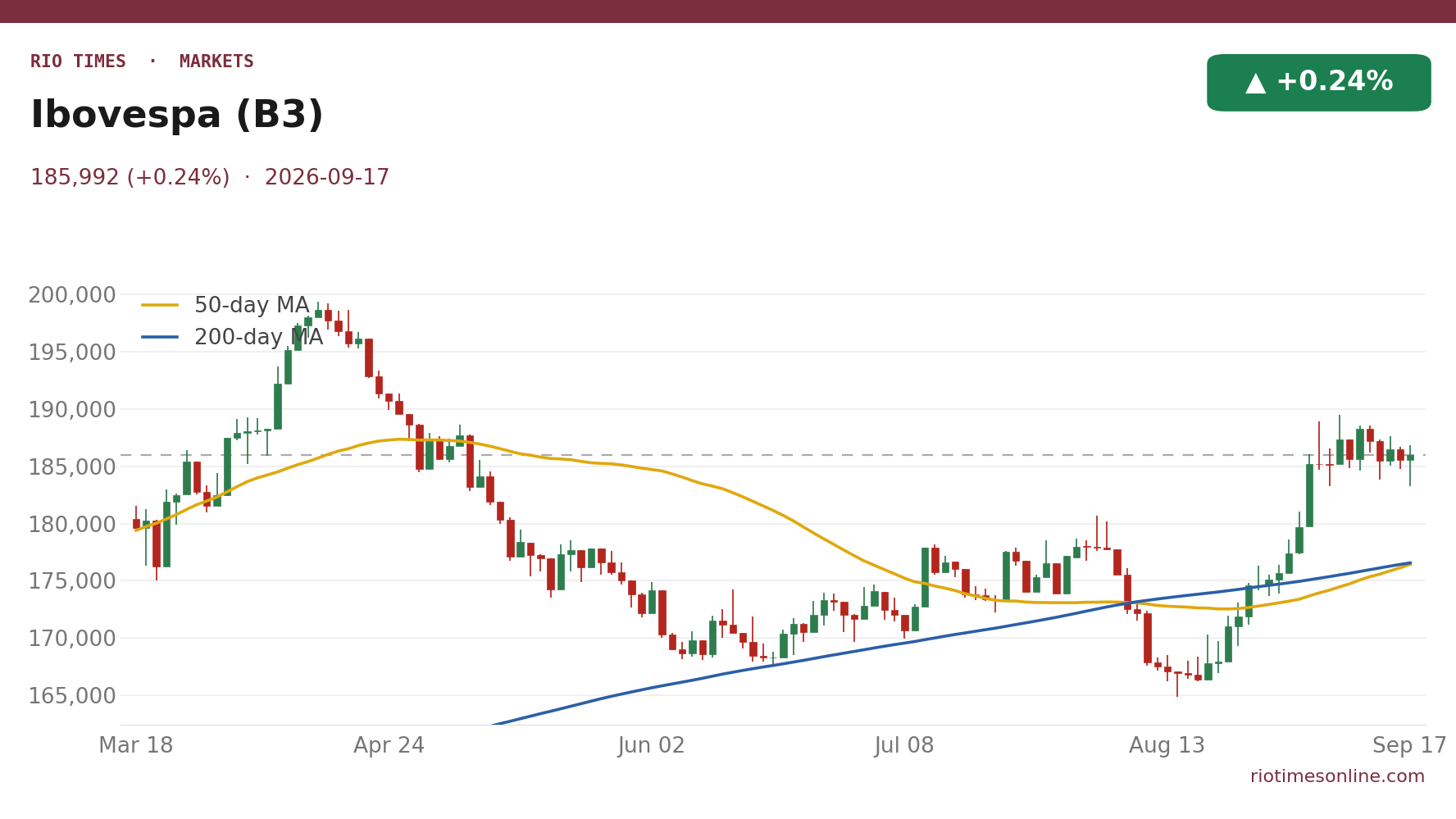
In local points the Ibovespa has traded sideways since the start of September. In dollar terms the picture is steadier still, because the real has held its ground through the same stretch.
That gap matters for foreign investors. A flat index and a firm currency has been a better combination this month than the headline points suggest.
02 The day’s numbers
| Measure | Level | Change | Read |
|---|---|---|---|
| Ibovespa | 185,992 | +0.24% | Gains despite an intraday fall of 1.24% |
| USD/BRL (real per dollar) | 5.1289 | -0.48% | The real strengthens against the dollar |
| Turnover | R$18.6bn (US$3.6bn) | — | A normal rather than a heavy session |
| S&P 500 | 7,637.76 | +1.14% | A supportive global backdrop |
| VIX | 15.44 | -12.82% | Volatility unwinds after the Fed decision |
| Gold (per ounce) | US$4,346 | +1.74% | Safe-haven demand stays firm |
The table describes a market that absorbed a fiscal headline and still rose. A gain of 0.24% is small, but the starting point was a drop of more than one percent.
The currency line is the more interesting one. The real strengthened in a week when the rate gap between Brazil and the United States narrowed, which is not the textbook response.
Live Market IntelligenceBrazil — Live Market Board
Rio Times · Live Market Intelligence
Brazil — Live Market Board
+0.24%
185,992.03
+0.24%
63,873.32
+0.58%
11,381.18
+1.30%
3,061,512
+1.08%
2,521.85
+0.40%
58,965.05
+1.80%
| Instrument | Last | Change | YoY | Prev. | High | Low | Volume |
|---|---|---|---|---|---|---|---|
| IBOV | 185,992.03 | +0.24% | +21.85% | 185,547.66 | 168,310 | 167,142 | — |
| USD/BRL | 5.16 | +0.01% | -5.13% | 5.16 | 5.18 | 5.14 | — |
| SELIC | 14.00% | — | — | — | — | — | |
| PETR4 | 41.64 | -0.05% | +35.19% | 41.66 | 41.97 | 41.15 | 41,499,400 |
| VALE3 | 72.97 | +0.83% | +30.75% | 72.37 | 73.54 | 72.66 | 17,658,000 |
| ITUB4 | 38.60 | -1.03% | +4.57% | 39.00 | 39.34 | 38.39 | 29,487,800 |
| BBDC4 | 16.85 | +0.36% | +3.50% | 16.79 | 16.90 | 16.67 | 19,416,900 |
| BBAS3 | 19.37 | +0.47% | +0.73% | 19.28 | 19.44 | 19.16 | 11,069,200 |
| B3SA3 | 14.26 | -0.21% | +12.73% | 14.29 | 14.47 | 14.11 | 33,037,800 |
| ABEV3 | 14.89 | -0.80% | +21.91% | 15.01 | 15.07 | 14.81 | 16,453,100 |
| WEGE3 | 47.59 | +0.49% | +29.99% | 47.36 | 48.08 | 47.36 | 3,364,600 |
| PRIO3 | 59.14 | -0.19% | +50.67% | 59.25 | 59.81 | 58.74 | 3,325,600 |
| SUZB3 | 41.33 | +2.35% | -23.55% | 40.38 | 41.48 | 40.35 | 3,914,900 |
| RENT3 | 34.68 | -0.09% | +0.84% | 34.71 | 34.96 | 34.35 | 7,979,100 |
| AZZA3 | 15.89 | -2.63% | -53.76% | 16.32 | 16.42 | 15.82 | 1,330,300 |
| CSNA3 | 4.30 | +0.47% | -42.65% | 4.28 | 4.41 | 4.26 | 10,076,100 |
| GGBR4 | 24.69 | +2.19% | +51.38% | 24.16 | 24.85 | 24.18 | 7,047,600 |
| ENEV3 | 24.21 | -1.38% | +70.49% | 24.55 | 24.64 | 23.99 | 9,297,000 |
03 Why it moved — a welfare rise read as politics, not policy
The Bolsa Família increase is real money. Nineteen point three million families receive it, and the annual cost from 2027 is R$22.7 billion or about US$4.42 billion.
Two weeks earlier the planning ministry had said no rise was planned. The 2027 budget carried no funds for it, which is why the announcement landed as a surprise.
Markets still chose to treat it as a campaign measure. The reasoning is that spending announced seventeen days before a vote tells you about the campaign rather than the next four years.
That reading is a bet, not a fact. It holds only while investors believe the fiscal framework survives whoever wins on 4 October.
04 The day’s movers
| Stock | Move | Why |
|---|---|---|
| Yduqs (YDUQ3) | +3.07% | Best performer in the index |
| Santander Brasil (SANB11) | +2.52% | Banks recovered with the broader afternoon turn |
| Vale (VALE3) | +2.07% | Tracked a firm session for miners in New York |
| CSN Mineração (CMIN3) | -5.59% | Worst performer in the index |
| Cury (CURY3) | -5.15% | Homebuilders sold on the fiscal headline |
| Marcopolo (POMO4) | -5.08% | Fell after a broker cut its rating |
Petrobras, Itaú and Banco do Brasil each moved less than a third of a percentage point. The session was decided at the edges of the index rather than in its heaviest names.
Bradesco’s preferred shares were the busiest stock on the exchange. That was a function of its capital raise rather than its price, which barely moved.
05 The regional scoreboard
| Market | Close | Session | Note |
|---|---|---|---|
| Ibovespa (Brazil) | 185,992.03 | +0.24% | Recovered from an intraday fall of 1.24% |
| S&P/BMV IPC (Mexico) | 63,873 | +0.58% | First session after Independence Day |
| S&P Merval (Argentina) | 3,061,512 | +1.08% | Rose while country risk climbed to 515 points |
| S&P IPSA (Chile) | 11,381 | +1.30% | Shortened session, closing at one in the afternoon |
| MSCI COLCAP (Colombia) | 2,521.85 | +0.40% | Index up while the peso fell 1.09% |
Every major regional index rose on Thursday, so Brazil was not an outlier. The divergence across Latin America was in the currencies rather than the equities.
The Colombian peso fell 1.09% to about 3,154 per dollar, the sharpest move in the region. The Chilean peso strengthened, closing at 959.25 to the dollar in a session cut short for Fiestas Patrias.
Mexico reopened after Independence Day with breadth firmly positive. Four hundred and seventy shares advanced against 268 that fell, on turnover of 18,038 million pesos or about US$1.05 billion.
Argentina’s index rose even as country risk climbed to 515 points, its highest since 26 August. Satellogic led the Buenos Aires gainers with 11.3%, ahead of Cresud at 6.3% and IRSA at 5.6%.
06 The corporate story of the day
Bradesco raised R$6.541 billion, roughly US$1.27 billion, in the first phase of a capital increase of up to R$10 billion or about US$1.95 billion. It had set a floor of R$8 billion, near US$1.56 billion, for that stage.
The shortfall sends the remaining shares to a further distribution. For a bank that size, the gap is a readable signal about appetite for Brazilian financial equity.
A second bank story sat alongside it. The Supreme Federal Court’s investigation into Banco Master remained a weight on sentiment across the sector.
07 What to watch
- IGP-M second preview: The Getúlio Vargas Foundation publishes it at eight in the morning, the only significant Brazilian release today.
- The 5.15 line on USD/BRL: A move above it would show the narrower rate gap finally reaching the currency.
- Bank shares: Bradesco’s shortfall and the Banco Master investigation give the sector two live questions at once.
- Election spending: Every announcement between now and 4 October will be tested against Thursday’s reading.
- Regional liquidity: Chile is closed today and Saturday for Fiestas Patrias, thinning cross-border flows.
Frequently Asked Questions
Where did the Ibovespa close on 17 September 2026?
The index ended at 185,992 points, up 0.24%, on turnover of R$18.6 billion or about US$3.6 billion. It had fallen as much as 1.24% during the session.
Why did the Ibovespa drop during the morning?
The government published a 15% rise in the Bolsa Família minimum payment in an extra edition of the official gazette. Traders first read it as fiscal loosening ahead of October’s election.
What is the dollar worth in Brazil?
The dollar closed at R$5.1289 on Thursday, down 0.48% on the day. That left the real marginally stronger against the American currency.
Which shares led and lagged the index?
Yduqs rose 3.07%, Santander Brasil 2.52% and Vale 2.07%. CSN Mineração fell 5.59%, Cury 5.15% and Marcopolo 5.08%.
How much did Bradesco raise?
Bradesco took R$6.541 billion, about US$1.27 billion, in the first phase of a capital increase of up to R$10 billion or roughly US$1.95 billion. That was below the R$8 billion floor, near US$1.56 billion, it had set for the stage.
What changed in the Bolsa Família programme?
The minimum payment rises 15% from R$600 to R$691, roughly US$117 to US$134, from 1 October 2026. It reaches 19.3 million families and costs R$5.8 billion, about US$1.13 billion, this year.
Sources: B3 session data; Exame and InfoMoney closing reports for 17 September 2026; Diário Oficial da União, extra edition of 17 September 2026; Bradesco material fact; exchange data from BMV, BYMA, the Bolsa de Santiago and the Bolsa de Valores de Colombia; La Tercera and Diario Estrategia for the Chilean close.
This article was produced by The Rio Times’ automated newsroom system. How we use AI · Report an error
LatAm Markets: Live Signals → — real-time movers, turnover leaders and FX across Latin America.
Read More from The Rio Times