Flávio Takes Japan, Lula Berlin in Brazil Vote Abroad
Brazil overseas vote: Flávio Bolsonaro won Japan and Lula led Berlin and Porto, while Revista Fórum’s 2022 comparisons show Lula gaining ground abroad.
Key Facts
—Who. Flávio Bolsonaro (PL) won Japan; Lula (PT) led in Berlin and Porto in the first round of Brazil’s presidential election.
—What. Polling-station tally sheets (boletins de urna) from abroad were posted and summed by Brazilian media hours before any official count.
—Where. Japan, Asia and Oceania first, then Europe, Portugal and the Middle East; as of 6 p.m. Brasília, US results were not reported in the sources we checked.
—Electorate abroad. 918,876 registered voters in 134 countries, including 265,437 in the United States, according to TSE figures reported by Brazilian media.
—Official numbers. The Superior Electoral Court (TSE) began publishing results at 5 p.m. Brasília time (4 p.m. ET, 9 p.m. Lisbon). Figures here are press tallies, not official totals.
—Update, 4 October. Comparing finished locations with 2022, Revista Fórum found Lula up 2.76 points across 23 locations (4.59 points in an earlier nine-location Asia-Pacific count); Flávio roughly held his father’s share.
—Meaning. Overseas voters are about 0.6% of the electorate and lean in different directions by country, so these tallies are not a forecast.
Brazilians living abroad voted first on Sunday, and their polling-station tallies point two ways: Flávio Bolsonaro won Japan with 71.7% of valid votes, while Lula led Berlin and Porto and, in one Revista Fórum count by mid-afternoon, the overseas sum. Where counting had finished, Revista Fórum’s own comparisons with 2022 showed Lula gaining ground while Flávio roughly held his father’s share. For US readers, the Brazil overseas vote is a small, self-selected slice of the electorate, and the official count began at 4 p.m. ET.
Where Brazilians Voted First
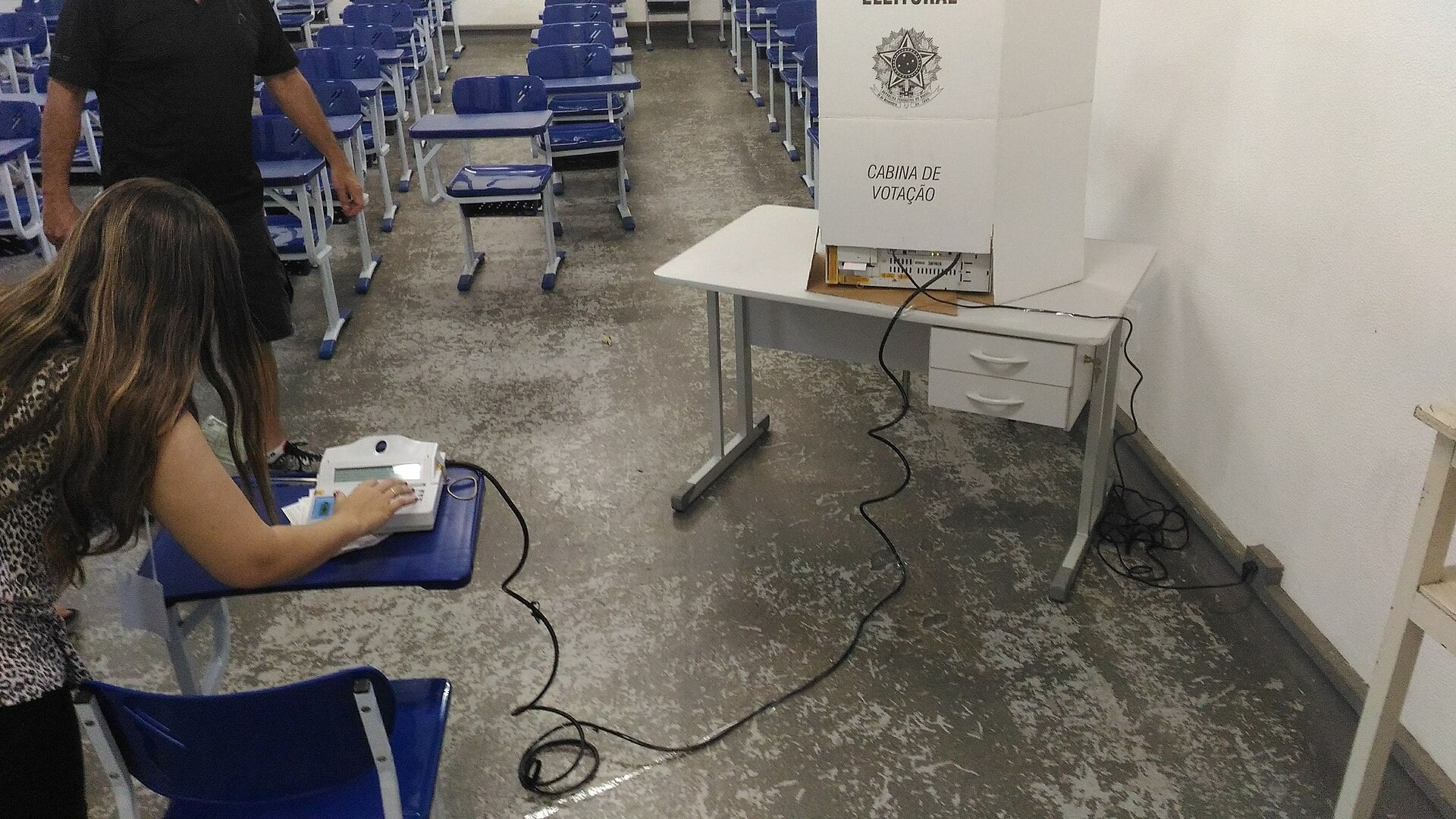
Brazil lets citizens abroad vote for president only. The TSE counts 918,876 of them in 134 countries, with polling stations in 186 cities, mostly at embassies and consulates. That is 31.82% more than the roughly 697,000 registered in 2022 and about 0.6% of the national electorate of about 158.7 million.
The biggest overseas electorates are the United States (265,437), Portugal (134,797), Japan (88,366), Canada (46,488) and Germany (about 41,500). By city, Lisbon leads with 78,833, followed by Boston (53,406), Porto (47,676), Nagoya (44,570), Miami (40,104) and New York (39,026). The TSE deployed 1,282 electronic voting machines plus 123 contingency urns abroad, according to Metrópoles.
Because of the time difference, Asia and Oceania closed first. Brazilian outlets began summing the printed tally sheets from those stations in the morning, Brasília time, and kept adding Europe through the afternoon. Their sums come from the press, not from the TSE.
What the Early Polling-Station Tallies Show
Everything below is partial and comes from tally sheets summed by Brazilian media. Figures can change until the TSE publishes its own count.
Japan. Flávio Bolsonaro took 24,601 votes (71.7% of valid votes) against 5,234 (15.3%) for Lula, from 119 ballot boxes, according to O Tempo. Centrist Augusto Cury had 1,501 and Renan Santos 1,197. In 2022, Jair Bolsonaro won Japan with 72.2%, so the pattern is unchanged.
Rest of Asia and Oceania. Metrópoles reported Lula ahead in South Korea (123 votes to 72), Singapore (190 to 92), Malaysia (44 to 27), Australia (4,562 to 2,579) and New Zealand (234 to 64). Flávio led in Taiwan (107 to 77). In the Middle East he led in Israel (523 to 92) and the United Arab Emirates (659 votes), while Lula led in Palestine (1,078 to 46).
Europe. Lula won Berlin with 83.02% of valid votes to 9.86% for Flávio, CartaCapital reported. In Portugal, Lula won Porto with 52.49% of valid votes (10,356) to 38.32% (7,559) for Flávio, according to DN Brasil and Euronews Portugal. As of the sources we found, Lisbon, the largest overseas city, had not been reported.
The running totals swung. Early in the afternoon, with Japan weighing heavily, a sum of tally sheets put Flávio ahead overseas with 49.42% to 39.30% at 1:16 p.m. Brasília. By 2:55 p.m., Metrópoles counted 32,319 votes for Flávio and 21,999 for Lula, with Lula ahead in 22 countries and Flávio in 9. By about 3:50 p.m., with 661 of 1,282 ballot boxes from 54 countries counted and all ballot boxes counted in Germany, Spain, Italy, the United Kingdom, Ireland, the Netherlands and Austria, Revista Fórum had Lula at 53.1% and Flávio at 37.2%.
Live Company IntelligencePorto Seguro S.A — the full investor dossier
Brazil Overseas Vote Compared With 2022
Revista Fórum compared 23 finished locations with 2022 first-round results from TSE open data, publishing at 2 p.m. Brasília. Lula rose from 23.96% to 26.72% of valid votes, while Flávio’s 60.56% was just below Jair Bolsonaro’s 61.22%.
Japan, the largest of those locations, barely moved: Flávio’s 71.70% compares with his father’s 72.21%, and Lula rose from 13.49% to 15.30%. Lula improved in 15 of the 23 locations, Fórum said, with his sharpest fall in Israel (39.37% to 13.07%).
An earlier Fórum count, published by Opera Mundi at 12:46 p.m. Brasília, used a simple average of nine finished Asia-Pacific locations, each weighted equally. Lula’s average rose 4.59 points to 48.84%, while Flávio’s 39.50% was 0.48 points below his father’s 2022 level.
The two figures use different methods and are Fórum’s own calculations, not TSE data. Neither has been independently confirmed.
Why Overseas Votes Are Not a Forecast
First, size. Brazilians abroad are about 0.6% of voters, so even a lopsided overseas result moves the national count very little.
Second, turnout and selection. In Portugal, abstention was around 70%, higher than in 2022, the consul-general in Portugal said, according to Renascença. Those who show up are the ones near a consulate, and communities differ sharply by country.
Third, history. In the 2022 first round, with 99.15% of overseas ballot boxes counted, Lula had 47.13% abroad and Jair Bolsonaro 41.63%. Yet Bolsonaro won Japan (72.2%) and the United States, where he took 57.9% (37,848 votes) to Lula’s 31.4%, while Lula took 60.4% in Portugal and about 77% in France. Overseas results are a patchwork, and one country can dominate the early sums, as Japan did on Sunday.
Who Is Who
Luiz Inácio Lula da Silva (Workers’ Party, PT, left) has been president since 2023 and is seeking another term, with Geraldo Alckmin as running mate. Flávio Bolsonaro (Liberal Party, PL, right) is a senator and the son of former president Jair Bolsonaro.
Four other candidates drew overseas votes. Ronaldo Caiado runs for the PSD, Romeu Zema for the Novo party, Augusto Cury for Avante and Renan Santos for Missão, a party he helped found.
For the full background, see our explainer on the election and the final polls before the vote.
What It Means for US Readers
The United States has the largest Brazilian electorate abroad, 265,437 registered voters, with Boston (53,406), Miami (40,104) and New York (39,026) among the biggest voting cities. In 2022 these communities leaned toward Jair Bolsonaro, and Miami gave him 74.3%. As of 6 p.m. Brasília, US tallies for 2026 had not been reported in the sources we checked.
Investors should not read these tallies as a signal. Brazilian markets are closed on Sunday and reopen on Monday, and the first reliable guide is the TSE count that began at 4 p.m. ET. Our guide to when results arrive explains the sequence.
What Is Not Known
As of 6 p.m. Brasília, we had not seen an official TSE overseas total, and press sums vary by source and time. Fórum’s comparisons with 2022 also differ by method: 2.76 points weighted by votes, 4.59 points with equal weights. In the sources we checked, there were no reported results for Lisbon, the United States or Canada. Tallies from the Brazil overseas vote say little about the national result, and nothing here projects a winner or a runoff. Follow the official count on our live results page.
Frequently Asked Questions
When do Brazil’s official election results start?
The Superior Electoral Court (TSE) began publishing results at 5 p.m. Brasília time on Sunday 4 October 2026, which is 4 p.m. ET and 9 p.m. Lisbon. The overseas figures in this article come from media sums of polling-station tallies, not from the TSE.
How many Brazilians can vote abroad?
The TSE counts 918,876 registered voters abroad in 134 countries, about 0.6% of the national electorate. The United States has the most, with 265,437, followed by Portugal with 134,797 and Japan with 88,366.
Who is leading among Brazilians abroad?
It depends on the country and the time of the sum. Flávio Bolsonaro won Japan with 71.7% of valid votes, while Lula led Berlin and Porto. A tally of 661 ballot boxes at about 3:50 p.m. Brasília had Lula at 53.1% and Flávio at 37.2%.
Do overseas votes predict the national result?
No. Overseas voters are about 0.6% of the electorate, turnout is low and results vary sharply by country. In 2022 Lula led the overseas count, but Jair Bolsonaro won Japan and the United States.
Sources
InfoMoney · Metrópoles · O Tempo · Revista Fórum · Poder360 · CartaCapital · Renascença · PT (2022 results) · Revista Fórum (2022 comparison) · Opera Mundi
Connected Coverage
Brazil election results: live count
Correction — 5 October 2026: Lula’s Porto share is 52.49%, not 52.50%, and the earlier claim that he won every Porto ballot box could not be confirmed and was removed. The overseas sums changed through the day and differ by outlet; the mid-afternoon lead for Lula is Revista Fórum’s own count.
In depth
This article was produced by The Rio Times’ automated AI newsroom. Editorial responsibility: Matthias Camenzind, Publisher and Editor-in-Chief. The Rio Times also runs Ask Rio Times, which answers from 100,000+ of our own articles, the daily Latin America Power Map, and prediction-market odds on elections and markets.. How we use AI · Report an error
Brazil runoff, Sunday, October 25: Brazil runoff: date, poll closing times and when results start. Latest: Brazil runoff polls, Flávio 51%, Lula 49%.