Banking stocks lift Nigerian market by N288 billion despite broad selloff
Nigeria · MARKETS
Key Facts
Single-session gain: Investors earned N288.44 billion (~US$211 million) in paper wealth on a recent Monday, driven by heavyweight stocks including MTN Nigeria, First HoldCo and United Bank for Africa.
June crash: Nigerian equities suffered their worst month on record in June 2026, erasing N13.29 trillion (~US$9.7 billion) in market value as the All-Share Index fell 8.28%.
Banking concentration: The combined market capitalisation of 12 listed deposit-money banks reached N22.51 trillion (~US$16.5 billion) in the first half of 2026, up from N16.12 trillion (~US$11.8 billion) at end-2025.
Recapitalisation drive: The Central Bank of Nigeria’s programme brought about N4.7 trillion (~US$3.4 billion) of new capital into the market through public offerings and rights issues.
Year-to-date performance: Despite the June correction, Nigerian stocks remained up over 50% year-to-date, keeping the country among the world’s top frontier markets.
Global context: Nigeria’s stock market was described as one of the world’s best-performing exchanges in 2026, with stocks up 62.1% year-to-date by late May.
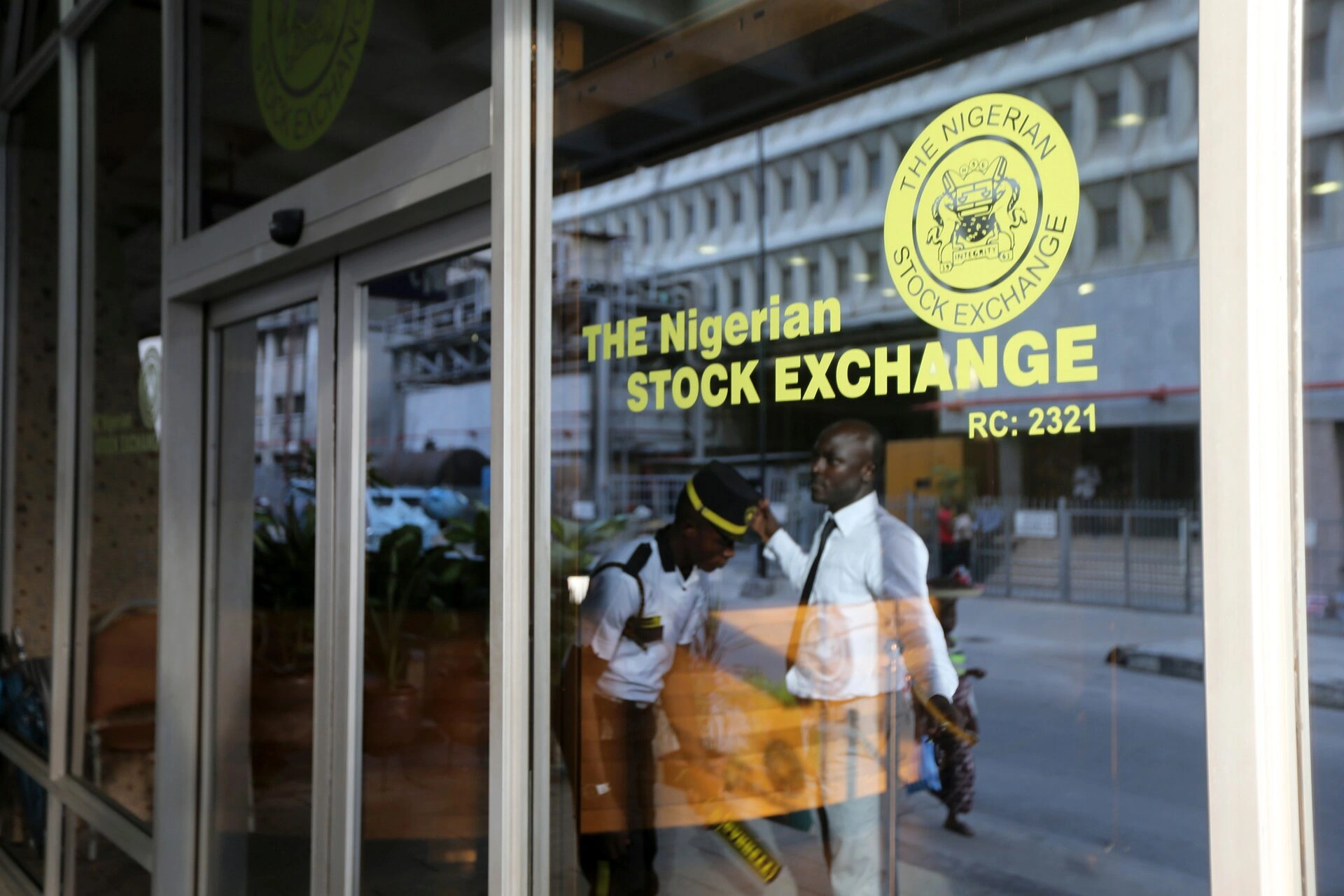
Nigerian banking stocks added N288.44 billion (~US$211 million) in market value in a single session, reversing the prior week’s losses even as most equities on the Nigerian Exchange continued to decline, underscoring the sector’s outsized influence on Africa’s second-largest stock market.
A concentrated rebound amid broad weakness
On a recent Monday session, the Nigerian Exchange (NGX) posted a headline gain of N288.44 billion (~US$211 million) in market capitalisation, snapping a string of weekly losses. The bounce was driven almost entirely by heavyweight stocks including MTN Nigeria, First HoldCo, Honeywell Flour Mills and United Bank for Africa (UBA).
Market breadth remained negative, with more stocks declining than advancing across consumer goods, insurance and oil and gas counters. This pattern signals rotation into large financials and select blue chips rather than a broad-based return of risk appetite.
The session illustrated how deeply Nigerian banking stocks now dominate the exchange. Modest percentage gains in a handful of lenders and telecoms were enough to swing total capitalisation upward, even with dozens of smaller names in decline.
The June rout that set the stage
The N288 billion rebound must be read against the scale of the preceding selloff. In June 2026, Nigerian equities suffered their worst month on record, erasing N13.29 trillion (~US$9.7 billion) in market value as the NGX All-Share Index (ASI) fell 8.28%.
Market capitalisation collapsed from about N160.5 trillion at the end of May to N147.2 trillion at the end of June, wiping out much of a five-month rally that had added roughly N60 trillion to listed value. By the week ending around 20 June, the ASI stood at 235,941.27 points and investors had lost N5.69 trillion in a single week.
Single-session shocks punctuated the decline. On 3 June, the ASI dropped 1.44% to 243,132.61 points, wiping N2.28 trillion off market cap, with insurance stocks falling 2.76% and banking stocks down 1.53%.
Why Nigerian banking stocks dominate the market
The outsize role of Nigerian banking stocks is rooted in a multi-year recapitalisation programme led by the Central Bank of Nigeria (CBN). Analysts estimate the drive has brought about N4.7 trillion (~US$3.4 billion) of new capital into the market via public offerings and rights issues.
By mid-2026, the combined market capitalisation of 12 listed deposit-money banks reached N22.51 trillion (~US$16.5 billion), up from N16.12 trillion (~US$11.8 billion) at end-2025, a gain of N6.4 trillion in six months. The NGX Banking Index surged over 12% by mid-February after several major lenders raised over N1 trillion from the stock market in early 2026.
This concentration creates both upside use and downside amplification. When investors are bullish on reform and earnings, banks pull the entire market higher. When banking stocks correct, the rest of the market struggles to offset their drag, creating the kind of multi-trillion-naira daily losses recorded in June.
Regulatory shock and forced repositioning
The same regulatory push that powered a rally in bank valuations also created conditions for a violent correction. An NGX market commentary noted that the immediate imperative to recapitalise and break existing conglomerates triggered panic selloffs and rebalancing away from banking giants such as Access Holdings and First HoldCo (formerly FBN Holdings).
A CBN exposure draft on financial holding companies was widely cited as a catalyst for profit-taking and short-term volatility in banking stocks. The regulatory overhang forced institutional investors to reassess sector risk and lock in profits after months of extraordinary gains.
Local analysts have consistently framed the June downturn as a healthy correction rather than a collapse. A widely circulated note emphasised that the whole picture remained very bullish despite June being a correction month, pointing to over 50% year-to-date returns and describing the selloff as merely consolidating the impact of severe banking regulatory change.
Tinubu’s reform agenda and market signalling
President Bola Tinubu has pursued a high-risk, high-reward macro agenda since taking office in May 2023, including fuel subsidy removal, exchange-rate unification and aggressive interest-rate hikes. Markets initially rewarded this agenda, with ASI gains above 60% year-to-date by May 2026.
The June correction and episodes of sharp selling show investors testing how far valuations had outrun fundamentals and how stable the policy environment really is. Banking stocks’ ability to lift the market by N288 billion while breadth remains weak can be read as a vote of confidence in core reforms, even as traders dump peripheral or richly valued names.
Nigeria’s large banks double as political and economic power centres, holding significant government debt and operating as regional champions across West and Central Africa. Recapitalisation decisions, foreign-exchange allocation rules and CBN enforcement priorities directly affect which banks emerge as national champions.
Frontier-market dynamics and global money
Nigeria’s stock market was described as one of the world’s best-performing exchanges in 2026, with stocks up 62.1% year-to-date by late May and the ASI closing at 252,243.11 points. Trading volumes were huge, with 1.04 billion shares worth N41.5 billion changing hands in a single session before volumes began to fall.
For foreign investors, Nigerian banking stocks embody a classic frontier-market dilemma: strong nominal returns and high margins in a reforming system, versus substantial currency, regulatory and governance risk. The oscillation between multi-trillion-naira losses and hundreds-of-billions-naira gains within weeks shows how quickly global and local risk appetite can turn.
These dynamics mean sharp moves in Nigerian banking stocks are watched not only by local investors but by Washington, Brussels and multilateral lenders as proxies for reform momentum and systemic risk tolerance. The broader scramble for influence across African financial systems forms part of a wider pattern explored in our pillar Africa: The New Scramble.
More: Nigeria news in English, every day from The Rio Times.
Frequently Asked Questions
How much did Nigerian banking stocks add to the market in the recent rebound?
Investors earned N288.44 billion (~US$211 million) in paper wealth in a single Monday session, driven by heavyweight stocks including MTN Nigeria, First HoldCo and United Bank for Africa.
What caused the record market losses in June 2026?
Nigerian equities erased N13.29 trillion (~US$9.7 billion) in June, the worst month on record, driven by profit-taking, dividend adjustments and portfolio rebalancing triggered by the Central Bank’s recapitalisation programme and a regulatory exposure draft on financial holding companies.
Why do banking stocks have such a large influence on the Nigerian Exchange?
The combined market capitalisation of 12 listed deposit-money banks reached N22.51 trillion (~US$16.5 billion) in the first half of 2026, meaning modest moves in a handful of large lenders can swing the entire market even when most other stocks are falling.
Connected Coverage
For deeper analysis of how financial systems, critical minerals and great-power competition intersect across the continent, read our pillar Africa: The New Scramble.
Sources
This article was produced by The Rio Times’ automated newsroom system. How we use AI · Report an error · Editorial responsibility: Matthias Camenzind, Editor-in-Chief