Argentina Ships First Offshore Pipes for Vaca Muerta Oil Pipeline
Argentina · Energy
Key Facts
- —What happened Argentina’s first offshore pipes for the Vaca Muerta oil pipeline have left port.
- —How big a jump The 99-pipe sailing is part of a 437-kilometre, US$3 billion project to export crude.
- —The catch The buried line is finished, but only five kilometres of seabed pipe remain.
- —Who it touches The terminal sits near a UNESCO-protected whale calving ground in Golfo San Matias.
- —What comes next First tanker loading is expected by early 2027, pending offshore installation and a UNESCO review.
The buried 437-kilometre line is already finished. The sea leg and its two mooring buoys are now the part that decides when Argentina can load its first export tanker.
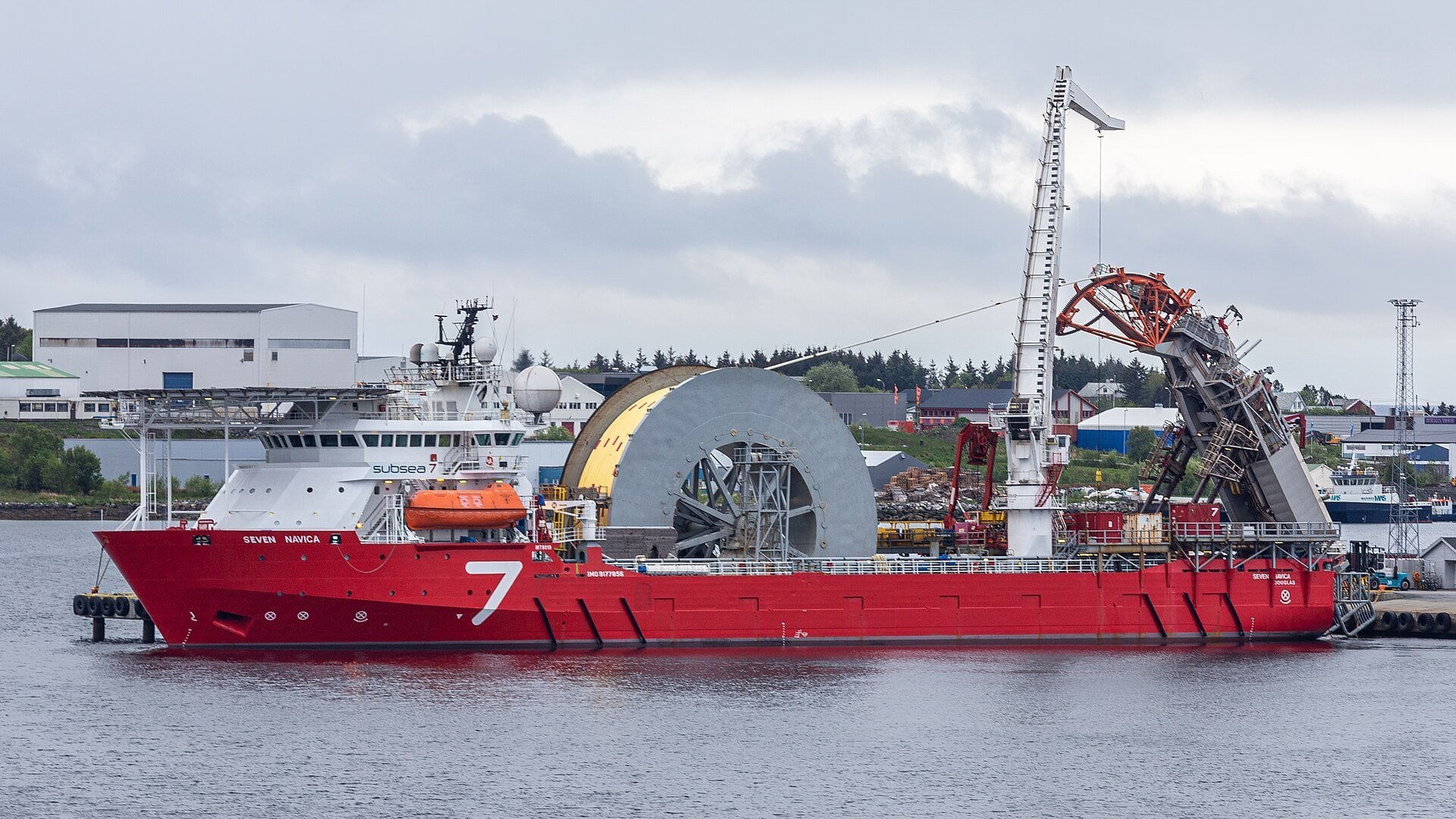
The first steel for the underwater stretch of Argentina’s Vaca Muerta oil pipeline has finally left port. A supply vessel loaded 99 pipes at San Antonio Este and set course for Punta Colorada, on the Atlantic coast.
After that short hop, the country’s biggest private energy project starts building the part that touches the sea.
What Actually Left the Dock
The vessel is called the Navvik Launcher, and it is the first of nine platform supply ships booked for this job. Loading began at one in the afternoon on Thursday, August 13, at the port of San Antonio Este.
It carried 99 pipes toward the works area off Sierra Grande, in Rio Negro province. Diario Rio Negro reported on August 19 that the load was complete and the first batch had sailed.
Those 99 are a small slice of a much bigger pile. In June, the bulk carrier MV Athanasia delivered 721 steel pipes to the same port.
They have been stacked there ever since.
Why These Pipes Are Not Ordinary Pipes
Of the 721 tubes, 658 wear a thick concrete jacket. That coating was applied at the Socotherm plant in Escobar, in Buenos Aires province, before the steel went back to the docks.
Concrete does two jobs at once here. It shields the steel from the seabed.
It also adds weight, so the line will not float or shift in the currents of the Golfo San Matias.
The Long Chain Behind One Boat Trip
The pipe itself came from SIAT, the welded-pipe business Tenaris runs in Argentina from Valentin Alsina, near Buenos Aires. More than 10,100 tonnes of it was shipped out of the public wharf at Dock Sud.
Loginter handled storage and stowage at Dock Sud, while Arendal coordinated the sea transport. So a single 99-pipe sailing sits on top of months of mill work, coating and warehousing.
That matters for a country trying to build local supply chains. Because the steel, the coating and the logistics were all Argentine, the project keeps much of its spending at home.
The Vaca Muerta Oil Pipeline in Plain Numbers
The line runs 437 kilometres from Allen, in Rio Negro, to a new terminal at Punta Colorada. YPF has put the total cost of pipeline plus terminal at about US$2.98 billion, which most reports round to US$3 billion.
The buried trunk line is 30 inches across. Near the coast and out under the water, the pipe widens to 38 inches, with 24-inch branches feeding each offshore loading point.
Techint said on August 14 that all 437 kilometres were built, after a pressure test on the Rio Negro crossing. Even so, the whole project was only about 77 to 80 percent finished in mid-August.
What Waits at Punta Colorada
The terminal will hold six tanks of 120,000 cubic metres each. Two mooring buoys, anchored offshore, will let very large tankers load without coming alongside a pier.
The subsea line between the tanks and the buoys is only about five kilometres long. Still, it is the piece that turns a Patagonian pipeline into an export business.
The buoys themselves are built in the United Arab Emirates and shipped out through the Strait of Hormuz. YPF chief executive Horacio Marin said in August that the second unit was already at sea.
The Offshore Fleet Is Assembling
A jack-up platform, a barge that lifts itself clear of the water on legs, took position off Punta Colorada in the second week of August. It is called the Combifloat C7. It will support the work of joining the pipe on the seabed.
Meanwhile the pipelay vessel Seminole is being prepared in Bahia Blanca, after arriving on a semi-submersible heavy-lift ship. Once ready, it will lay the concrete-coated line out to the buoys.
When the First Tanker Sails
YPF told a congressional committee in late July that the first cargo should leave between the end of 2026 and early 2027. Argentine reporting since then points to the early-2027 end of that window.
The system starts at about 180,000 barrels a day. It is designed to climb to 550,000 barrels a day during 2027 and, on company projections, to 700,000 by 2028.
That ramp is the whole point. Vaca Muerta output has outgrown existing export routes.
So a second Atlantic outlet decides how fast Argentina can sell its crude.
Who Owns It and Who Paid
The vehicle, VMOS S.A., groups YPF with Vista, Pan American Energy, Pampa Energia, Chevron, Pluspetrol, Shell, Tecpetrol and Neuquen’s GyP. YPF holds about 30 percent.
Financing leaned on a syndicated loan of roughly US$2 billion from international banks. Argentine reports call it the largest commercial infrastructure credit in the country’s history.
The project is also signed up to RIGI, Argentina’s tax and currency scheme for very large investments.
The Environmental Question
Not everyone welcomes the terminal. UNESCO, the United Nations culture and heritage body, has asked Argentina for more environmental information, because a protected marine area sits nearby.
The deadline is February 2027. The Golfo San Matias is a calving ground for southern right whales.
Therefore the offshore campaign is being watched closely by conservation groups as well as by traders.
YPF Also Turns to the Younger Sister
While the coast fills with ships, YPF is reviving a very different bet in the far south. Palermo Aike, in Santa Cruz province, is the shale formation Argentine officials call the younger sister of Vaca Muerta.
The province’s first shale well, MAYPA.x-1, was drilled by YPF with its partner CGC.
It went 3,500 metres down and 1,000 metres sideways, and cost around US$50 million. A production test of about 180 days is under way.
ADNSUR reported on August 15 that YPF is preparing a new exploration campaign there, with work starting in November or December. CGC owner Eduardo Eurnekian has put the play’s potential at up to 10 billion barrels of oil.
He also cites more than 130 trillion cubic feet of gas. Those are CGC’s own estimates, not certified reserves.
Santa Cruz’s energy minister, Jaime Alvarez, prefers a softer line, calling Palermo Aike possibly half a Vaca Muerta.
What to Watch Next
The next milestones are physical and easy to track. Eight more supply-ship runs will move the rest of the 721 pipes.
Then the Seminole must start laying, and the second monobuoy has to be anchored. Only after those steps does a tanker date become real.
Until then, the finished 437 kilometres of buried steel are a very expensive line waiting on five kilometres of seabed.
More: Argentina news in English, every day from The Rio Times.
What is the Vaca Muerta oil pipeline?
It is a 437-kilometre crude line, known as VMOS. It runs from Allen in Rio Negro to a new export terminal at Punta Colorada.
Who supplied the pipes for the offshore section?
SIAT, the Argentine welded-pipe business of Tenaris. More than 10,100 tonnes were shipped from Dock Sud, and 658 of the 721 pipes were concrete-coated at Socotherm in Escobar.
When will Argentina export oil through Punta Colorada?
YPF has guided to a window between late 2026 and early 2027, and recent Argentine reporting leans toward early 2027. The system starts near 180,000 barrels a day.
What is the younger sister of Vaca Muerta?
Palermo Aike, a shale formation in Santa Cruz province. YPF drilled the first unconventional well there with CGC and plans a new exploration campaign starting in November or December 2026.
Connected Coverage
Sources: Diario Rio Negro; ArgenPorts; GlobalPorts; Techint; Infobae; ADNSUR.
Frequently Asked Questions
This article was produced by The Rio Times’ automated newsroom system. How we use AI · Report an error · Editorial responsibility: Matthias Camenzind, Editor-in-Chief