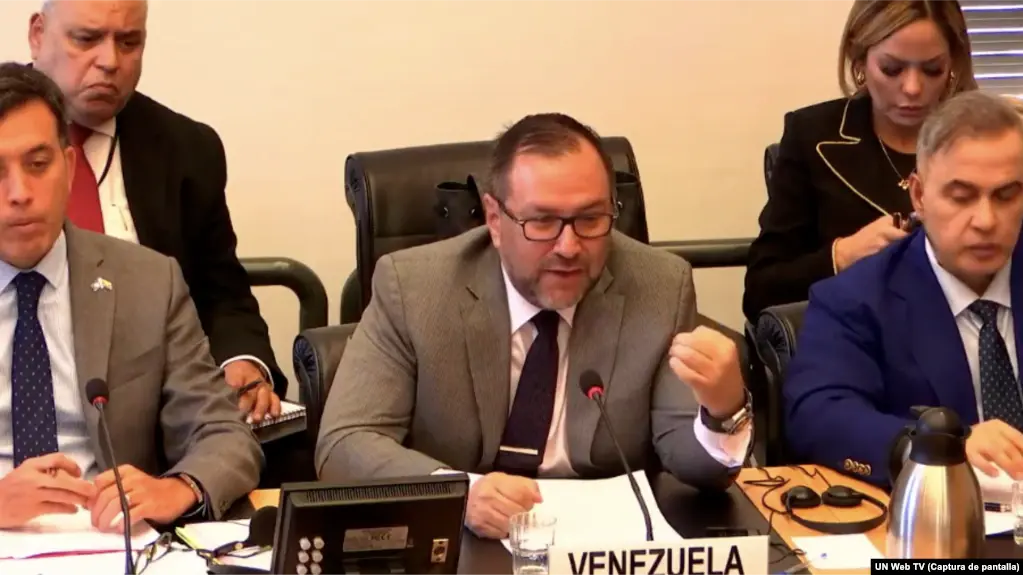
Foreign Minister Yvan Gil of Venezuela refuted allegations of political rights violations during his address to a United Nations committee.
Gil says no one in Venezuela has lost their political rights unless a court decides. He adds that only those with proven corruption face disqualifications.
However, opposition leader María Corina Machado received a 15-year public office ban. The Comptroller General’s Office, not a court, issued it.
Legal experts argue that these bans conflict with international norms, affecting the right to be elected.
Civil society groups also raise concerns. They say these bans are arbitrary and target both opposition and dissenting party members.
Consequently, questions arise about who can participate in the upcoming 2024 elections. Another opposition leader, Henrique Capriles, faces a similar 15-year ban.
Despite this, he and Machado remain active in politics. This creates debate about the outcome if a banned candidate wins.
International bodies also weigh in. The European Union’s observation mission found problems in the electoral process.
The UN Human Rights Commissioner calls for transparency and due process in Venezuela’s electoral procedures.
Background
Maria Corina Machado has been a prominent opposition figure in Venezuela for years.
Her disqualification from public office raises questions about the inclusivity of the political process.
She has consistently called for democratic reforms and is often at odds with the government’s policies. This has made her a contentious figure in Venezuelan politics.
Machado’s disqualification is seen by many as a targeted move to limit opposition influence.
Her exclusion adds to the list of politicians being sidelined in the lead-up to the 2024 elections.
She is particularly significant because she’s been a favorite in voter intention polls.
The limitations placed on her candidacy could potentially sway the election’s outcome, further polarizing the political environment.
More: Venezuela news in English, every day from The Rio Times.
This article was produced by The Rio Times’ automated newsroom system. How we use AI · Report an error
Read More from The Rio Times