Peru Tomato Prices Jump 29% in Lima as El Niño Hits

ECONOMY · PERU
Key Facts
- —The country Peru, on South America’s Pacific coast. Lima’s consumer price index, published monthly by the national statistics institute INEI, is the country’s main inflation gauge.
- —What happened Tomato prices in Lima rose 28.9% in September 2026, INEI said on 1 October. It partly blames Coastal El Niño damage to crops.
- —The numbers Lima prices rose 0.12% in September and 4.55% over twelve months (INEI, 1 October). The central bank targets 1–3%.
- —What it means for you Vegetables, potatoes and sugar cost more in Lima; fish, chicken and most fruit cost less. Food overall slipped 0.07% in September (INEI).
- —Still open How far crop losses spread as El Niño strengthens, and whether the central bank raises its 4.25% policy rate in the coming months.
Food prices in Lima moved in two directions in September, as Peru’s Coastal El Niño began to show up in market stalls. Tomatoes rose 28.9% in a single month, green peas 18.5% and sweet corn 16.8%.
Cheaper fish, chicken and fruit offset most of that rise, according to INEI, Peru’s national statistics institute. The food and non-alcoholic drinks group as a whole fell 0.07%, the only spending group to get cheaper.
Vegetables and sugar led the rise
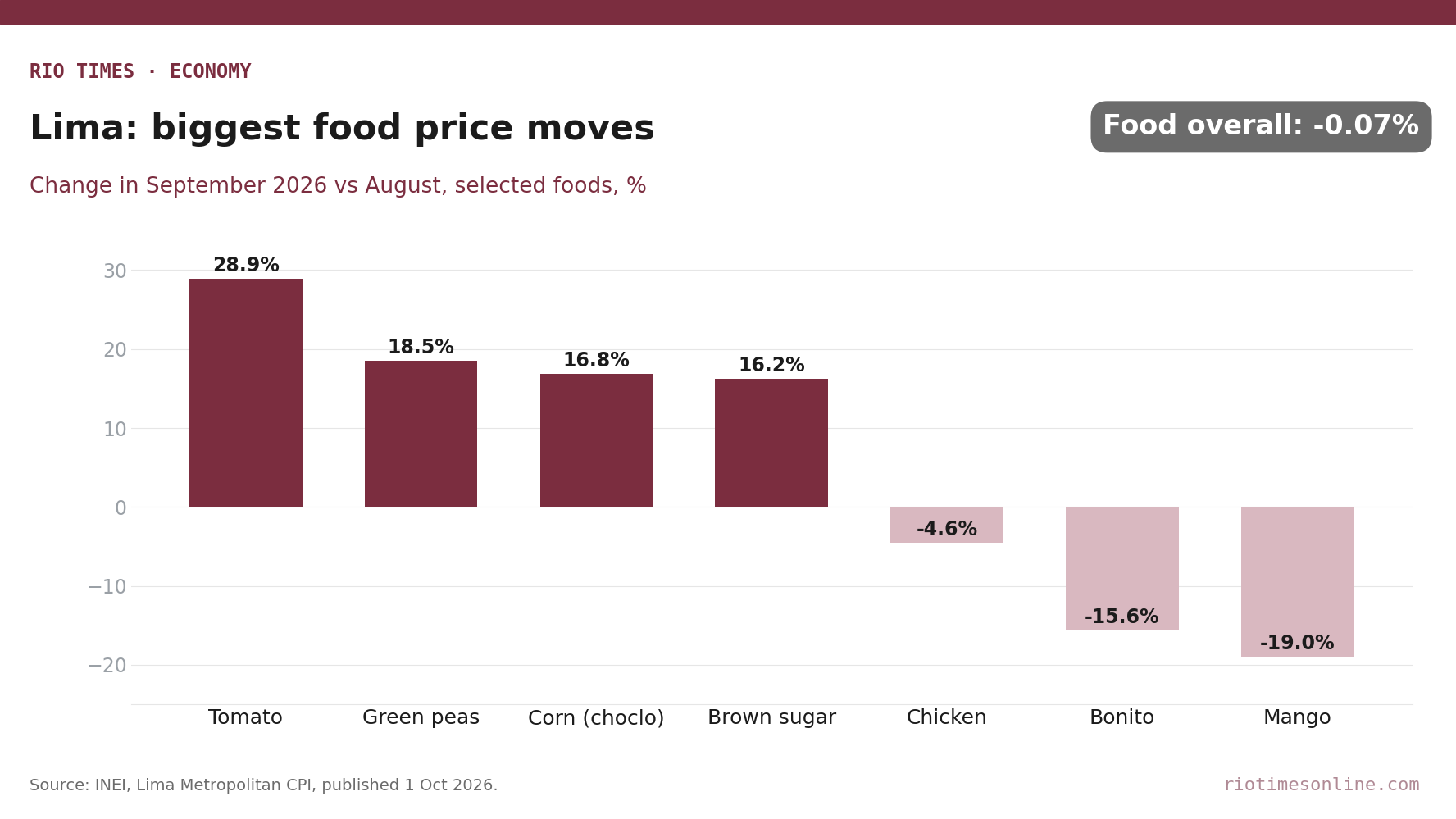
INEI said vegetables, pulses and tubers rose 5.0% in Lima in September. Leeks, bell peppers and gherkins all rose about 15–16%, while yellow and coloured potatoes climbed 6.6% and 8.9%.
Brown sugar rose 16.2% and white sugar 10.4%. Passion fruit topped the whole basket with a 34.8% jump, according to the release.
INEI’s technical report links part of the increase to Coastal El Niño, RPP Noticias reported on 2 October. It cites pests, water shortages and out-of-season rain that destroyed crops and thinned market supply.
Tomatoes alone added 0.059 percentage points to the monthly figure, the largest single contribution, RPP reported. Coastal El Niño is a local warming of the sea off northern Peru, distinct from the wider Pacific event.
Fish, chicken and fruit pulled food prices the other way
Fish and seafood fell 8.0% in September, led by perico (mahi-mahi) at minus 15.7% and bonito at minus 15.6%. Whole chicken dropped 4.6% on better supply, INEI said.
Mango fell 19.0%, and lime, orange and strawberry also got cheaper. Of the 586 products in the basket, 308 rose, 133 fell and 145 held steady.
The warm sea has a second effect. ENFEN, the government’s El Niño study commission, said on 28 September that bonito and perico are moving closer to the coast; INEI did not link this to prices.
Fuel, not food, drove the monthly figure
The biggest upward push came from transport. Vehicle fuel rose 5.2% in Lima, with gasohol up 5.8% and diesel up 3.9%, which INEI tied to higher world oil prices.
Annual inflation in Lima reached 4.55%, up from 4.4% in August. Nationwide, prices rose 0.14% in September and 4.17% over twelve months, INEI said.
Core inflation, which strips out food and energy, rose only 0.07% in the month. That suggests the pressure is concentrated in a few volatile items rather than spreading across the economy.
What the central bank expects
The Central Reserve Bank (BCRP) expects inflation to end 2026 at 4.2%, according to its September inflation report, as covered by Gestión and El Comercio. It sees a return to its 1–3% target range around March or April 2027.
The bank cut its 2026 growth forecast from 3.4% to 3.2% on 18 September, mainly because of El Niño. President Julio Velarde warned El Niño could affect food prices but hoped the impact would be temporary.
The bank held its policy rate at 4.25% but did not rule out a rise if El Niño lifts inflation expectations. Peru entered this episode with thin fiscal savings, as Peru Meets El Niño With Its Smallest Buffer in 25 Years explained.
The political side of the response is covered in Peru Decree Powers Cut to Security and El Niño.
What Is Not Yet Known
It is unclear how much of September’s vegetable rise is El Niño and how much is normal seasonal swing. INEI’s attribution is partial and gives no share for the weather.
ENFEN raised the chance of an extraordinary Coastal El Niño in October to 88% and expects it to last until January 2027, RPP reported. Heavier rain on the north and central coast could hit more crops before summer.
INEI publishes October’s Lima price figures in early November. The central bank’s next rate decision will show whether it judges higher food prices to be temporary.
Sources: INEI press release, 1 Oct 2026; RPP Noticias, 2 Oct 2026; RPP Noticias on ENFEN, 29 Sep 2026; Gestión, 18 Sep 2026; El Comercio, 19 Sep 2026.
This article was produced by The Rio Times’ automated newsroom system. How we use AI · Report an error · Editorial responsibility: Matthias Camenzind, Editor-in-Chief
LatAm Markets: Live Signals → — real-time movers, turnover leaders and FX across Latin America.