
ECONOMY · PANAMA
Key Facts
- The country Panama, a dollarised economy of about 4.5 million people, earns most of its income from services such as the canal, banking and logistics rather than goods.
- What happened National goods exports fell 22.1% to US$534.6 million in January–June 2026, the Ministry of Economy and Finance (MEF) reported on 29 September, using INEC data.
- The numbers The drop was US$151.5 million. Excluding one-off copper shipments in June 2025, other exports rose US$18.2 million, or 3.5% (MEF, 29 September 2026).
- What it means for you The headline fall mostly reflects last year’s copper sale, not weaker farms or factories. Melons, pineapples, shrimp, coffee, timber and beef all sold more abroad.
- Still open Whether the Cobre Panamá copper mine restarts or closes for good, and whether the banana recovery seen from April holds into the second half.
Panama exports of national goods fell 22.1% in the first half of 2026, to US$534.6 million. The Ministry of Economy and Finance (MEF) published the figure on 29 September, based on data from the national statistics institute, INEC.
The ministry blames a base effect rather than a collapse in trade. In June 2025 Panama shipped stockpiled copper from the idle Cobre Panamá mine, which inflated last year’s comparison figure.
A one-off copper sale distorts the comparison
Exports fell by US$151.5 million against January–June 2025. Panama uses the US dollar alongside the balboa, which is fixed one-to-one, so the figures need no conversion.
Stripping out the extraordinary copper shipments, other national exports grew US$18.2 million, or 3.5%, the MEF said. Eco TV, a Panamanian business broadcaster, reported the same figures on 29 September.
The copper came from material left at the mine after the Supreme Court struck down its contract in 2023. The government is now weighing the site’s future, as covered in Cobre Panamá Mine: Ministers Recommend an Orderly Closure Paid by the Site.
Where Panama exports went
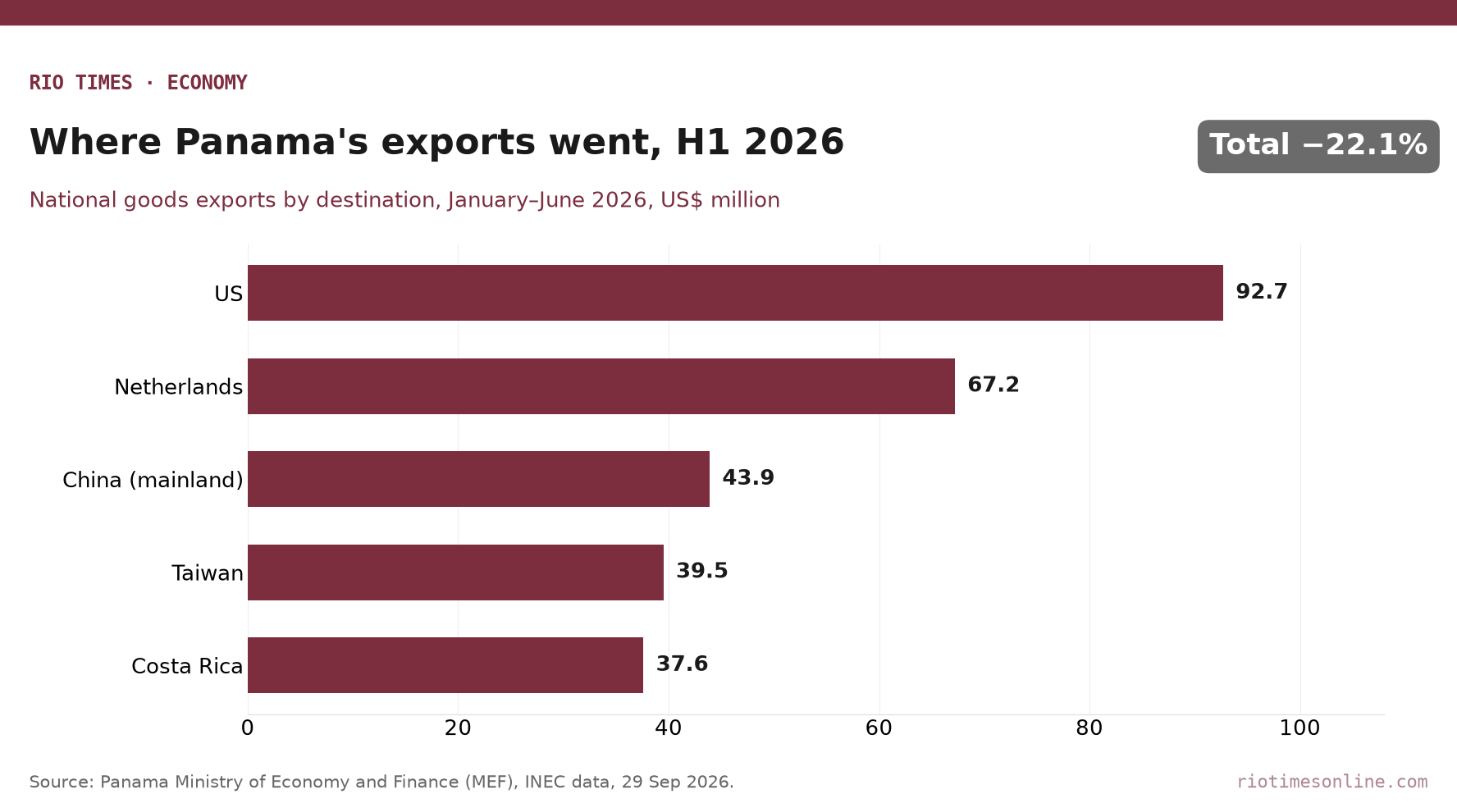
The United States was the largest buyer at US$92.7 million, followed by the Netherlands at US$67.2 million. Mainland China took US$43.9 million, Taiwan US$39.5 million and Costa Rica US$37.6 million.
A further US$42.9 million in exports moved through the Colón Free Zone, the duty-free trading hub on the Caribbean coast. The ministry did not say whether that sum is counted in the total.
Bananas and smaller goods recover
Banana sales topped US$10 million in each month from April to June. June reached US$17.1 million, above the US$16.4 million of March 2025, the best month before the 2025 labour stoppage.
Average banana prices rose 2.9% in Europe and 6.3% in the United States during the half, according to the MEF. Chiquita Panamá now has about 20 farms and roughly 5,000 hectares back in production.
By tariff chapter, gold scrap and costume jewellery added US$15.1 million and timber US$11.4 million. Meat added US$5.6 million, paper and cardboard US$5.1 million, and fruit US$3.9 million.
Goods remain a small part of the economy
The weak export line sits beside solid overall growth. INEC put first-half output growth at 5.5%, as reported in Panama Economy Grows 5.5% in the First Half of 2026.
That growth comes mainly from services, so a goods slump moves the wider economy only modestly. The risk is concentration: without copper, Panama exports rely on a narrow set of farm and sea products.
What Is Not Yet Known
The MEF did not publish the exact value of the June 2025 copper shipments. It also gave no full-year forecast for goods exports.
It is unclear whether the banana rebound will last through the rainy season. The future of Cobre Panamá, and any renewed copper sales, also remains undecided.
Sources: Panama Ministry of Economy and Finance (MEF), “Exportaciones nacionales alcanzan B/.534.6 millones” and Coyuntura Económica report for June 2026, based on INEC (Comptroller General) data, 29 September 2026; Eco TV Panama, 29 September 2026.
More: Panama news in English, every day from The Rio Times.
This article was produced by The Rio Times’ automated AI newsroom. Editorial responsibility: Matthias Camenzind, Publisher and Editor-in-Chief. The Rio Times also runs Ask Rio Times, which answers from 100,000+ of our own articles, the daily Latin America Power Map, and prediction-market odds on elections and markets.. How we use AI · Report an error