
Published Monday, 26 October, 3:15 p.m. ET · Source: Morgan Stanley research note, B3 exchange data, RT market data
Key Facts
—The warning. Morgan Stanley says Brazilian stocks could fall 20% to 30% if worries about government spending keep growing.
—The market. The Ibovespa, Brazil’s main stock index, was down about 14.7%, near 175,000, at 2:46 p.m. ET.
—The dollar. It rose as much as 12% to 5.60 reais, and Morgan Stanley sees 5.70 in a second stage.
—What comes next. Markets wait to see whom Lula picks as finance minister.
Live tonight
Brazil’s runoff, live
The official TSE count for Flávio Bolsonaro and Lula, updated every minute (voting closed at 7 p.m. Brasília, 6 p.m. ET).
Brazil runoff polls · Polymarket and Kalshi odds · When results come · Brazil election poll data (CSV)
Prediction markets · who wins the runoff
Implied chance of winning Brazil’s presidency on 25 October, from traders’ prices.
Polymarket
Flávio Bolsonaro – · Lula – (US$249 million traded)
Kalshi (regulated in the US by the CFTC)
Flávio Bolsonaro 0.4% · Lula 99.6%
As of 25 October, 11:40 pm ET (03:40 Lisbon), updated every 20 minutes. Prices are bets, not polls, and can move fast.
Why we show this: prediction markets turn real-money bets into a live probability that moves within minutes of the news, which is why investors, campaigns and newsrooms in the United States now follow them closely. We show them next to polls and official results, never instead of them.
Brazil’s investors had bet on a change of president, and on Monday they got a fourth term for Lula and a market rout. Morgan Stanley, the US investment bank, now warns that stocks could fall another 20% to 30% if worries about Brazil’s economy and public spending keep growing.
The Ibovespa was down about 14.7% at 2:46 p.m. ET, from a Friday close of just over 205,000 points. The dollar rose as much as 12% against the real, to 5.60 reais, before easing to about 5.41 by 3 p.m. ET, from just under 5 on Friday.
A Rout After a Surprise Win
Lula, the 80-year-old leftist president, won Sunday’s runoff with 51.8% of valid votes. Final polls had given his rival, the conservative senator Flávio Bolsonaro, a lead of roughly one to two points. Flávio is the son of former president Jair Bolsonaro.
Investors had been celebrating since the first round, when Flávio finished nearly two points ahead. The index had climbed above 200,000 points, pricing in a Bolsonaro win and lower interest rates, so Monday’s result forced a sharp reversal.
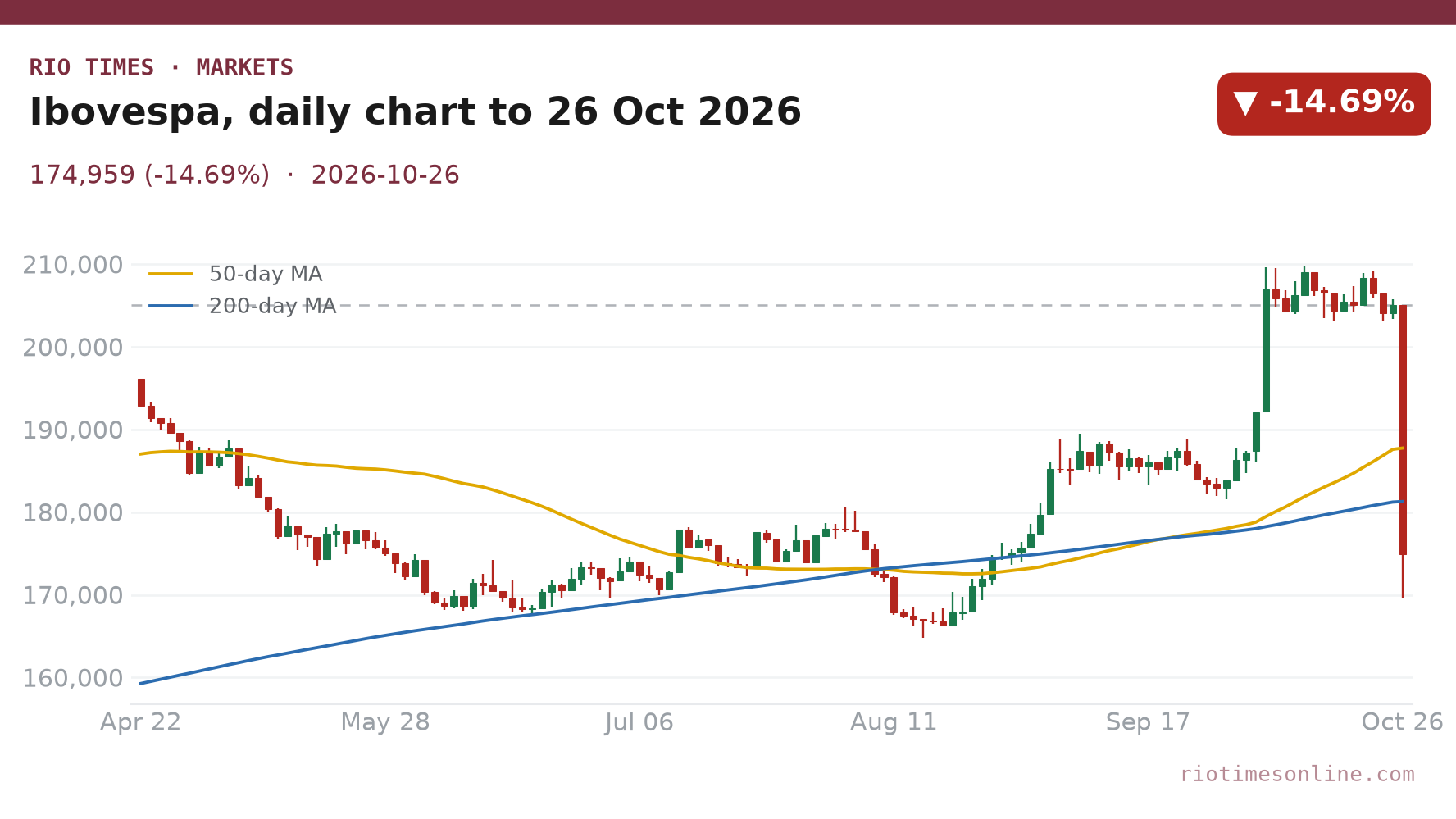
B3, the São Paulo stock exchange, halted trading for 30 minutes when a circuit breaker, a rule that pauses a falling market, was triggered. Tesouro Direto, the retail platform for government bonds, also suspended trading after sharp swings in rates.
In New York, the iShares MSCI Brazil ETF (EWZ), the main US-listed Brazil fund, fell 20.5% to US$33.85 from US$42.59 on Friday, as of about 2:45 p.m. ET. Earlier on Monday, Goldman Sachs said the dollar could near 5.60 reais.
What Morgan Stanley Expects Next
In a note released Monday, Morgan Stanley says Lula’s win raises doubts about Brazil’s public finances. That could erase the gains of recent weeks, even if company profits hold up.
Morgan Stanley sees stocks falling 20% to 30%. In its worst case the Ibovespa reaches 130,000 points by mid-2027, as the price investors pay for each real of profit shrinks from 9.6 times to 6.2 times.
The first stage, already under way, undoes the calm after the first round. Interest-rate futures for January 2029, known as DI contracts, would rise about 2 percentage points, and the dollar would reach 5.50 reais.
A second stage would follow in the coming months, as markets price in the fiscal risk. The January 2029 rate would climb another 1 percentage point to 15.50%, and the dollar would reach 5.60 to 5.70 reais. In a worse case still, the dollar could hit 6 reais.
Live Market IntelligenceBrazil — Live Market Board
Rio Times · Live Market Intelligence
Brazil — Live Market Board
-14.69%
174,959.47
-14.69%
69,879.62
-0.01%
10,575.59
-1.59%
3,017,221
—
2,487.00
-2.09%
57,093.72
-0.06%
| Instrument | Last | Change | YoY | Prev. | High | Low | Volume |
|---|---|---|---|---|---|---|---|
| IBOV | 174,959.47 | -14.69% | +21.85% | 205,082.56 | 168,310 | 167,142 | — |
| USD/BRL | 5.16 | +0.01% | -5.13% | 5.16 | 5.18 | 5.14 | — |
| SELIC | 14.00% | — | — | — | — | — | |
| PETR4 | 41.64 | -0.05% | +35.19% | 41.66 | 41.97 | 41.15 | 41,499,400 |
| VALE3 | 72.97 | +0.83% | +30.75% | 72.37 | 73.54 | 72.66 | 17,658,000 |
| ITUB4 | 38.60 | -1.03% | +4.57% | 39.00 | 39.34 | 38.39 | 29,487,800 |
| BBDC4 | 16.85 | +0.36% | +3.50% | 16.79 | 16.90 | 16.67 | 19,416,900 |
| BBAS3 | 19.37 | +0.47% | +0.73% | 19.28 | 19.44 | 19.16 | 11,069,200 |
| B3SA3 | 14.26 | -0.21% | +12.73% | 14.29 | 14.47 | 14.11 | 33,037,800 |
| ABEV3 | 14.89 | -0.80% | +21.91% | 15.01 | 15.07 | 14.81 | 16,453,100 |
| WEGE3 | 47.59 | +0.49% | +29.99% | 47.36 | 48.08 | 47.36 | 3,364,600 |
| PRIO3 | 59.14 | -0.19% | +50.67% | 59.25 | 59.81 | 58.74 | 3,325,600 |
| SUZB3 | 41.33 | +2.35% | -23.55% | 40.38 | 41.48 | 40.35 | 3,914,900 |
| RENT3 | 34.68 | -0.09% | +0.84% | 34.71 | 34.96 | 34.35 | 7,979,100 |
| AZZA3 | 15.89 | -2.63% | -53.76% | 16.32 | 16.42 | 15.82 | 1,330,300 |
| CSNA3 | 4.30 | +0.47% | -42.65% | 4.28 | 4.41 | 4.26 | 10,076,100 |
| GGBR4 | 24.69 | +2.19% | +51.38% | 24.16 | 24.85 | 24.18 | 7,047,600 |
| ENEV3 | 24.21 | -1.38% | +70.49% | 24.55 | 24.64 | 23.99 | 9,297,000 |
Why Government Spending Drives the Fear
Fiscal risk is doubt that a government can keep its debt under control. When that doubt grows, investors demand higher returns to hold Brazilian assets, and share prices fall even if profits do not.
Morgan Stanley says relief would come from a credible spending plan, starting with Lula’s choice of finance minister. Companies that sell mostly inside Brazil would suffer most, while exporters look more resilient.
What It Means for US Readers
Dollar investors in Brazil face a double hit, falling share prices and a weaker real. A fund like EWZ lost about a fifth of its value in one session, and Brazilian ADRs, the US-traded shares of Brazilian companies, may feel the same pressure.
Travellers and expats who earn dollars get more reais for each dollar, while Brazilians who borrow or import in dollars face higher costs. The next signal is the finance minister, ahead of the start of Lula’s fourth term on 5 January.
What Is Not Known
Nobody knows yet who will run the finance ministry or which spending rules the new government will keep. Morgan Stanley’s 20% to 30% fall is a forecast, not a certainty, and markets can overshoot in both directions.
Sources
Morgan Stanley Research note, 26 October 2026 · B3, São Paulo stock exchange · TSE, Brazil’s electoral court · RT market data
This article was produced by The Rio Times’ automated newsroom system. How we use AI · Report an error · Editorial responsibility: Matthias Camenzind, Editor-in-Chief
LatAm Markets: Live Signals → — real-time movers, turnover leaders and FX across Latin America.
Frequently Asked Questions
How far could Brazil’s stocks fall, according to Morgan Stanley?
Morgan Stanley sees a fall of 20% to 30%. In its worst case the Ibovespa would reach about 130,000 points by mid-2027.
Where could the dollar go against the real?
Morgan Stanley expects 5.50 reais per dollar first, then 5.60 to 5.70 in a second stage. The dollar was near 5.41 reais at 3 p.m. ET on Monday.