Lacoste Has Opened a Cafe in São Paulo, and It Is the Brand’s First in Latin America
Key Facts
- —What happened Lacoste opened its first Latin American cafe in São Paulo on Wednesday.
- —Where it is The cafe sits beside the brand’s boutique at Shopping Cidade Jardim.
- —How big a jump It is not the first anywhere; Paris and New York already have ones.
- —The catch The cafe is a tactic to make shoppers linger longer and buy more clothing.
- —What it means A clothing label selling croissants is a deliberate stay-time calculation.
- —What comes next The brand has not announced further Latin American cafe locations yet.
A clothing label selling croissants is not a whim. It is a calculation about how long you stay in the shop.
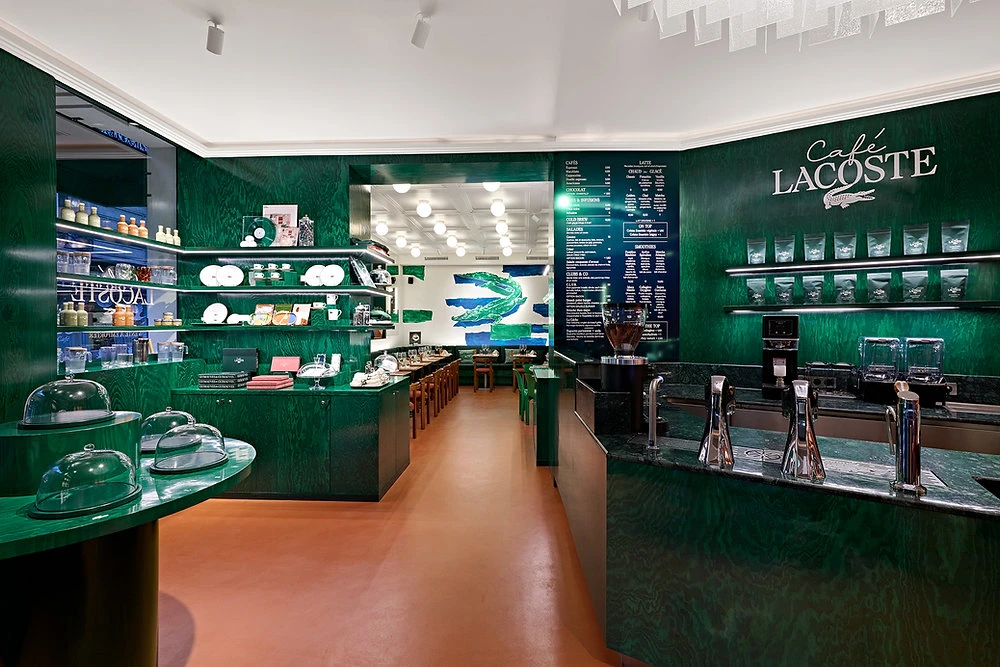
The Lacoste cafe São Paulo opened on Wednesday, next door to the brand’s boutique at Shopping Cidade Jardim. It is the first Café Lacoste in Latin America — a claim worth stating precisely, because it is not the brand’s first anywhere. The concept was built in Paris, and there is a Le Café Lacoste in New York.
What the Lacoste cafe São Paulo actually serves
French bakery, mostly, with the brand’s puns layered on top. There is a traditional croissant and a pistachio one, pain au chocolat, and gougère — the cheese choux pastry that is a genuinely Burgundian thing to put on a menu in São Paulo.
The savoury side runs to a Croc Monsieur and a Croc César, which are what they sound like, plus a Green Avo Smash and smoothies with functional add-ins including one called Supra Curcuma.
The coffee list is espresso, macchiato, latte and filter, alongside a drink called Eau de Croco. And there is one thing you cannot get in Paris or New York: a house blend made from Brazilian beans, created for this location and sold only in Brazil.
Reported prices run from about R$15 to R$70, roughly US$3 to US$14 at 5.18 reais to the dollar. That is Cidade Jardim pricing rather than corner-padaria pricing, which will surprise nobody who has been to Cidade Jardim.
Why a clothing brand sells you a croissant
The polite explanation is brand universe. The commercial one is dwell time. A shopper who sits down for forty minutes next to your boutique is a shopper who walks back into it, and luxury retail has spent a decade discovering that a café is a cheaper way to buy that than advertising is.
Lacoste is late to this rather than early. Ralph Lauren, Armani, Gucci, Tiffany, Dior and Louis Vuitton have all run restaurants or cafés, several of them in São Paulo. What is notable here is the choice of market: the first Latin American one goes to Brazil rather than to Mexico City, which is the region’s other obvious luxury retail hub.
The brand’s Latin America expansion is led by Pedro Zannoni as regional chief executive. A café is a small capital commitment next to a store opening, and a useful signal of where a brand expects to keep spending.
Where it sits, and whether it is worth the trip
Shopping Cidade Jardim is in Morumbi, on the Marginal Pinheiros side of the city, and it is the most explicitly luxury mall in São Paulo. It is not somewhere you pass through; you go there deliberately.
The hours are generous by mall standards — 10 am to 10 pm Monday to Saturday, noon to 8 pm on Sunday — which suggests the café is meant to work as a destination in its own right rather than purely as an adjunct to the shop’s opening times.
One caveat worth stating: the detail available so far comes from the launch coverage rather than from an operating review. Nobody has yet reported on whether the pastry is any good.
The wider pattern in São Paulo
São Paulo has become the region’s test market for brand-owned food and drink. The city already has restaurant or café formats attached to international fashion houses, and the mall it happened in is not accidental — Cidade Jardim was built to concentrate exactly this kind of tenant.
The economics are less about the coffee than about the lease. A café adjacent to a boutique shares footfall, staff infrastructure and a landlord relationship the brand already has, which makes it a far smaller commitment than a standalone restaurant.
It is also a hedge. Apparel sales in Brazil have been uneven; food and beverage in high-end malls has not. Adding a second revenue line inside the same square metres is a rational response to that spread.
Whether it survives is a separate question. The graveyard of brand cafés in São Paulo is not small, and the ones that last tend to be those where the food is treated as a business rather than as merchandising.
Why this matters if you watch Brazilian retail
Brazil keeps being chosen first. When a European brand decides to test a format in Latin America, São Paulo increasingly gets it before Mexico City does — a function of the size of the domestic luxury market and of how concentrated it is in a few square kilometres of one city.
That concentration is the whole business model. Cidade Jardim, Iguatemi and JK Iguatemi between them hold most of the country’s high-end retail, which makes a single-site experiment unusually cheap to run and unusually easy to read.
For readers elsewhere in the region, the thing to watch is whether it stays a single site. Brand cafés that work turn into a small chain within two years; ones that do not quietly close when the lease turns.
More: Brazil news in English, every day from The Rio Times.
Sources: Exame — café com jacaré: the Lacoste coffee shop in São Paulo
Frequently Asked Questions
Where is the Lacoste cafe in São Paulo?
At Shopping Cidade Jardim in Morumbi, São Paulo, immediately next to the Lacoste boutique. It opened on Wednesday 19 August 2026 and runs Monday to Saturday from 10 am to 10 pm and Sunday from noon to 8 pm.
Is it the first Lacoste cafe in the world?
No. It is reported as the first in Latin America. The concept was created for the Café Lacoste in Paris and the brand also operates a Le Café Lacoste in New York, so this is a regional first rather than a global one.
What does it cost?
Reported prices run from about R$15 to R$70, roughly US$3 to US$14 at 5.18 reais to the dollar. The menu covers French viennoiserie, a Croc Monsieur and Croc César, smoothies, and a house coffee blend of Brazilian beans sold only in Brazil.
This article was produced by The Rio Times’ automated newsroom system. How we use AI · Report an error · Editorial responsibility: Matthias Camenzind, Editor-in-Chief