Great Power Rivalry Threatens ASEAN’s Neutral Stance at East Asia Summit
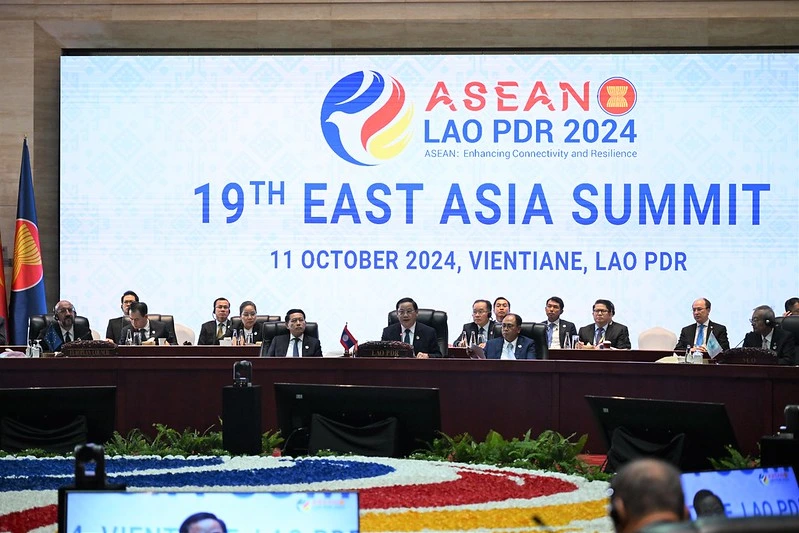
(Analysis) The recent East Asia Summit (EAS) in Vientiane, Laos, has exposed growing cracks in ASEAN’s ability to maintain neutrality.
China and Russia’s joint move to block an ASEAN-drafted statement has raised concerns about the bloc’s future role. This development marks a significant shift in regional dynamics and highlights the increasing pressure on Southeast Asian nations.
ASEAN has long prided itself on its ability to balance relations between major powers. The organization has served as a platform for dialogue and cooperation in the region for decades.
However, the intensifying rivalry between the United States and China has made this balancing act increasingly difficult. The blocked statement at the EAS focused on the contentious South China Sea issue.
China’s assertive actions in the disputed waters have caused tension with several ASEAN member states. The US and its allies have supported ASEAN’s efforts to address these concerns through diplomatic channels.
Alexander Vuving, a professor at the Asia-Pacific Centre for Security Studies, noted the unprecedented nature of this event. He pointed out that Russia’s alignment with China in opposing ASEAN unity is a new development.
This shift suggests a deepening partnership between Moscow and Beijing in Southeast Asian affairs. The US, Japan, Australia, South Korea, and India had expressed support for the draft statement.
Their backing underscores the growing interest of external powers in regional matters. This interest, while potentially beneficial, also complicates ASEAN’s efforts to maintain its central role.
ASEAN’s Unity and Regional Challenges
ASEAN’s ability to speak with one voice on key issues has been a cornerstone of its influence. The failure to issue a joint statement at the EAS weakens this position.
It raises questions about the organization’s effectiveness in addressing regional challenges. The South China Sea dispute remains a major source of tension in the region.
China’s claims conflict with those of several ASEAN members, including Vietnam and the Philippines. The inability to reach consensus on this issue could embolden more assertive actions in the future.
ASEAN countries now face difficult choices in balancing their economic and security interests. Many rely on China for trade and investment but also value security ties with the US and its allies.
This dilemma is likely to become more pronounced as great power competition intensifies. The bloc must find ways to preserve its collective agency and avoid becoming a mere battleground for external powers.
This task will require strengthening internal unity and enhancing ASEAN’s capacity to manage regional disputes. Failure to adapt could result in a more fragmented and unstable Southeast Asia.
As the geopolitical landscape evolves, ASEAN’s role as a neutral mediator faces its greatest test. The organization’s ability to navigate these challenges will shape the future of regional cooperation and stability.
In short, the coming years will prove crucial in determining whether ASEAN can maintain its relevance and influence.
This article was produced by The Rio Times’ automated newsroom system. How we use AI · Report an error
Read More from The Rio Times