India’s Nuclear Triad: Balancing Power in the Indian Ocean
India’s recent launch of its second nuclear-powered submarine, the INS Arighaat, marks a significant step in its naval capabilities. The submarine, unveiled in Visakhapatnam, carries K-15 missiles with a 750 km range.
Defence Minister Rajnath Singh expressed confidence that the Arighaat would strengthen India’s nuclear deterrence and national security.
The Arighaat joins its predecessor, the INS Arihant, in bolstering India’s nuclear triad—the ability to launch nuclear weapons from land, sea, and air.
This development represents India’s growing focus on naval power projection in the Indian Ocean region. However, analysts suggest that despite this progress, India still lags behind China in overall naval strength.
China’s navy remains significantly larger and more technologically advanced than India’s. The Chinese fleet includes six Jin-class nuclear-powered ballistic missile submarines.
These vessels can carry missiles with ranges exceeding 8,000 km, far outstripping the capabilities of India’s current submarines.
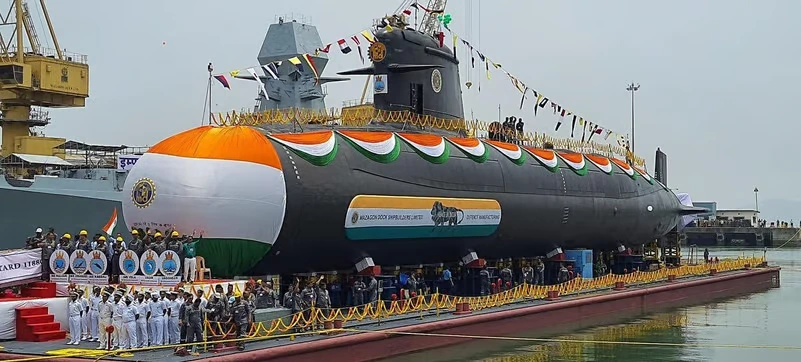
India’s nuclear submarine program faces several challenges in catching up to China. The country needs to develop longer-range missiles and more advanced submarine technologies.
Additionally, India’s submarine construction timelines are much slower than China’s rapid naval expansion. However, India’s geographic position as the dominant power in the Indian Ocean provides some strategic advantages.
India’s Submarine Program
The country’s growing submarine fleet enhances its ability to monitor and potentially deter Chinese naval activities in the region. India plans to eventually operate six nuclear-powered attack submarines, which would significantly boost its naval capabilities.
The contrasting nuclear policies of India, China, and Pakistan add complexity to the regional dynamics. India maintains a “no first use” nuclear doctrine, while Pakistan has made no such commitment.
China also claims a “no first use” policy, but its intentions remain unclear to some observers. India’s nuclear submarine program represents a long-term investment in naval power.
While it may not immediately close the gap with China, it strengthens India’s strategic position in the Indian Ocean.
The program also demonstrates India’s growing domestic defense manufacturing capabilities, with the new submarines being largely indigenously produced.
As India continues to develop its submarine fleet and associated technologies, it will likely gain more parity with China in naval capabilities. However, this process will take time, resources, and sustained commitment to naval modernization.
The nuclear submarine program represents just one aspect of India’s broader efforts to enhance its maritime security and regional influence.
This article was produced by The Rio Times’ automated newsroom system. How we use AI · Report an error
Read More from The Rio Times