Space Race 2.0: China’s Quest to Surpass U.S. in Cosmic Exploration
(Analysis) China has revealed a grand plan to become a world leader in space science by 2050. The country has outlined 17 key areas for growth across five major scientific themes.
This marks China’s first national-level space science program. The plan lays out a three-stage approach to reach its ambitious goals.
The program focuses on five main scientific themes. These include the extreme universe, space-time ripples, and a panoramic view of Sun-Earth interactions.
It also covers habitable planets and biological and physical sciences in space. Within these themes, China has pinpointed 17 priority areas for development.
These priority areas cover a wide range of exciting scientific pursuits. They include research into dark matter and the detection of gravitational waves.
The plan also emphasizes exploring exoplanets and searching for signs of life beyond Earth. These goals show China’s commitment to pushing the boundaries of space science.
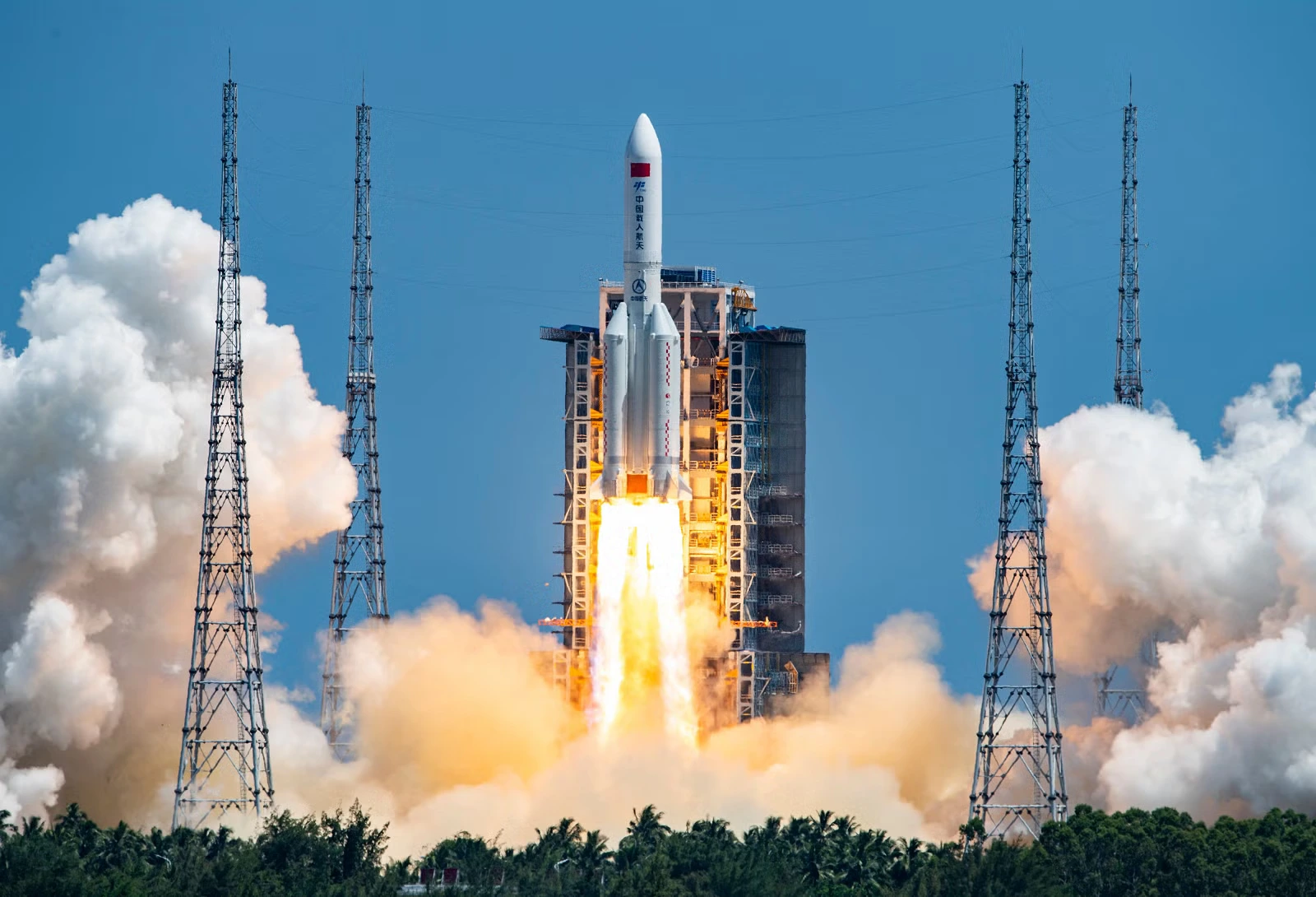
China’s roadmap is divided into three distinct phases. The first phase, from 2024 to 2027, will focus on space station operations. It will also include crewed lunar exploration and the launch of several new space science satellites.
The second phase, spanning 2028 to 2035, will see the construction of the International Lunar Research Station. During this second phase, China plans to launch about 15 scientific satellite missions.
The final phase from 2036 to 2050 is the most ambitious. It aims to launch over 30 space science missions. This steady progression shows China’s long-term commitment to space exploration.
China’s Growing Space Ambitions:
China’s space budget has grown significantly in recent years. It increased from $2 billion in 2022 to $14 billion in 2023. However, this is still much less than what the United States spends on space.
The U.S. invested an estimated $73 billion in space activities in 2023. The U.S. space budget is and remains significantly larger than China’s.
For fiscal year 2024, the Department of Defense is getting $825 billion, with approximately $29 billion allocated to the U.S. Space Force. This is about $1 billion less than the $30 billion initially requested.
The United States remains the leader in space exploration. It has ongoing projects like the James Webb Space Telescope. The U.S. is also planning crewed missions to Mars.
Europe, through the European Space Agency, collaborates with various nations on ambitious space projects. Russia is working closely with China on space initiatives.
They are collaborating on projects like the International Lunar Research Station. This partnership shows the growing importance of international cooperation in space exploration.
China’s plan to lead in space science by 2050 is ambitious but challenging. The country has made great strides in recent years. It has launched its own space station and brought back samples from the far side of the moon.
Key Questions for the Future
Yet, China still trails the United States in overall capabilities and funding. Several challenges lie ahead for China’s space ambitions. The funding gap with the United States is significant.
China will need to make major scientific and engineering breakthroughs in complex areas. These include quantum mechanics and gravitational wave detection.
Geopolitical tensions may also limit China’s ability to collaborate with some advanced space-faring nations. Key questions remain about China’s path to space leadership.
How will China close the funding and technology gap with the United States? Can China attract and keep top scientific talent to achieve its goals? How will global politics affect international teamwork in space science?
Will China’s government-led approach to space exploration be as innovative as the mixed public-private model seen in the United States?
These questions will shape the future of China’s space program. They will determine whether China can achieve its goal of becoming a world leader in space science by 2050.
This article was produced by The Rio Times’ automated newsroom system. How we use AI · Report an error · Editorial responsibility: Matthias Camenzind, Editor-in-Chief