Brazil Stocks Plunge 13.88% After Lula Win | Brazil Market Report, Oct 26
Key Facts
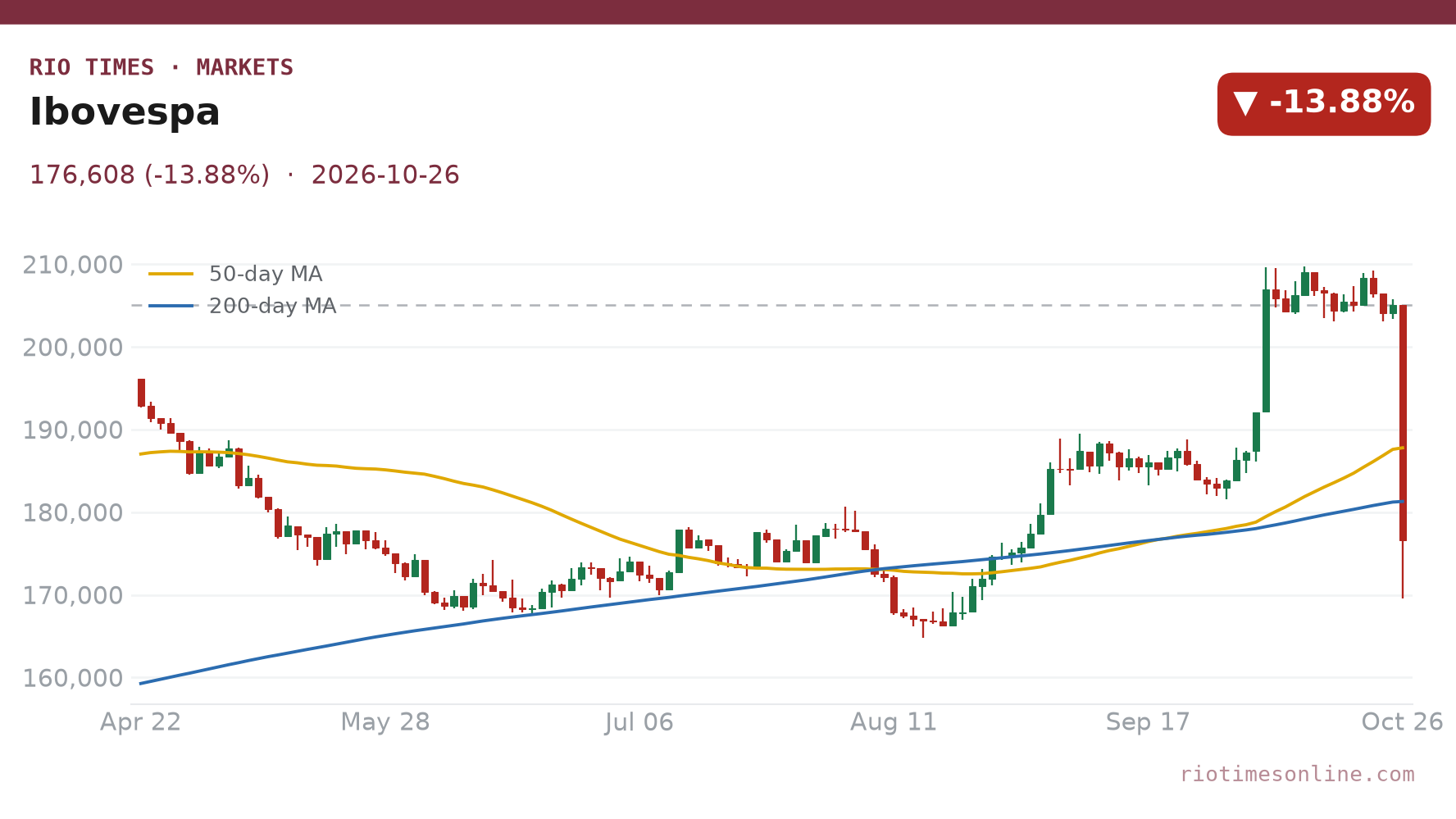
- Brazil’s main stock index, the Ibovespa, plummeted 13.88% to 176,608 points its steepest one-day fall since March 2020.
- The US dollar jumped 8.79% against the Brazilian real, closing at 5.4154 reais, its largest one-day move since at least 2020.
- Trading was halted for 30 minutes by a circuit breaker after the index fell 10% on Monday morning.
- Investors dumped domestic-focused stocks with lenders hit hardest, while exporter Vale rose 4.0%.
- The index swung from 205,089 to a low of 169,516 points during the session, a drop of 17.3% from Friday’s close at its worst.
- Prediction markets: Polymarket, a prediction market, puts 51.5% on an unchanged Brazilian interest rate in December, as of 26 October, 8:48 pm ET.
Live tonight
Brazil’s runoff, live
The official TSE count for Flávio Bolsonaro and Lula, updated every minute (voting closed at 7 p.m. Brasília, 6 p.m. ET).
Brazil runoff polls · Polymarket and Kalshi odds · When results come · Brazil election poll data (CSV)
Prediction markets · who wins the runoff
Implied chance of winning Brazil’s presidency on 25 October, from traders’ prices.
Polymarket
Flávio Bolsonaro – · Lula – (US$249 million traded)
Kalshi (regulated in the US by the CFTC)
Flávio Bolsonaro 0.4% · Lula 99.6%
As of 25 October, 11:40 pm ET (03:40 Lisbon), updated every 20 minutes. Prices are bets, not polls, and can move fast.
Why we show this: prediction markets turn real-money bets into a live probability that moves within minutes of the news, which is why investors, campaigns and newsrooms in the United States now follow them closely. We show them next to polls and official results, never instead of them.
Today’s Focus
Brazil’s Ibovespa stock index crashed 13.88% on Monday, closing at 176,608 points, as investors reacted to President Luiz Inácio Lula da Silva’s re-election victory. The sell-off was so violent that the São Paulo stock exchange triggered a circuit breaker, halting trading for 30 minutes for the first time since the pandemic.
The Brazilian real suffered alongside equities, with the US dollar rising 8.79% to 5.4154 reais. That is the largest one-day move in the real since at least 2020, and it reflects worry about Brazil’s fiscal outlook.
The pain was concentrated in domestic-facing companies like banks, while exporters such as miner Vale rose.
What matters today. Investors are repricing Brazilian assets after an election outcome that markets fear will mean looser fiscal policy and tighter government control over the economy.

01 The session in one read
The Ibovespa — Brazil’s benchmark stock index, a basket of the São Paulo exchange’s most traded companies — fell 13.88% on Monday, closing at 176,608 points. That is its steepest one-day fall since March 2020.
The sell-off was so fast at the open that B3, the Brazilian stock exchange, triggered a circuit breaker — an automatic 30-minute trading halt designed to slow panic selling. It was the first time the mechanism had been activated since the early days of the pandemic in March 2020.
The trigger was political. President Luiz Inácio Lula da Silva won re-election on Sunday, and investors spent Monday dumping Brazilian assets on fears that a fourth Lula term would mean more public spending, higher debt and greater state influence over the economy.
The US dollar rose 8.79% against the Brazilian real, Brazil’s currency, to 5.4154 reais. That is a huge move for a major currency in a single day and reflects foreign investors rushing for the exits.
Monday’s crash was driven by a clear political catalyst — Lula’s re-election — rather than any deterioration in global conditions. That is critical because it means the damage may not be quickly reversed by a bounce in US stocks or commodity prices. The dollar’s 8.79% jump against the real and falls of 7% to 22% in major lenders and Petrobras point to broad risk reduction rather than selective profit-taking. The variable to watch is whether the new government signals fiscal discipline in the coming days, or whether investors are left to price in fiscal risk without official reassurance.
02 The day’s numbers
| Measure | Level | Change | Read |
|---|---|---|---|
| Ibovespa | 176,608 | −13.88% | Steepest fall since March 2020; circuit breaker triggered |
| USD/BRL | 5.4154 | +8.79% | Largest one-day slide since at least 2020 |
| Session range | 169,516 – 205,089 | — | Extreme volatility from open to close |
| 52-week high | 209,067 | −15.5% | Index now deep below its yearly peak |
| 52-week low | 146,173 | +20.8% | Index still above its one-year low |
| Key technical area | 169,500 – 170,000 | — | Monday’s intraday low sits here; first support |
The numbers tell a story of violent repricing. The Ibovespa’s 13.88% drop in a single session is rare — it means the index gave up a large chunk of the gains it had built through 2026.
The dollar’s 8.79% jump against the real is equally striking. A weaker currency makes imports more expensive and fuels inflation, which in turn pressures the central bank to keep interest rates high.
Brazil also published September balance-of-payments data on Monday. The current account deficit was US$5.10 billion, wider than the forecast of US$4.5 billion.
Foreign direct investment, money that foreign companies put into Brazilian businesses, was US$11.29 billion. That beat the forecast of US$9.5 billion and compares with US$7.40 billion in August, both from the RT economic calendar and the central bank.
The FGV consumer confidence index for October, a monthly survey by a Brazilian research institute, was expected at 83.7 after 84.2 in September. We could not verify the reading at the time of writing, so we do not state it.
Live Market IntelligenceBrazil — Live Market Board
Rio Times · Live Market Intelligence
Brazil — Live Market Board
| Instrument | Last | Change | YoY | Prev. | High | Low | Volume |
|---|---|---|---|---|---|---|---|
| IBOV | 176,608.23 | -13.88% | +21.85% | 205,082.56 | 168,310 | 167,142 | — |
| USD/BRL | 5.16 | +0.01% | -5.13% | 5.16 | 5.18 | 5.14 | — |
| SELIC | 14.00% | — | — | — | — | — | |
| PETR4 | 41.64 | -0.05% | +35.19% | 41.66 | 41.97 | 41.15 | 41,499,400 |
| VALE3 | 72.97 | +0.83% | +30.75% | 72.37 | 73.54 | 72.66 | 17,658,000 |
| ITUB4 | 38.60 | -1.03% | +4.57% | 39.00 | 39.34 | 38.39 | 29,487,800 |
| BBDC4 | 16.85 | +0.36% | +3.50% | 16.79 | 16.90 | 16.67 | 19,416,900 |
| BBAS3 | 19.37 | +0.47% | +0.73% | 19.28 | 19.44 | 19.16 | 11,069,200 |
| B3SA3 | 14.26 | -0.21% | +12.73% | 14.29 | 14.47 | 14.11 | 33,037,800 |
| ABEV3 | 14.89 | -0.80% | +21.91% | 15.01 | 15.07 | 14.81 | 16,453,100 |
| WEGE3 | 47.59 | +0.49% | +29.99% | 47.36 | 48.08 | 47.36 | 3,364,600 |
| PRIO3 | 59.14 | -0.19% | +50.67% | 59.25 | 59.81 | 58.74 | 3,325,600 |
| SUZB3 | 41.33 | +2.35% | -23.55% | 40.38 | 41.48 | 40.35 | 3,914,900 |
| RENT3 | 34.68 | -0.09% | +0.84% | 34.71 | 34.96 | 34.35 | 7,979,100 |
| AZZA3 | 15.89 | -2.63% | -53.76% | 16.32 | 16.42 | 15.82 | 1,330,300 |
| CSNA3 | 4.30 | +0.47% | -42.65% | 4.28 | 4.41 | 4.26 | 10,076,100 |
| GGBR4 | 24.69 | +2.19% | +51.38% | 24.16 | 24.85 | 24.18 | 7,047,600 |
| ENEV3 | 24.21 | -1.38% | +70.49% | 24.55 | 24.64 | 23.99 | 9,297,000 |
03 Why it moved — election shock
The catalyst was unambiguous: Lula’s re-election victory. Investors sold Brazilian stocks and the real from the first minutes of trading. By the close the Ibovespa had lost 13.88% and the dollar had gained 8.79% against the real.
The session was extremely volatile. The index swung from a high of 205,089 points to a low of 169,516, a gap of 17.3% from Friday’s close.
The fiscal fear is simple to grasp: investors worry the new government will spend more than the economy can afford. That means higher debt, higher inflation and higher interest rates — all of which hurt stock valuations and the currency.
04 The day’s movers
| Driver | Level / Move | Change | Note |
|---|---|---|---|
| Vale | R$64.38 | +4.01% | Rare bright spot; exporter benefits from weaker real |
| Petrobras (preferred) | R$53.88 | −8.18% | State-controlled oil giant, preferred shares |
| Petrobras (common) | R$60.80 | −6.81% | Common shares, smaller drop |
| Itaú Unibanco (preferred) | R$41.70 | −13.66% | Brazil’s largest private lender sold off hard |
| Bradesco (preferred) | R$15.95 | −21.70% | Among the worst single-stock falls |
| Itaúsa (preferred) | R$13.39 | −12.54% | Holding company mirrors Itaú’s slide |
| Ambev | R$15.37 | −7.85% | Brewer exposed to weak domestic demand |
| MBRF | R$16.62 | −10.60% | Brazilian food group, caught in the rout |
The pattern is clear: companies that earn dollars abroad — like miner Vale — held up or rose, because a weaker real actually boosts their profits when converted back to local currency. Vale’s shares climbed 4.01% to R$64.38.
In contrast, companies that depend on Brazilian consumers and domestic demand were crushed. Bradesco, one of the country’s largest private banks, fell 21.70%. Petrobras, the state-controlled oil giant, lost between 6.8% and 8.2% depending on the share class.
The selling was not limited to a few troubled names. Lenders, the state oil company and consumer brands all fell by high single or double digits.
05 The regional scoreboard
| Index | Country | Change |
|---|---|---|
| Ibovespa | Brazil | −13.88% |
| IPSA | Chile | −1.59% |
| IPC | Mexico | −0.58% |
| Merval | Argentina | −3.0% |
| COLCAP | Colombia | −1.38% |
Brazil’s crash was the standout, but the shock waves rippled across the region. Chile’s IPSA fell 1.59%, Colombia’s COLCAP lost 1.38%, and Mexico’s IPC slipped 0.58%.
The relatively smaller moves elsewhere suggest investors see Brazil’s political situation as specific rather than a continent-wide problem. Argentina’s Merval fell 3.0%.
06 The technical picture
The Ibovespa is now 15.5% below its 52-week high of 209,067 points, and Monday’s crash took it straight through several levels that had previously acted as support. The session low of 169,516 points creates a first line of defence around the 169,500–170,000 area.
That is the level to watch in the coming sessions. If the index holds there, it may signal that the initial panic has been absorbed. A break below would open the way toward the 52-week low of 146,173 points.
Even after Monday, the index is up 20.2% from its close of 27 October 2025. That cushion will feel thin if fiscal fears persist.
What Prediction Markets Say
On Polymarket, a prediction market, traders put the chance that Brazil’s central bank leaves its benchmark interest rate, the Selic, unchanged at its December meeting at 51.5%. They see a 23.0% chance of a cut of 0.25 percentage points and 11.3% for a rise of 0.5 points or more. About US$46,000 has been traded on this market, as of 26 October 2026, 8:48 pm ET.
Prices on prediction markets are bets, not polls or forecasts by officials.
Why we show this: prediction markets turn real-money bets into a live probability that moves within minutes of the news, which is why investors, campaigns and newsrooms in the United States now follow them closely. We show them next to polls and official results, never instead of them.
07 What to watch
- Lula’s first policy signals: Any hint on fiscal discipline — or lack of it — will set the tone for Brazilian assets in the short term.
- Central bank response: Whether the central bank comments on the real’s slide and its effect on inflation.
- Technical support at 169,500: A break below Monday’s low could trigger another wave of forced selling.
- Foreign investor flows: Watch whether global funds continue to exit Brazil or treat the crash as a buying opportunity.
Background: Brazil’s Azul Gets Up to US$397M Fuel Loan.
Background: Brazil Stocks Rise 0.47% Before Runoff Vote.
Frequently Asked Questions
What is the Ibovespa?
It is Brazil’s benchmark stock index, tracking the most actively traded companies on the São Paulo exchange, B3.
Why did Brazilian stocks fall so much?
President Lula’s re-election raised investor worries about public spending and debt, and many sold Brazilian assets.
What is a circuit breaker?
It is an automatic trading halt triggered when an index falls a certain amount, designed to give investors time to absorb information and prevent panic selling.
Why did Vale rise while most stocks fell?
Vale is a major exporter. A weaker Brazilian real makes its dollar revenues worth more in local currency, so exporters often benefit when the currency slides.
Market data: RT; exchange figures from B3
This article was produced by The Rio Times’ automated newsroom system. How we use AI · Report an error · Editorial responsibility: Matthias Camenzind, Editor-in-Chief
LatAm Markets: Live Signals → — real-time movers, turnover leaders and FX across Latin America.
Get The Rio Times delivered to your inbox — market intelligence, daily briefs, and breaking analysis across Latin America.
Start for US$1