Colombia Submission Law Heads to Congress in October

SECURITY · COLOMBIA
Key Facts
- —The country Colombia, a close US security partner, where armed groups still fight over drug routes, illegal mining and extortion.
- —Why it matters The bill sets how gang members could surrender in exchange for shorter sentences, while extradition requests stay in force. Colombia has long sent drug suspects to US courts.
- —Why now President Abelardo de la Espriella took office on 7 August and has ruled out political talks with armed groups. This law is his alternative.
- —What happened On Monday 5 October Justice Minister Iván Cancino said the bill will be presented this week or next, before the third week of October ends.
- —The numbers Sentence cuts of up to 30% for leaders and 50% for other members, according to the minister. The bill needs four votes in Congress.
- —What it means for you No immediate change on the ground. Travellers should keep following official advisories for regions where armed groups operate.
- —Still open The text has not been published. Which groups qualify, and whether Congress keeps the terms, is unknown.
Colombia will send a submission law for criminal groups to Congress within days, Justice Minister Iván Cancino said on Monday 5 October. The Colombia submission law offers reduced sentences to gang members who disarm and confess, but no political negotiations. For US readers, the key point is extradition: the minister says no request will be suspended for anyone who submits.
Cancino spoke by video to a national forum in Barranquilla marking 20 years of the Justice and Peace Law. “This week, or at the latest next week, the country will know the submission law,” he said, according to Caracol Radio and El Tiempo.
Cancino also said the bill would be filed before the end of the third week of October, NTN24 and Infobae reported. It must pass four debates, two in the Senate and two in the House of Representatives.
A Legal Track, Not Peace Talks
The bill is the centrepiece of security policy under Abelardo de la Espriella. He became president on Friday 7 August, succeeding Gustavo Petro.
Petro, a leftist who governed from 2022 to 2026, pursued “total peace”. That policy opened talks with guerrillas and with criminal gangs that had no political status. Analysts Luis Fernando Trejos and Reynell Badillo wrote in La Silla Vacía that very few of those gang talks produced concrete results.
Cancino drew a hard line on Monday. “This government will pursue illegal organisations. We will give the tools for submission, not for negotiations,” he said. Any discussion with those who want to submit “will be legal”, with no political character.
He added a warning. “Whoever challenges the State, does not accept this and wants to keep committing crimes will be pursued with all the force that the Constitution and the law allow.”
The ministry has used the same language before. On Saturday 12 September it told a man known as alias “Pinocho”, Fredy Castillo Carrillo, who had signalled he wanted to surrender, that there would be “no shortcuts, privileges or agreements” outside the law.
What the Colombia Submission Law Would Offer
The full text is not public. The terms below come from the minister’s statements in September and on Monday, as published by the Presidency, Semana and Cambio.
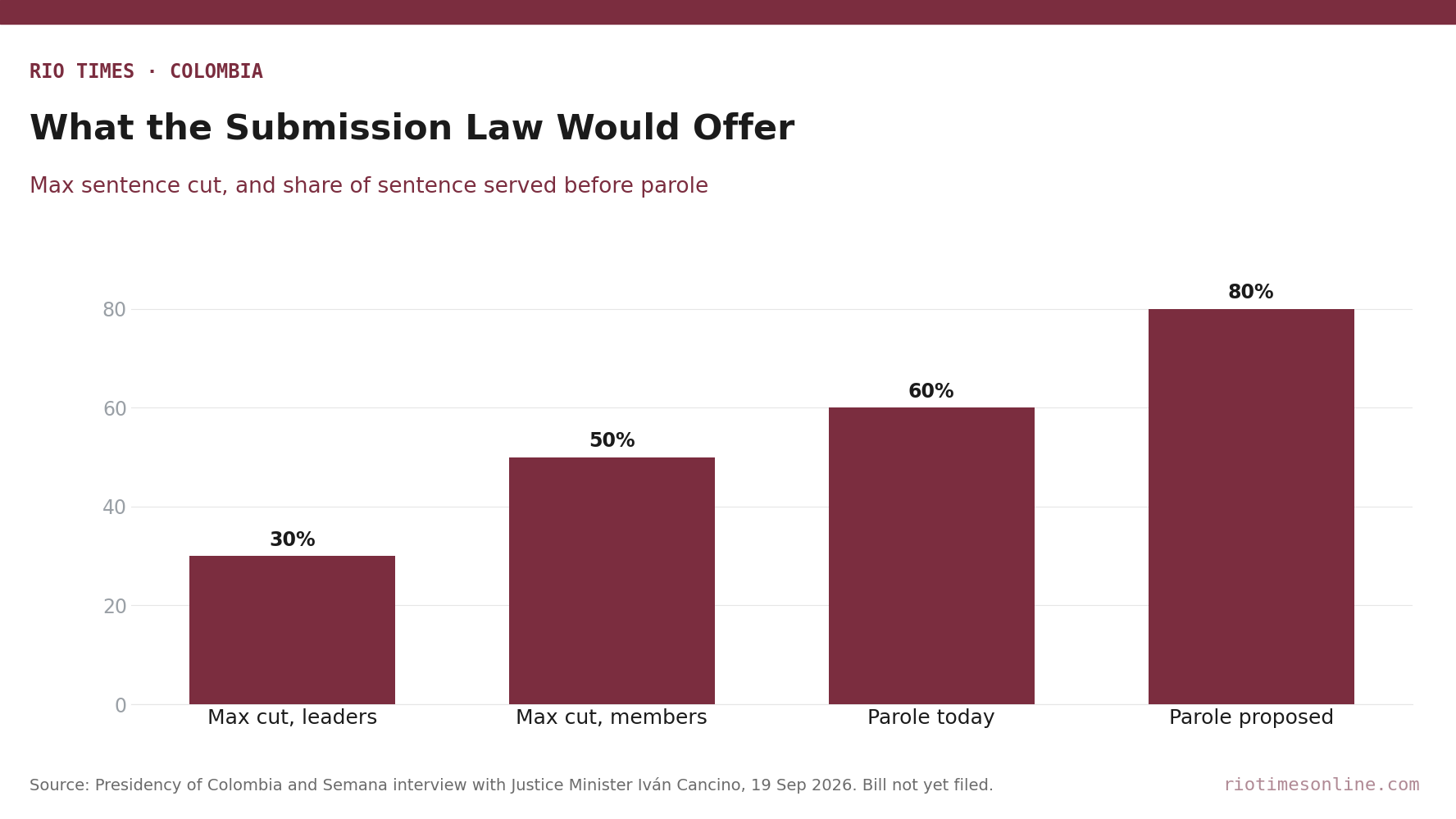
Sentence cuts. People with command roles could get at most 30% off their sentence. Other members could aspire to 50%. “The hard part is that they give you that 50%,” Cancino told Semana in an interview the Presidency summarised on Saturday 19 September.
Tougher parole. In the same interview, he said parole would require serving four fifths of a sentence, instead of the usual three fifths. Victims would also need to give a favourable opinion.
Truth first. Applicants must hand over drug routes, sources of financing and links to corruption and politicians. They must also give information on illegal crops and on people who are missing or kidnapped.
No pause on arrests. Arrest warrants stay in force. People already in custody cannot apply. The government has also ruled out special prisons.
Victims would sit at the centre, he said on Monday. “Whoever asks the State for extraordinary benefits has to meet extraordinary obligations,” Cancino said. Handing over money alone would not be enough.
What It Means for You
For investors and US policymakers, the extradition clause is the headline of the Colombia submission law. “No extradition will be suspended because the person is in submission,” Cancino said in September. Someone extradited could later return and settle their Colombian case under the law.
That matters because Colombia has long sent drug suspects to stand trial in US courts. Cancino has said the government aims to double extraditions by its 100th day in office. That target is a pledge, not a result.
For travellers and residents, nothing changes yet. A bill is not a law, and armed groups remain active in several regions. Our report on the Colombia Offensive Hits Armed Groups in Five Regions shows where the security forces are now concentrating.
There is also a stabiliser. Colombia has used submission rules before. Decrees in 1990 and 1991 under President César Gaviria led members of the Medellín Cartel to surrender, Trejos and Badillo noted. The Justice and Peace Law of 2005 framed the demobilisation of the AUC paramilitary federation.
Those precedents also show the limits. Cancino cited a judiciary tally to March 2025 of about 100 rulings covering nearly 1,000 applicants. Courts recognised about COP 6 trillion (about US$1.9 billion) in compensation, but he said too little has reached victims.
What Is Not Known
The bill text has not been published, so every term above is the minister’s description. Congress can change any of it during four debates.
It is not clear which groups would qualify. Cancino has spoken of illegal, criminal and terrorist organisations without naming them. Whether the National Liberation Army (ELN), a leftist guerrilla group, could use the law is unknown.
The filing date is also soft. On Monday Cancino spoke of “hours”, and also of this week or next. Interior Minister Rodrigo Lara was preparing the bill with him, Cambio reported in September. No schedule for debates exists yet.
Finally, it is unknown how many fighters would sign up when leaders can win at most 30% off. The bill builds on the government’s refusal to grant any group political status, covered in Colombia Closes Its Last Peace Table and Strips Armed Groups of Political Status.
More: Colombia news in English, every day from The Rio Times.
What is Colombia’s submission law?
A planned bill that would let members of armed and criminal groups surrender to ordinary courts in exchange for reduced sentences. They would have to disarm, confess and give information. It involves no political negotiation.
When will the bill reach Congress?
Justice Minister Iván Cancino said on 5 October it would be presented this week or next, before the end of the third week of October. It then needs four debates in the Senate and House.
Would the law stop extraditions to the United States?
No, according to the minister. He said arrest warrants and extradition requests stay in force for anyone who submits, and that no extradition will be suspended.
Sources: Presidency of Colombia, statement of 19 September 2026; Ministry of Justice, statement of 12 September 2026; El Tiempo; Caracol Radio; Infobae; NTN24; Semana; Cambio; La Silla Vacía.
This article was produced by The Rio Times’ automated newsroom system. How we use AI · Report an error · Editorial responsibility: Matthias Camenzind, Editor-in-Chief