ALMA observatory’s antennas enter the operating room in Chile
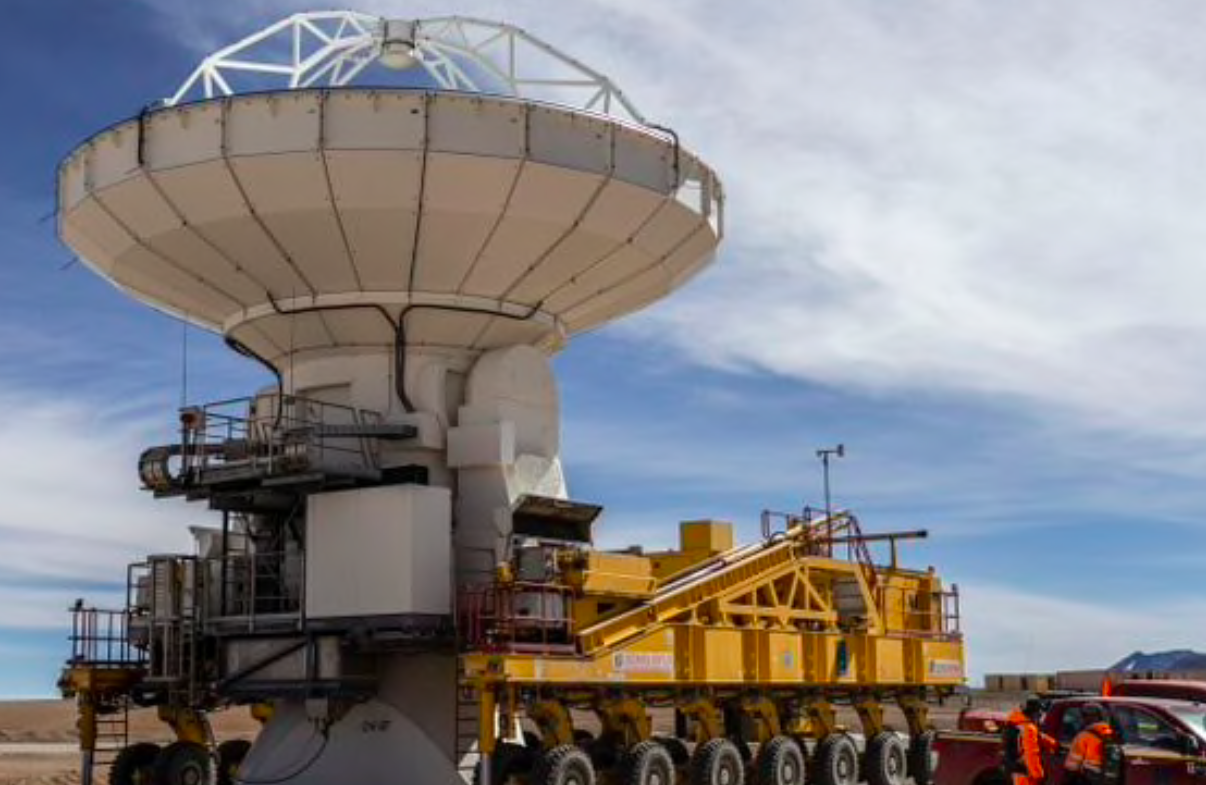
RIO DE JANEIRO, BRAZIL – A truck as long as a five-story building drives slowly through the corner of the earth most similar to the planet Mars. Among the red sand mountains of the Llano de Chajnantor, in the Chilean Andes, the vehicle carries a white antenna 12 meters in diameter and weighing 100 tons. At about 5,200 meters above sea level -Madrid, the highest capital in the European Union, is at 650-, the deafening whistle of the wind is only interrupted by the whistle emitted by the truck. A man with his face completely covered stands a couple of meters from the vehicle and directs it with a remote control. His mission is to position the antenna with the precision of a surgeon on one of the bases of the ALMA Joint Operations Site (AOS), the largest radio telescope in the world.
For the first time since the construction of ALMA, a decade ago, the 66 antennas (54 of 12 meters in diameter and 12 of seven meters in diameter) that function as a single giant telescope are undergoing “major maintenance”. The macro maneuver consists in that, once a month, an antenna is transferred from AOS to the operations support center (OSF), at an altitude of 2,900 meters. There, the engineers and technicians carry out a mechanical and electrical update.
Read also: Check out our coverage on Chile
The dryness, the high altitude, the few clouds and the lack of light pollution allow the observatory to investigate the cold universe, the one that cannot be seen with conventional telescopes. However, these conditions that are so suitable for astronomy also pose a logistical challenge, since the antennas must withstand changes in temperature in the heart of the driest desert in the world, which range from 20 degrees below zero at night and more than 10 during the day.

Francisco González, supervisor of the array maintenance group, arrived at the observatory when it was in its construction phase in 2011. By then there were about 25 antennas. All three manufacturers (Mitsubishi, Vertex and Alcatel) trained the maintenance team on how to repair them. “There are multiple failures, but over time and training we have learned to analyze failures without any inconvenience and act before a deficiency occurs that affects the observation work of astronomers,” says González, with an oxygen tank hanging on his back, which is administered through cannulas through his nostrils.
In the mechanical area, just like a car, the maintenance team performs grease and bearing changes on the antennas, among other things. But ALMA is taking advantage of the transfer of the white antennas to the OSF laboratories to sophisticate the receptive capabilities of the antennas built jointly by the European Southern Observatory (ESO), the United States National Science Foundation (NSF) and the National Institutes of Natural Sciences of Japan (NINS). The antennas are robust enough to be moved between different bases without damaging their high-precision mechanisms. The closest they can be is 30 feet from each other, which allows for a larger field of view, and the furthest apart is 10 miles, where details are best appreciated.
“Like a car radio receiver, the antenna’s reception capabilities are divided into 10 large “radios” that we call “bands”. They range from one to 10, and each covers one degree of frequency. Astronomers carry out an observing project in a specific reception band at a specific frequency. When I arrived we only had three reception bands. Over time it has been increasing and now we have eight and we are integrating band one, the lowest observation band. Every time an antenna goes down for maintenance, it is used to put the band on it”, explains González.
Engineer Nicolás Peña estimates that within a year and a half the 66 antennas will have band one integrated. The only one that would be missing then is number two, which is still in the development phase. “Once we incorporate all of them, the reception capabilities of our antennas will be 100% for the frequency range that our observatory covers: from 50 to 950 ghz,” says Peña in the OFS laboratories, where the electric hearts of the antennas in maintenance are on display.
The goal that Sean Dougherty, director of ALMA, has set for himself is to double the sensitivity of the telescope by 2030, as he said last week in an interview with El PAÍS. This will allow images of the shadows of black holes, for example, to be twice as detailed and sharp. Once they achieve that, the sensitivity of the radio telescope will be 10 times larger than it is today, the next challenge, according to Dougherty, is to expand the number of antennas, which will cost US$10 million each. There’s room for them. There are 182 bases available and only 66 are occupied.
More: Chile news in English, every day from The Rio Times.
Editorial responsibility: Matthias Camenzind, Editor-in-Chief · Editorial standards · Report an error