Brazil: New Cyclone to Lash Rio Grande do Sul as Storms Hit 78 Municipalities
Brazil · Weather
Key Facts
—The toll so far. Four people injured, 39,117 affected, 6,088 driven from their homes and 63 left homeless after storms sweeping Rio Grande do Sul since Friday, the state’s Civil Defence reported on Monday evening. No deaths or missing persons have been recorded.
—The reach. 83 occurrences across 78 municipalities — intense rain, hail, destructive wind gusts and mudslides — with 4,982 homes damaged, 153 unroofed and 28 schools and four health facilities hit.
—Worst hit. Santiago, where a hailstorm affected more than 26,000 people, damaged 3,000 homes and 20 schools and forced the local charity hospital to restrict services.
—What comes next. An extratropical cyclone is forecast to form overnight between Uruguay and Rio Grande do Sul, driving renewed storms across the South on Tuesday with wind gusts of up to 90 km/h.
—The response. The state Civil Defence is sending tarpaulins and roof tiles to the hardest-hit municipalities; damage tallies remain preliminary and are still being updated.
Rio Grande do Sul is counting the cost of a four-day barrage of hail, torrential rain and destructive winds — and the worst may still be ahead. An extratropical cyclone is expected to spin up off the state’s coast overnight, keeping the tempest going into Tuesday and pushing storms as far north as São Paulo.
Four Days of Storms, Then a Hailstone Barrage
Rio Grande do Sul has been recording adverse weather since Friday, 25 September. By 6 p.m. on Monday the state Civil Defence counted 83 occurrences in 78 municipalities — up from 60 occurrences in 58 municipalities at midday — related mainly to intense rain, hail, gale-force gusts known locally as vendavais, and mudslides. Sixty-eight of those cities reported injuries or material damage.
The human toll, though mercifully free of deaths so far, is substantial: four people injured — two in Pontão, one in Alegrete and one in Capão do Cipó — 39,117 affected, 6,088 displaced from their homes and 63 left homeless. Material damage extends to 4,982 residences, of which 153 were unroofed and 17 flooded, alongside 28 schools, four health facilities and a score of other public and private buildings.
The municipalities with the most people affected are Santiago, Alegrete, Santana do Livramento, Capão do Cipó, Itaara, Erval Grande, Catuípe, Erechim, São Valentim and São Vicente do Sul — a swathe of the state’s west and north, along and beyond the Uruguayan border.
Santiago and Alegrete Bear the Brunt
Santiago, in the state’s western plains, took the single heaviest blow. A hailstorm there affected more than 26,000 people, left 13 homeless and 6,000 displaced, and damaged 3,000 homes, 20 schools and a health unit. The Hospital de Caridade de Santiago restricted its services after the hail damaged the building, the state government said.
In Alegrete, hail affected more than 2,000 people, injured one, left ten homeless and damaged 400 residences, with further damage reported to power poles and sections of the electricity grid. The Civil Defence said it is supporting the hardest-hit municipalities with deliveries of tarpaulins and roof tiles, and stressed that the figures remain preliminary as councils continue to file reports.
An Extratropical Cyclone Forms Overnight
The respite will be brief. Between Monday night and Tuesday morning an extratropical cyclone is forecast to form between Uruguay and Rio Grande do Sul, spawning a new cold front that reinvigorates the instability and widens the area at risk, g1 reported, citing Climatempo. From the early hours into Tuesday morning, storms are expected across much of the South region, with gusts that may reach 90 km/h in some areas.
Extratropical cyclones are low-pressure systems that typically form at mid-latitudes, fed by the collision of air masses with different characteristics; they can bring heavy rain, wind gusts and abrupt weather changes. The state has painful recent experience of their power — a bomb cyclone in August prompted a red alert across Rio Grande do Sul.
On Tuesday the weather also turns unstable in Paraná, where some storms may be severe, before the cold front advances in the afternoon into Mato Grosso do Sul, São Paulo and parts of Minas Gerais, bringing showers and thicker cloud. Monday’s highest risk had been concentrated in Rio Grande do Sul itself, with Porto Alegre, Santa Maria, Alegrete, Santa Cruz do Sul, Rosário do Sul and Caxias do Sul among the cities liable to heavy rain.
A State Still Scarred by 2024
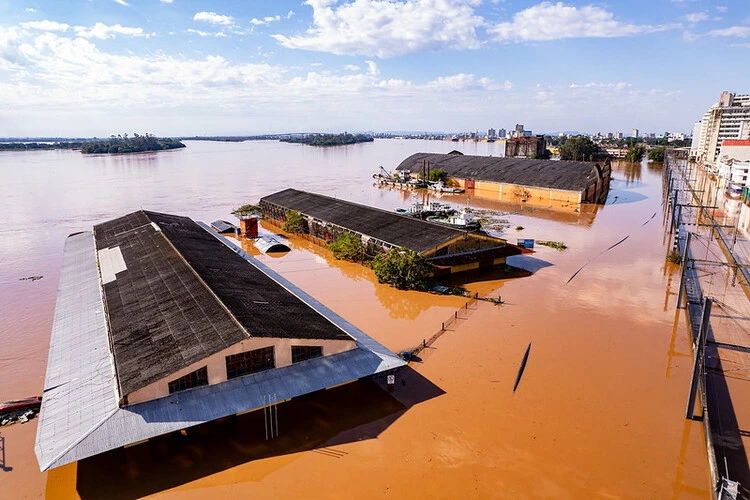
Every new storm system lands on a state that has not forgotten May 2024, when historic flooding submerged cities, displaced hundreds of thousands and left more than 180 dead in Brazil’s worst climate disaster of the century so far. The current episode is far smaller in scale, but the speed with which the tally of damaged homes climbed past 4,900 — and the cyclone now forming offshore — has authorities moving quickly.
The same front will at least break the heat gripping the Centre-West, where Cuiabá was forecast to reach 40°C on Monday, according to the National Meteorology Institute (Inmet). For the South, though, the message from forecasters and the Civil Defence is the same: secure roofs, avoid open areas during lightning and follow municipal alerts through Tuesday.
What We Could Not Confirm
All damage figures are preliminary Civil Defence tallies and are still rising as municipalities file updates; a final count may differ considerably. We could not verify forecasts circulating in Brazilian media of gusts up to 100 km/h on Tuesday — the figure cited by g1 and Climatempo is 90 km/h. No official estimate of economic losses, including to crops, has been published, and it is not yet clear whether Tuesday’s system will deepen into a bomb cyclone comparable to August’s.
More: Brazil news in English, every day from The Rio Times.
Frequently Asked Questions
What is happening in Rio Grande do Sul right now?
The state has been hit by storms since Friday: 83 occurrences in 78 municipalities, with four people injured, more than 39,000 affected and almost 5,000 homes damaged. An extratropical cyclone forming overnight is expected to bring renewed storms and gusts of up to 90 km/h on Tuesday.
Which cities were worst hit by the hail in Rio Grande do Sul?
Santiago, where hail affected more than 26,000 people, damaged 3,000 homes and 20 schools and forced the local hospital to restrict services, followed by Alegrete, Santana do Livramento, Capão do Cipó and Itaara, according to the state Civil Defence.
What is an extratropical cyclone?
A low-pressure system that typically forms at mid-latitudes where contrasting air masses meet. Extratropical cyclones can produce heavy rain, strong wind gusts and sudden weather changes — southern Brazil sees several each year, and an intense “bomb cyclone” prompted a red alert in Rio Grande do Sul in August.
Connected Coverage
Rio Grande do Sul’s storm season is testing a state still rebuilding from the 2024 floods — and cyclones keep coming.
Sources: g1; Portal do Estado do Rio Grande do Sul (Defesa Civil).
This article was produced by The Rio Times’ automated newsroom system. How we use AI · Report an error
Read More from The Rio Times