
BOLIVIA · COCHABAMBA · POLITICS
Bolivia’s former president Evo Morales told supporters on Saturday, 24 October 2026 that armed struggle could return if his political movement keeps being squeezed out, while adding that he does not agree with it.
Key Facts
- —Power Index Bolivia ranks 12th of 14 in The Rio Times Latin America Power Index, with 28.4 points (October 2026 edition).
- —What happened Ex-president Evo Morales warned on Saturday, 24 October 2026 that armed struggle could return to Bolivia.
- —His caveat He disagrees with that path and calls the political right the one hinting at it.
- —Legal status Morales faces at least two arrest orders but no conviction; his side rejects them.
- —US link Washington named 15 Bolivians for visa restrictions on Thursday, 22 October 2026.
- —Travel The State Department rates Bolivia Level 2 and Chapare Province Level 4, “do not travel”.
Evo Morales, Bolivia’s president from 2006 to 2019, warned on Saturday, 24 October 2026 that “at any moment armed struggle can return” if his political movement keeps being eliminated, the television network Unitel and the newspaper Correo del Sur reported. He added that he does not agree with that path and said it is the political right that is hinting at it.
The remark matters to Americans because Morales is wanted on at least two arrest orders, Washington named 15 Bolivians for visa restrictions two days earlier, and his supporters are threatening a march on La Paz. Correo del Sur reports that the march has been put back to Friday, 6 November 2026.
In Plain English
- Evo Morales: Bolivia’s president from 2006 to 2019, described by Unitel as the leader of the coca growers; he has not held the presidency since.
- Evo Pueblo: the political movement that held Saturday’s congress and that Morales leads.
- Rodrigo Paz: Bolivia’s current president, whose economic measures Morales’s camp opposes.
- Visa restriction: a US measure that refuses visas to named people and their immediate families; it is not a criminal conviction.
What Morales Said at the Rally
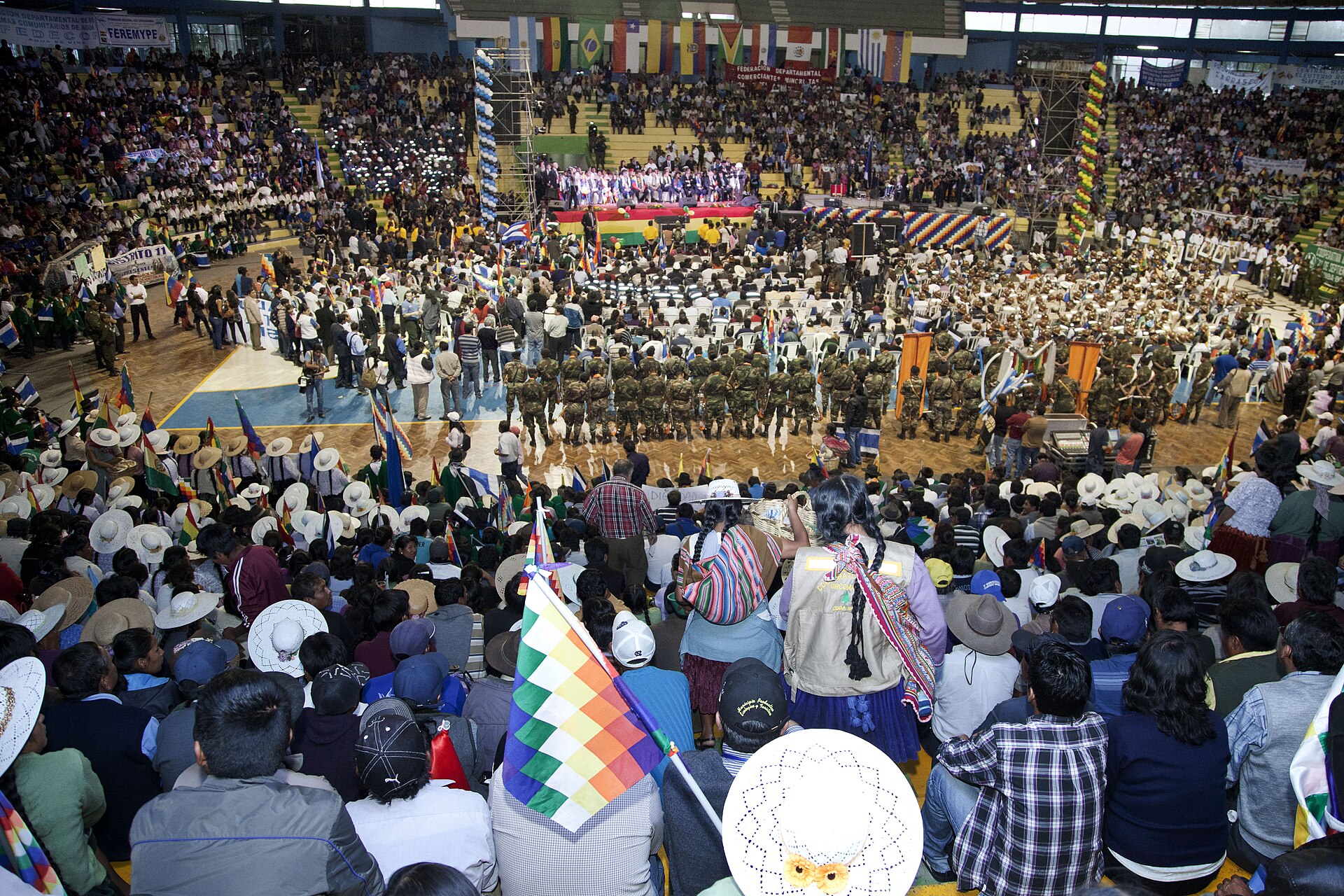
Morales spoke at the congress of his movement, Evo Pueblo, held in Lauca Ñ in Cochabamba department, where the governor of Cochabamba, Leonardo Loza, and union leaders were present, Unitel and Correo del Sur reported. “I am very afraid, I want you to know,” he told delegates, according to Correo del Sur, before saying that if his movement keeps being eliminated, armed struggle can return at any moment.
He also said he does not agree with such a path and that “the right is hinting at this”, Unitel reported. Correo del Sur adds that he later wrote on social media that his movement chose “a revolution with the vote and not with the bullet”, and that this path had avoided armed conflict in Bolivia.
In His Words (Translated From Spanish)
- “I am very afraid, I want you to know. If they keep eliminating us as a political liberation movement, but democratically, at any moment armed struggle can return.” Correo del Sur, with the same passage in Unitel.
- “We decided to make a revolution with the vote and not with the bullet.” Morales on social media, as quoted by Correo del Sur.
In a report dated Saturday, 24 October 2026, the news agency ANF quoted him saying that social sectors will rise against the government’s economic measures: “With or without leaders, we will defend the rights of the peoples.” He also complained that leaders who do not surrender are prosecuted, ANF reported.
Why Morales Is Wanted
Morales faces at least two arrest orders in Bolivia that police have not carried out, the radio network Erbol reported on Monday, 5 October 2026. In Tarija, a trial on aggravated human trafficking over a link with a minor in 2015 has yet to begin, El Deber reported.
The second order stems from protests, and Morales has said of it: “I was not at the march, I was not at the blockades,” Unitel reported. His lawyer, Elmer Bautista, calls the Tarija process “improper and illegal”, El Deber reported.
ANF says police have not captured him because he is sheltered by his supporters in the Cochabamba tropics. He has not been convicted in either case, and his side rejects both.
Timeline
- Thursday, 22 October 2026: the State Department names 15 Bolivians for visa restrictions.
- Saturday, 24 October 2026: Morales warns of armed struggle at the Evo Pueblo congress in Lauca Ñ.
- Friday, 6 November 2026: the new date reported by Correo del Sur for the march on La Paz.
The Protest Plan and the Economy
Last month Morales gave the government an ultimatum to reverse the diesel price rise and the economic policies agreed with the International Monetary Fund, ANF reported, and said protests would start on Tuesday, 13 October 2026. The protest was suspended without a new date, ANF said, and Correo del Sur reports that a march planned in Cochabamba this week was also cancelled over fears that leaders would be arrested.
No other outlet read on Sunday morning carried the 6 November date, so it rests on Correo del Sur’s report. The ombudsman, Pedro Callisaya, warned that conflicts did not fall despite the state of exception because of lasting demands over food and jobs, ANF reported.
Key Numbers
- 168: social conflict events counted by Bolivia’s ombudsman’s office from 1 July to 30 September 2026; 109 took place and 59 stayed announcements (ANF).
- US$3.978 billion: net international reserves on Friday, 16 October 2026, of which US$647 million was in foreign currency (Unitel, citing the central bank).
- Bs 11.88 per US dollar: the central bank’s official exchange rate for 24 to 26 October 2026; its website says it consolidated the full abandonment of the fixed exchange regime in June 2026.
The US Visa List He Dismissed
On Thursday, 22 October 2026, Secretary of State Marco Rubio’s statement said the State Department was imposing visa restrictions on 40 individuals in Bolivia and named 15 Bolivian nationals. The department says the policy, announced on Monday, 28 September 2026, targets people who undermine democratically elected governments through corruption or narcotrafficking, regardless of political affiliation.
Washington “stands with the government of Bolivia” against criminal influence in its courts, police and legislature, the statement says. The legal basis is Section 212(a)(3)(C) of the Immigration and Nationality Act, which lets the Secretary of State refuse a visa where entry could have serious adverse foreign policy consequences.
Who Is on the List
- Legislators: deputies Rafael Dario López Mercado and Rolando Santos Pacheco Chávez.
- Justice officials: former Attorney General Juan Lanchipa Ponce and Santa Cruz court president Aldo Ismael Quezada Cerruti, among others.
- What it is not: the statement describes no court finding against any of the 15.
At the congress Morales said that “the visa is of no use to us at all”, but that Washington uses it to “blackmail corrupt authorities, some judges, prosecutors who work with drug trafficking”. He added that those who “negotiate with the empire” become untouchable while those who do not lose their visa, Unitel and Correo del Sur reported.
The presidency’s spokesman, José Luis Gálvez, told Unitel that the US measures show “many coincidences” with investigations the government was already running, El Día reported. A visa restriction is an administrative step, not a conviction.
What It Means for You
The State Department’s Bolivia advisory, issued on Tuesday, 18 August 2026, is Level 2, “exercise increased caution”, because of crime, unrest and health. It rates Chapare Province in Cochabamba department Level 4, “do not travel”, because of crime linked to narcotrafficking, and says roadblocks are a common form of protest across the country.
Anyone driving between La Paz, Cochabamba and Santa Cruz should follow local media and the Bolivian highway agency’s map, as the advisory recommends, especially around Friday, 6 November 2026, the march date Correo del Sur reports. Large demonstrations can happen with little warning and may block transport and essential services.
For investors and companies, the political risk sits on top of foreign-currency reserves of US$647 million, below the 2026 high of US$897 million in May, and a boliviano that no longer has a fixed rate, now Bs 11.88 per US dollar. The State Department ties its visa campaign to the Shield of the Americas leaders’ statement of 22 September, so Bolivia’s internal politics now sit inside a US-backed regional security framework.
Before You Go
- Read the State Department’s Bolivia advisory of 18 August 2026 for the current levels.
- Check local news before any road trip in Cochabamba department or toward La Paz.
- Check the central bank’s official exchange rate before changing dollars, because the boliviano no longer has a fixed rate.
What Is Not Known
Neither Unitel nor Correo del Sur says who Morales believes is “eliminating” his movement or what he meant by the word “democratically” in that sentence. Both reports quote only fragments of the speech, and the two outlets’ wordings of the key sentence differ by a word.
It is not known whether Morales’s warning is a rhetorical flourish or a signal, and he said himself that he disagrees with armed struggle. No response from President Rodrigo Paz’s government to the remark had been published by Sunday morning.
It is also unclear whether the march on La Paz will go ahead on 6 November, since the date comes from one newspaper. The government said on Monday, 5 October 2026 that it was activating “collaboration at regional level” on the Morales case, Erbol reported, but no arrest operation has been announced.
Connected Coverage
Frequently Asked Questions
What did Evo Morales say about armed struggle?
At a Saturday congress he warned that “at any moment armed struggle can return” if his movement keeps being eliminated. He also said he does not agree with that path and blamed the right for hinting at it.
Is Evo Morales wanted by police?
Yes, Erbol reported at least two arrest orders in Bolivia that have not been carried out. He has not been convicted, and his side rejects the proceedings.
What is the US visa list for Bolivia?
On Thursday, 22 October 2026, the State Department named 15 Bolivians for visa restrictions and said it was restricting 40 people in Bolivia. A restriction bars visas for them and their immediate families, and it is not a conviction.
Is it safe for Americans to visit Bolivia now?
The State Department rates Bolivia Level 2, “exercise increased caution”, and Chapare Province Level 4, “do not travel”. It says roadblocks are a common form of protest, so check local media before any road trip.
When is the march on La Paz?
Correo del Sur reports that Morales’s supporters moved the march to Friday, 6 November 2026. No other outlet read on Sunday morning confirmed the date.
Sources: Unitel, 24 October 2026, Correo del Sur, 25 October 2026, ANF, 24 October 2026, ANF, ombudsman report, 24 October 2026, El Deber, Tarija trial and arrest order, Erbol, 5 October 2026, Unitel, 11 October 2026, Unitel, reserves, October 2026, El Día, 23 October 2026, Banco Central de Bolivia, official exchange rate for 24 to 26 October 2026, US State Department, press statement of 22 October 2026, US Embassy in Bolivia, policy statement of 28 September 2026, US State Department, Bolivia Travel Advisory issued 18 August 2026. All retrieved 25 October 2026.
This article was produced by The Rio Times’ automated newsroom system. How we use AI · Report an error · Editorial responsibility: Matthias Camenzind, Editor-in-Chief