Argentina’s Mattress Dollars Hold at US$268.8 Billion, Just Below the Record
ECONOMY · ARGENTINA
Key Facts
- —The country Argentina, where savers have kept dollars outside local banks for decades as a hedge against inflation, devaluations and deposit freezes.
- —What happened INDEC, the national statistics office, estimated on 29 September that residents held US$268.8 billion in foreign cash and deposits on 30 June 2026.
- —The numbers That was US$54 million more than in March and about US$8.7 billion more than a year earlier. The series peak was US$268.9 billion at the end of 2025.
- —What it means for you Argentines keep a large share of their savings in dollars outside local banks. The June data predate Inocencia Fiscal II, a second law inviting savers to deposit undeclared dollars.
- —Still open How much of the stock is cash at home rather than accounts abroad, which INDEC does not publish, and whether the new law draws savings into banks.
Argentina’s mattress dollars barely grew in the second quarter of 2026 but stayed close to a record. INDEC, the national statistics office, put residents’ foreign cash and deposits at US$268.8 billion on 30 June.
That was US$54 million more than at the end of March, according to the report published on 29 September. Holdings of households and businesses alone reached US$260.4 billion, the highest in INDEC’s series.

What INDEC counts as mattress dollars
The figure comes from the international investment position, a quarterly balance sheet of what residents own and owe abroad. Its currency-and-deposits line covers notes kept at home or in safe-deposit boxes.
It also includes bank accounts held outside Argentina. The published table does not separate cash at home from deposits abroad.
El Economista reported that INDEC builds the estimate from bank currency purchases, central bank capital flows, foreign data and tourism. La Nación cited a larger US$285.1 billion, which is INDEC’s wider “other investment” line including loans and trade credit.
A plateau after a steep climb
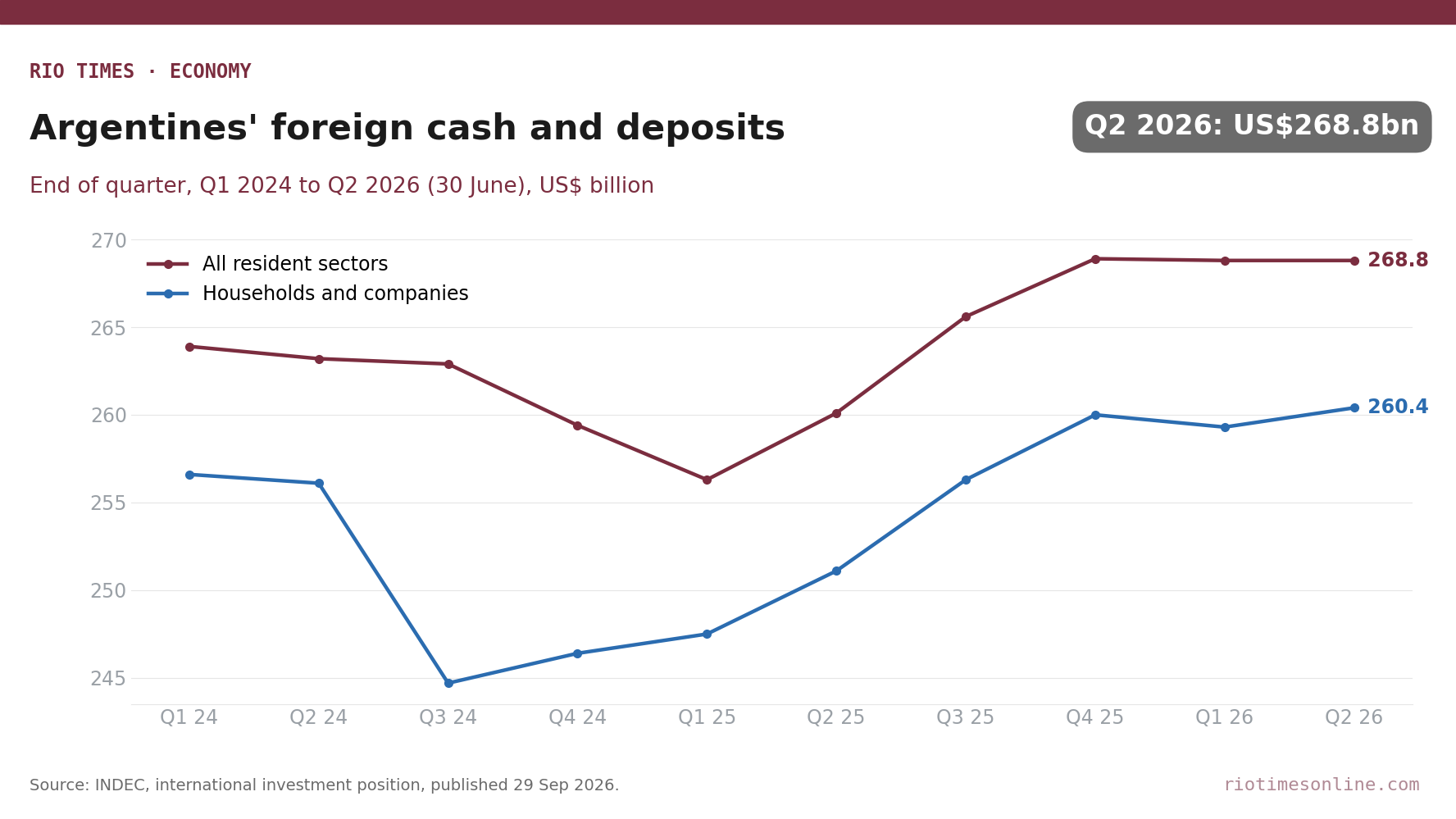
The stock rose from US$256.3 billion in March 2025 to US$268.9 billion at the end of 2025, the series peak. It has since held almost flat at US$268.8 billion.
The quarterly flow shows the slowdown. Net purchases of foreign cash and deposits were US$54 million between April and June, against US$3.8 billion a year earlier.
Households and businesses, which INDEC calls “other sectors”, held US$260.4 billion, up from US$259.3 billion in March. Their holdings fell sharply in the third quarter of 2024, coinciding with that year’s tax amnesty.
Clarín and El Economista compared the June total with US$254.4 billion a year earlier. INDEC’s revised series now puts June 2025 at US$260.1 billion, so the annual rise is about US$8.7 billion.
Twenty years of saving in dollars
The series shows how deep the habit runs. Holdings stood at US$74.3 billion in 2006 and passed US$100 billion in 2009.
They reached US$153.3 billion at the end of 2015 and US$226.6 billion at the end of 2019. Repeated inflation spikes, devaluations and the 2001 deposit freeze taught savers to keep dollars beyond the banks’ reach.
The government wants the dollars in banks
The data arrive as President Javier Milei’s government tries to draw these savings into the formal economy. Congress cleared Inocencia Fiscal II, a second Fiscal Innocence law, on 17 September, easing tax scrutiny for savers who deposit undeclared dollars.
The June figures predate that law, so they cannot show its effect yet. The external accounts look steadier: Argentina posted a US$2.2 billion current-account surplus in the quarter.
Balance-of-payments flows also added US$3.7 billion to central bank reserves. Counting all assets and liabilities, Argentina was a net creditor to the rest of the world by US$33.9 billion.
What Is Not Yet Known
INDEC does not publish how much of the US$268.8 billion is cash at home and how much sits in foreign accounts. That split matters for any effort to bring mattress dollars into local banks.
It is also unclear how many savers will use the new regime, which extends a first Fiscal Innocence law in force since January. The third-quarter reading will cover only the weeks around the law’s passage.
Sources: INDEC, Balanza de pagos, posición de inversión internacional y deuda externa, second quarter 2026 (29 September 2026); INDEC historical series, tables 15 and 18; El Economista (30 September 2026); Clarín; La Nación.
This article was produced by The Rio Times’ automated newsroom system. How we use AI · Report an error
In depth
Read More from The Rio Times