An Extremist and Conspiratorial Cocktail Against Purported New World Order in Germany
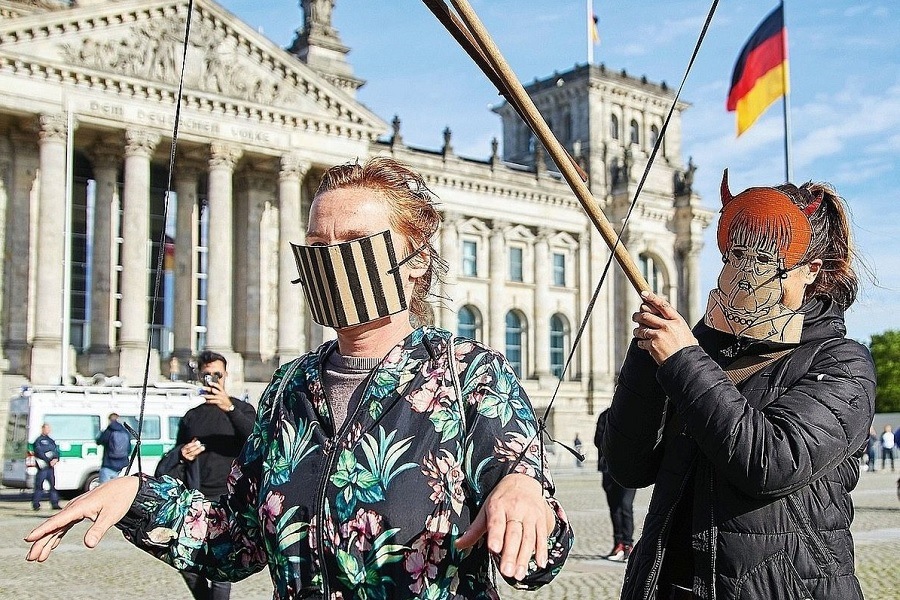
RIO DE JANEIRO, BRAZIL – They are united by their enemies. These are multitudes of heterogeneous and angered people, who share the feeling of being victims of the global elites, who would be using the outbreak of a new virus as a pretext to enrich and curtail the freedoms “of the people”. Thousands of people take to the streets in German cities against the “corona dictatorship”, in an ideological mismatch that largely transcends the left/right divide.
They represent a tiny minority but create a racket that is already being heard with concern within the walls of the Bundestag, the lower house of the German Parliament. They threaten to become a new type of populist movement, confronting the traditional parties.

The far-right, disconcerted by the pandemic, perceives in this popular dissatisfaction a political opportunity that they do not wish to waste.
Georg Gierasch, a newly unemployed 43-year-old driver, goes to one of the rallies summoned in Berlin carrying a poster on his back that reads “Widerstand [resistance] 2020”, the name of a new group that joins part of the discontent, along with a slogan: “Let us be different, the time has come”. Gierasch explains why the weekends are spent protesting on Rosa-Luxemburg Square in Berlin.
“They curtail our rights and our freedom of movement because of a flu. We’re not free to think either. We can only think about what the government says, and that scares us.” In the background, the police shout in vain through the loudspeaker: “Distance, distance!”
Gierasch shares an additional fear with many who take their anger to the street in recent days. “The government is working on a vaccine with Bill Gates and then forcing us all to take it. Anyone who doesn’t will be discriminated against on everything in their professional life, to travel…”.
Gates, for conspiracy theorists, is the visible face of evil, the man some even accuse of breeding the covid-19 virus to sell millions of vaccines. That the vaccine in question does not exist does not seem to be an obstacle to conspiracy theories gaining ground.
The growing presence of anti-Semitic messages is yet another ingredient of this conspiratorial cocktail that has sounded the alarms. A number of protesters display a yellow star on their lapel, the insignia with which the Nazis marked the Jews, with printed messages such as “no vaccination”.
“Anyone taking part in a demonstration against the restriction of fundamental rights must be aware of who is next to them and what kind of messages are being spread there,” said Josef Schuster, president of the Jewish Council in Germany, cautioning against attempts to trivialize the Holocaust.
A few meters ahead, a hippie couple, with their children, declare to be against the vaccines. “We think the measures are only an excuse to do what they want, to establish a health dictatorship and a police state where vaccines are mandatory,” she says. “The coronavirus is no more dangerous than any other flu. This is all theatrics,” he adds, who doesn’t want his name to be mentioned.
This is the third time they have joined the weekly protest. They left Mecklenburg-Western Pomerania in the north of the country, loaded with biscuits in the form of the German constitution, in which Article 5, on freedom of opinion, and Article 20, which includes the right to resist attempts to abolish the constitutional order, can be read.
They say they do not intend to travel to Berlin next Saturday because there are now enough people in their region to call a local protest. Along with militants of more or less bizarre causes, there are plain ordinary citizens expressing their frustration with the new reality.

Those who take to the streets are a clear minority in a country where citizens have broadly supported government management. However, surveys are starting to show a degree of fatigue in supporting restrictions, even though in Germany there is no official quarantine and people are allowed to go out at any time.
German control of the pandemic is perceived in many countries as a model: the health system has not been brought to a halt at any time, and the number of deaths, 7,634, is comparatively much lower than in other European nations.
In part, the experience of a pandemic, which many perceive as something remote, which has nothing to do with themselves or their families, could end up turning Germany into a victim of its own success.
The far-right, which has not yet found a political direction in a crisis that has strengthened the traditional parties, is also very much present in the protests. These may be gatherings but also walks in large groups that multiply throughout the country, defying the rules for keeping a distance.
At times they act as organizers, and other times as simple participants, without hiding their sympathy for the protests they feed. They stand as guardians of the democratic ideals and of respect for the popular will, in the face of what they consider an authoritarian course of Angela Merkel’s government. They also offer a friendly shoulder able to empathize with the concerns of ordinary citizens.
Gunnar Lindemann, Member of the Alternative for Germany (AfD) in the Berlin regional parliament, has attended three demonstrations. “I go there to speak to the people. They are very grateful that there is a deputy who will listen to them and take them seriously,” says Lindemann on the telephone.
He believes that measures to halt the spread of the virus “destroy the economy” and considers that “you have to look at Sweden”, a country that, free of confinement and with open schools and bars, has become the mecca of coronavirus denialists.
The AfD does not want to miss this train of popular discontent, after having crashed in the polls. The exploitation of the refugee crisis has lost momentum, and opposition to climate policies has not garnered the expected traction. Alice Weidel herself, the AfD bench co-leader, clarified the party line on Thursday, in a statement in which she accused the government of wanting to implement an “immunity card, which, once introduced, will also pave the way for arbitrary discrimination in many other areas”.
She added: “The coronavirus crisis should not be used to gradually build a surveillance state”.
Handbook populism
In addition to each one’s motivations, the German protests sprout populism that is classic in both substance and form. Those who take to the streets profess a contempt for the elites and in general for everything that smells like the establishment, including scientists and mainstream media, perceived as necessary collaborators to establish a state of fear that justifies the measures.
“It’s dangerous because they’re trying to implement a new narrative through conspiracy theories that say people like Bill Gates want to implement a new world order. People are spending more time at home, connected to the computer, and the Internet during this crisis is filled with fake news,” says Sandro Witt, a researcher at the Mobit association, which specializes in studying right-wing extremism.
Alternative Internet forums are the conveyor belt for the spread of fake information. Facebook, Telegram, and YouTube are the main channels where arguments against the German government are repeated, albeit with a global calling.
The conspiracy is global, and the powerful will crush those beneath them even more, they say. It is very clear, when talking to people on the street, what sources they drink from, because many reiterate the arguments circulating across the Internet in an almost verbatim fashion.
Source: El País
More: Brazil news in English, every day from The Rio Times.
This article was produced by The Rio Times’ automated newsroom system. How we use AI · Report an error · Editorial responsibility: Matthias Camenzind, Editor-in-Chief
Brazil runoff, Sunday, October 25: Brazil runoff start time and results schedule. Latest: Brazil runoff polls, Flávio 51%, Lula 49%.