Florianópolis Tops Brazil’s Safest Cities Ranking of 27
BRAZIL · SAFETY
The Brazil capital safety ranking is one of the most-requested data sets among foreign residents and visitors, and the new Atlas da Violência 2026 has just refreshed it. The Tuesday release by the IPEA economic-research institute and the Brazilian Public Security Forum, the FBSP, ranks all 27 state capitals plus the federal district by homicide rate per 100,000 residents.
The story is one of declining national averages alongside stark regional gaps.
Brazil — Key Facts
- The headline: The Brazil capital safety ranking from the Atlas da Violência 2026 places Florianópolis at the top with 9.7 homicides per 100,000 residents in 2024, with Salvador at the bottom at 52.7.
- The national story: Brazil’s overall homicide rate fell to 20.1 per 100,000 in 2024, the lowest reading since the series began in 2014, a 32.8 percent reduction over 11 years.
- The capital extremes: Among the 27 capitals, Florianópolis (9.7), Brasília (10.9), Curitiba (13.2), Goiânia (14.7) and São Paulo (15.3) are safest, while Salvador (52.7), Maceió (45.9), Macapá (45.6), Recife (45.5) and Fortaleza (42.2) rank worst.
- The regional pattern: Seventeen of the 20 most violent Brazilian cities with over 100,000 residents are in the Northeast, with Maranguape in Ceará topping the national list at 87.2 per 100,000.
- Latin American impact: Brazil’s homicide trend bends toward regional best-practice levels but remains well above Argentina, Chile and Uruguay norms.
The Brazil capital safety ranking from top to bottom
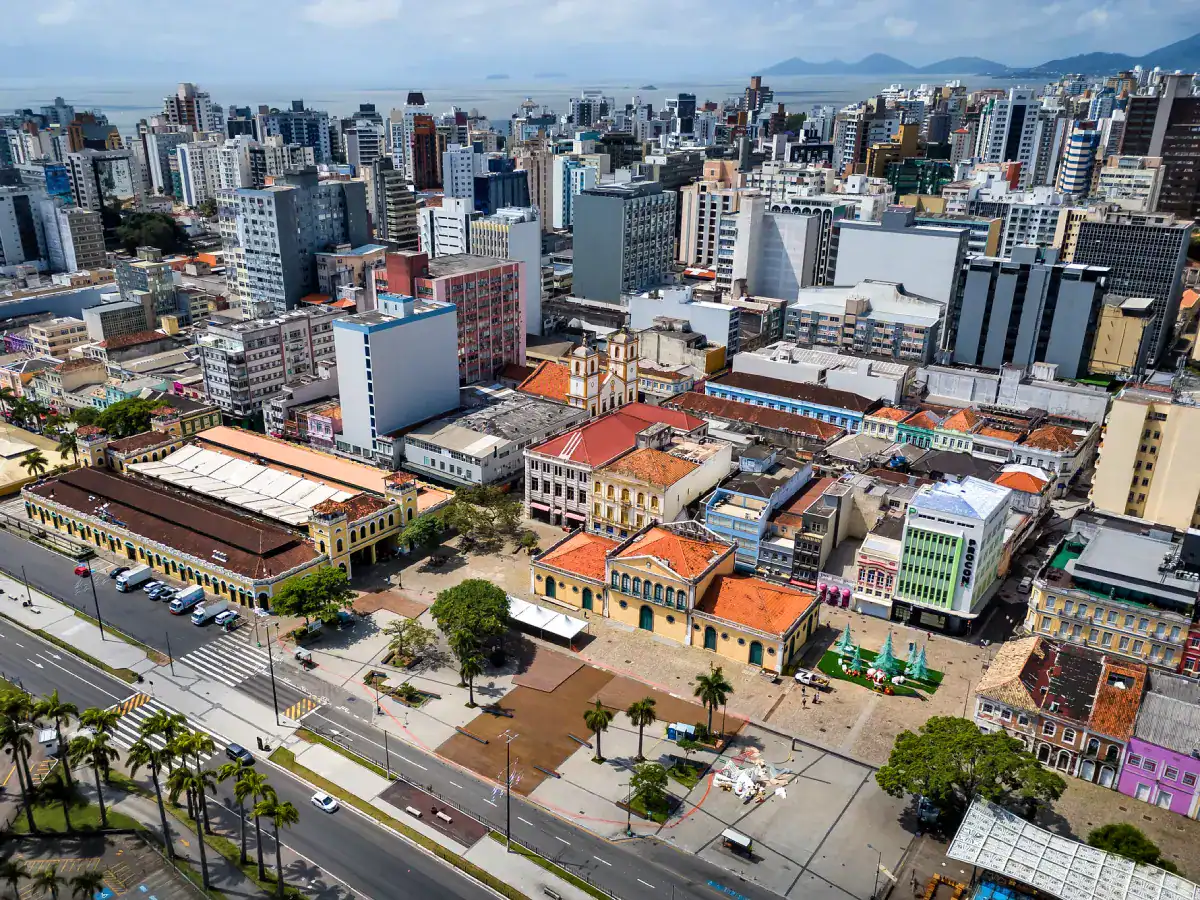
Florianópolis leads the safest-capitals list. The Santa Catarina capital recorded 9.7 homicides per 100,000 residents in 2024, far below the national average of 20.1.
The result confirms why the city has become the country’s leading digital-nomad and remote-work destination, with its dense expat neighborhoods in Lagoa da Conceição and Campeche.
Brasília follows in second place at 10.9 per 100,000, with Curitiba third at 13.2, Goiânia fourth at 14.7 and São Paulo fifth at 15.3. The five safest capitals all sit below the national reference of 23.4 homicides per 100,000 calculated for capital-level comparison.
Belo Horizonte, Vitória, Campo Grande and Cuiabá sit in the next safety tier above the national average.
Rio de Janeiro is the standout case among large international-tourism capitals. The Atlas does not publish a separate rank for Rio in the version cited by major Brazilian outlets, and the city sits in the middle-to-upper safety tier within the national distribution.
The city has been the focus of multiple high-visibility security operations and policy debates through 2025 and 2026.
The most violent capitals on the Brazil capital safety ranking
Salvador is the most violent Brazilian capital at 52.7 per 100,000. The Bahia capital nevertheless recorded a sharp decline of 11.1 percent year-on-year from 59.3 in 2023.
Over 11 years the cumulative reduction in Salvador is 8.5 percent, with the city continuing to absorb the broader national downward trend more slowly than capitals elsewhere.
Maceió follows at 45.9, Macapá at 45.6, Recife at 45.5 and Fortaleza at 42.2, with the five least-safe capitals all in the Northeast and North regions. The contrast with the safest five is stark, with the Florianópolis to Salvador gap at roughly 5.4 times.
The numbers reflect the persistence of regional inequalities in Brazilian public security.
Salvador concentrates the largest absolute number of homicides among capitals at an estimated 1,354 in 2024. Its rate, while leading capitals, sits below several smaller cities in the Bahia interior.
The proportional rate distinguishes Salvador from its surrounding region rather than placing it at the very top of the national municipal list.
Why the regional pattern matters
At the state level, Amapá leads with a homicide rate of 45.6 per 100,000, followed by Bahia at 45.4, Pernambuco at 44.1 and Ceará at 42.2. At the other extreme, São Paulo state sits at 8.0, Santa Catarina at 8.4 and the Federal District at 10.9.
The lowest-rate states are concentrated in the South and Southeast, the highest in the Northeast and North.
Seventeen of the 20 most violent Brazilian cities with over 100,000 residents are in the Northeast. Maranguape in Ceará tops the national list at 87.2 per 100,000, with Jequié in Bahia second at 79.4 and the other six cities in the top 10 split between Ceará, Bahia and a single Pernambuco entry.
Six of the 10 most violent cities sit inside Bahia.
At the safest end, Jaraguá do Sul in Santa Catarina holds the national record for cities over 100,000 residents at 2.0 homicides per 100,000. Brusque in Santa Catarina is next at 2.6, with Santa Bárbara d’Oeste in São Paulo state at 3.2, Lavras in Minas Gerais at 3.6 and Bragança Paulista in São Paulo state at 3.8.
The bottom of the safety distribution clusters in the South and Southeast.
What the data say about violence against women
The Atlas tracks homicides of women separately. The national rate stood at 3.4 per 100,000 women in 2024, with Bahia recording 5.4 (well above the national reference) despite showing a 10 percent reduction year-on-year.
The states with the highest female-homicide rates were Roraima at 12.6, Rondônia at 5.7 and Ceará at 5.7.
For younger Brazilians the picture is harsher. The national rate of homicides per 100,000 youths was 101.8 in Bahia, 114.7 in Amapá and 10.7 in São Paulo state.
The Atlas points to the persistence of structural inequalities and unequal access to public services as drivers of the youth-violence concentration.
Geographic factors emerged as influential. Cities along major federal highways and ports figure prominently in the top of the violence rankings.
The Atlas highlights drug-trafficking and arms-flow corridors as significant explanatory variables for cities such as Jequié, Juazeiro and Feira de Santana in Bahia.
More: Brazil news in English, every day from The Rio Times.
Regional read on the Brazil capital safety ranking
The Brazilian national rate of 20.1 per 100,000 is the lowest since the IPEA series began in 2014, and the downward trend partly converges with regional best practice. Chile recorded 6.7 homicides per 100,000 in 2024, Argentina 4.6 and Uruguay 8.6.
Brazil remains well above those three peers but has narrowed the gap meaningfully over the decade.
The IPEA report emphasizes that targeted public-security policy, monitoring system expansion and prevention efforts in several states drove the national decline. The unequal distribution of results, however, reinforces the case for regional strategies, the report says.
Some states have seen sharp declines, others have stagnated and a few have worsened.
For foreign residents the data confirm the practical city-selection logic many expatriates already follow. Florianópolis is the country’s safest capital and the leading digital-nomad destination, while São Paulo and Curitiba combine economic depth with relatively low violent-crime rates by Brazilian standards.
The Northeast capitals require a more granular neighborhood-level read than the headline rate alone provides.
Key Facts
— Florianópolis is the safest Brazilian capital according to the Atlas da Violência 2026, with a homicide rate of 9.7 per 100,000 residents in 2024. The Santa Catarina capital sits well below the national average of 20.1 and is the leading destination for digital nomads and remote-work expats.
— Salvador is the most violent Brazilian capital at 52.7 homicides per 100,000 residents in 2024. The Bahia capital nevertheless posted an 11.1 percent year-on-year decline from 59.3 in 2023, the largest single-year improvement among the most violent capitals.
— Brazil’s 20.1 per 100,000 rate remains well above its three southern neighbors. Chile recorded 6.7, Argentina 4.6 and Uruguay 8.6 in 2024.
— The Brazilian rate has fallen 32.8 percent over the past 11 years, narrowing but not closing the gap with regional best practice.
— Among cities with over 100,000 residents, Jaraguá do Sul in Santa Catarina is the safest at 2.0 homicides per 100,000. Brusque, also in Santa Catarina, comes second at 2.6, followed by Santa Bárbara d’Oeste in São Paulo state at 3.2.
— The full report is available on the IPEA institutional repository. It is co-produced annually by the Instituto de Pesquisa Econômica Aplicada and the Fórum Brasileiro de Segurança Pública.
— The 2026 edition, coordinated by Daniel Cerqueira and Samira Bueno, runs 170 pages and was released on May 26, 2026.
Connected Coverage
For the broader expat landscape, see our piece on expat communities in Brazil 2026. Also read our coverage of the São Paulo PCC operation and the five-country Santiago security pact.
The Rio Times — Friday, May 29, 2026 — 05:00 BRT — By Sofia Gabriela Martinez
This article was produced by The Rio Times’ automated newsroom system. How we use AI · Report an error · Editorial responsibility: Matthias Camenzind, Editor-in-Chief
The Florianópolis Guide
What The Rio Times publishes for foreigners in Florianópolis, Brazil.
This month
Living in Florianópolis
- Cost of Living in Florianópolis 2026: Expensive Island, Cheap Rent
- Palhoça, Near Florianópolis, Ranks Among Brazil's Best for Cheaper Rent
- Brazil's $1,500 Digital Nomad Visa Pulls Remote Workers to Rio and Florianópolis
- Living in Florianópolis: The 2026 Expat Guide
Understand Brazil