Uruguay Maldonado Homelessness Reaches About 800

SOCIETY · URUGUAY
Key Facts
- —The country Uruguay, a stable nation of about 3.4 million. Maldonado department on the Atlantic coast holds Punta del Este, the country’s main summer resort.
- —What happened On 2 October Social Development Minister Gonzalo Civila told Teledoce that street homelessness in Maldonado has “grown a lot”. About 800 people are estimated to sleep rough there.
- —The numbers Police identified 809 people on the street between February and late September, El Observador reported on 26 September. The police register stood at 462 in July.
- —What it means for you Beach camp removals by police and the coastguard continue. The minister says shelter help is now available 24 hours a day in every department.
- —Still open Whether the 150-bed emergency centre on Route 39 stays open now that the winter red alert ended on 1 October.
Maldonado homelessness has risen sharply this year, and Uruguay’s government now says so openly. On Friday 2 October, Social Development Minister Gonzalo Civila told the broadcaster Teledoce it had “grown a lot”.
Teledoce put the estimate at about 800 people sleeping rough. The admission comes one day after the government ended its winter “red alert”, the emergency regime that allowed compulsory transfers to shelters.
What the minister said
Civila heads Mides, the Ministry of Social Development, which runs Uruguay’s shelters. He said Mides will keep “scaling up” services, as the problem “grew a lot” in Maldonado and some other interior departments.
He said Mides works with the Intendencia, Maldonado’s departmental government, to keep the capacity built during the alert. His quote reached the public through Teledoce and has not been repeated in other outlets so far.
How the count has grown
Police figures show how Maldonado homelessness has grown, though they measure different things. In April, deputy police chief Jorge Guerra cited about 360 people in a police census, PuntaNews reported on 22 September.
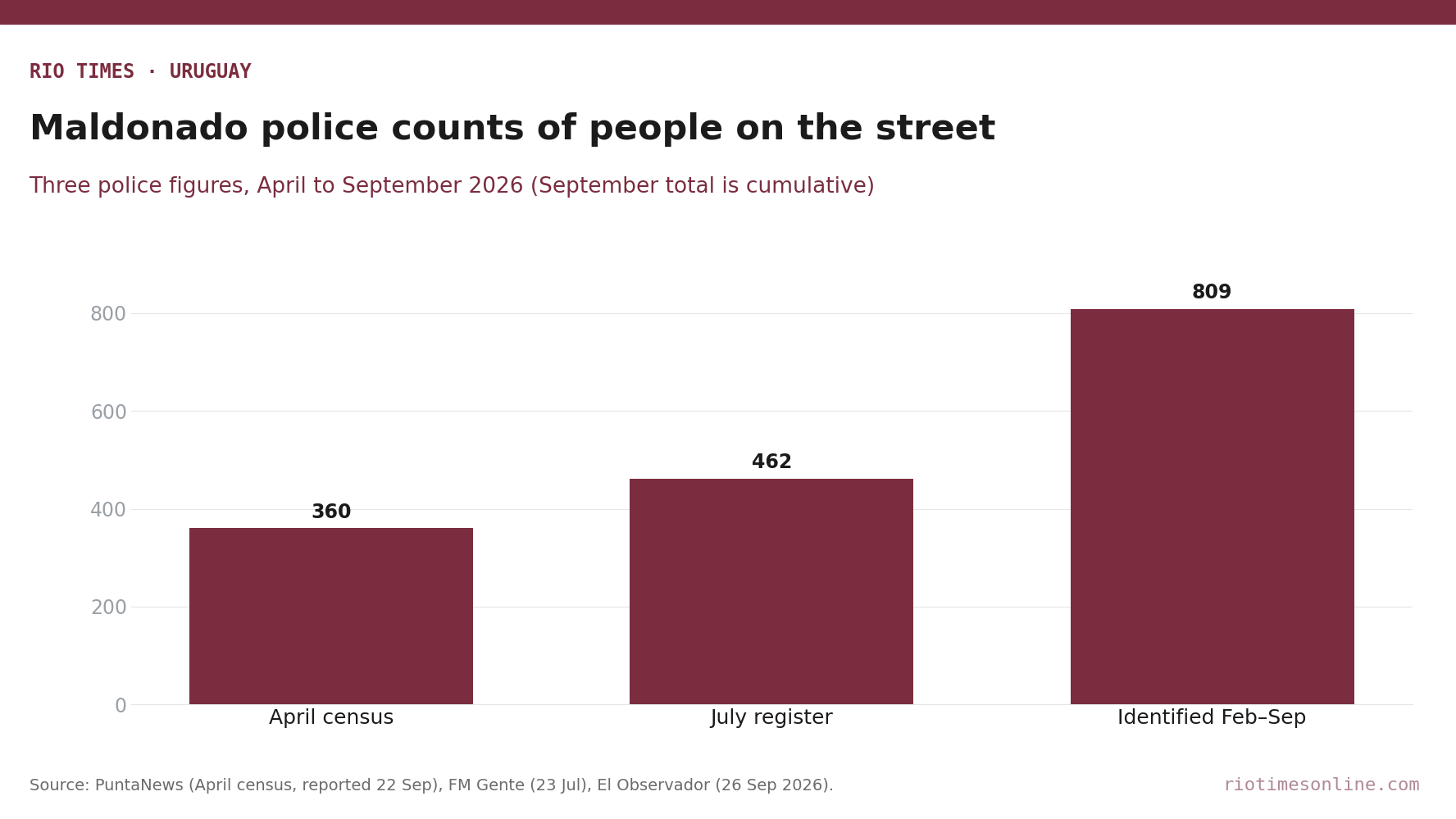
By 23 July, police chief Víctor Trezza told FM Gente the register held 462 people. On 26 September El Observador reported 809 people identified by police since February, 711 of them after the red alert began.
That 809 is a running total, not a snapshot, and some people were counted more than once in interventions. El Observador’s own estimate was 700 to 800 people living outdoors, mainly in Maldonado city, Punta del Este and San Carlos.
The same report found 85 percent are from Maldonado or long settled there, and 6 percent came from Montevideo. That points to a local problem rather than an influx from elsewhere.
The red alert ends
President Yamandú Orsi declared the cold-weather red alert on 6 May. The presidency announced its end from 1 October, citing the close of winter.
Nationwide, more than half a million shelter places were filled during the alert, El Observador reported, citing the presidency and Sinae. The Interior Ministry now plans wider use of the misdemeanours law against sleeping in public spaces.
In Maldonado, the Intendencia set up an evacuation centre on Route 39 near the racecourse. It holds about 150 people and took more than 160 on the coldest nights, El Observador reported.
Pressure before the summer season
Tourism is Maldonado’s main economic activity, and the summer season is approaching. On 18 September the coastguard removed seven makeshift camps from Punta del Este beaches, Telenoche reported.
There is a stabiliser in the system. Civila said Mides now offers 24-hour help in every department, where before only five interior departments had it.
Opposition deputy Diego Echeverría of the National Party has asked Mides for shelter numbers and plans for 2027. On the resort’s economy, read our Punta del Este cost-of-living guide; on the country, see Uruguay Explained.
What Is Not Yet Known
It is unclear whether the Route 39 centre will stay open past October. Mides’s departmental director Paula Caballero warned that closing it would leave its residents on the street.
There is also no single official count of Maldonado homelessness. Mides has not yet answered Echeverría’s request or published a new departmental survey.
Sources: Teledoce, interview with Minister Gonzalo Civila, 2 October 2026; Presidencia de la República, end of the red alert, 1 October 2026; El Observador, 26 September and 1 October 2026; FM Gente and Cadena del Mar, 23 July 2026; PuntaNews, 22 September 2026; Telenoche, 18 September 2026.
Editorial responsibility: Matthias Camenzind, Editor-in-Chief · Editorial standards · Report an error