Suez Canal Explained 2026
The Suez Canal carries a large share of world trade, and its revenue is rising again as major container lines plan to send ships back through it.

EGYPT · SUEZ CANAL
The Suez Canal is the Egyptian shipping channel that spares vessels between Asia and Europe the long way round Africa. The International Monetary Fund (IMF), the global lender, said on 7 March 2024 that it normally passes about 15 percent of global maritime trade volume.
It matters to US readers now because the Suez Canal Authority (SCA), the Egyptian state body that runs it, said on 28 June 2026 that revenue reached US$4.67 billion in the 2025/26 fiscal year, about half of the record. Big container lines are also moving services back onto the route in stages from this December, which shapes the paths that goods take to markets such as the United States.
Key Facts
- Who The Suez Canal Authority, Egypt’s state operator, runs the canal under chairman Osama Rabie.
- What Maersk (Danish) and Hapag-Lloyd (German) container lines are returning services to the Suez route from December.
- Where An Egyptian waterway linking the Mediterranean and the Red Sea, open since 1869.
- Why it matters Canal revenue rose 23% in 2025/26, adding to Egypt’s foreign currency earnings.
- As of 25 November 2026, 13:00 GMT
The Suez Canal carries a large share of world trade, and its revenue is rising again as major container lines plan to send ships back through it.
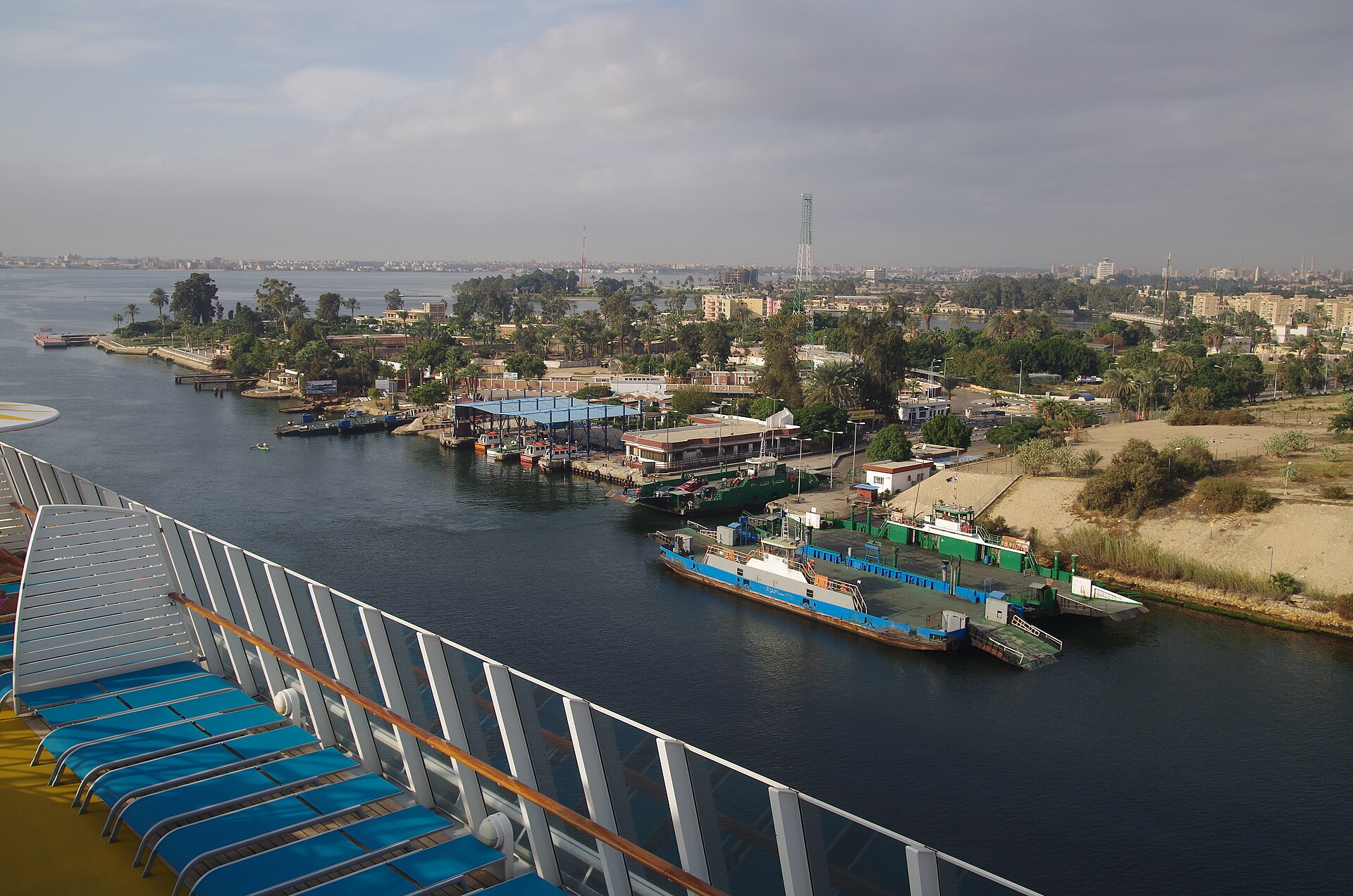
What Is the Suez Canal?
The SCA says the canal opened to navigation on 17 November 1869, when it was 164 km long and 8 m deep. Today the SCA gives its length as 193.30 km and its depth as 24 m.
It can take ships of up to 240,000 deadweight tonnes, a measure of how much cargo a vessel can carry. The SCA sets the permissible draft, meaning the depth of hull below the waterline, at 66 feet.
The SCA says a major expansion, whose first dredger went to work on 5 November 2014, added a 35 km parallel channel beside the old one. The new channel is 24 m deep and 317 m wide at water level, it says.
The SCA also deepened existing western bypasses of 37 km to the same depth, and it puts the overall project length at 72 km. The Suez Canal Economic Zone (SCZONE), the special economic area linked to the waterway, was established under Egyptian Law 83 of 2002 and revised in 2015, according to the zone authority.
How Much Does Egypt Earn From It?
Osama Rabie, the SCA chairman, said in a television interview on Sunday 28 June 2026 that canal revenue was US$4.67 billion in the 2025/26 fiscal year, which ended on 30 June 2026. That was up 23% on the year before.
Rabie said revenue fell in 2024 because of tensions in the Red Sea and the Bab al-Mandeb strait, the narrow sea gate at its southern end. The record was US$9.4 billion in 2023, he said, so the latest figure is about half of the peak, as our earlier report on revenue still below the peak showed.
Opening the 15th International Maritime Transport and Logistics Conference (MARLOG), an Egyptian shipping industry gathering, on 8 February 2026, Rabie said 1,315 ships with 56 million net tons (a measure of a ship’s cargo-carrying space) passed from 1 January to 8 February 2026. In the same period a year earlier the canal handled 1,243 ships and 47 million tons, he said.
Rabie put revenue for that period at US$449 million, against US$368 million a year earlier. SCA projections point to about US$10 billion in the 2027/28 financial year, according to Rabie’s 28 June interview.
What Happened When Ships Left?
The IMF said in a blog post titled Red Sea Attacks Disrupt Global Trade, dated 7 March 2024, that Suez Canal trade volume dropped by 50 percent year on year in the first two months of 2024. Transit around the Cape of Good Hope, the long way round Africa, surged by an estimated 74 percent above the previous year’s level, it added.
Rabie, speaking at the MARLOG conference on 8 February 2026, called 2024 a “year of testing” because of the Red Sea disruption. He said the canal has “redefined itself” as a sophisticated logistics system.
The danger has not gone away. Yemen’s internationally recognised government said that on 11 August 2026 Houthi missiles hit the Egyptian-owned cargo ship Tihamah in the Bab al-Mandeb strait, with the Houthis being the armed group that holds northern Yemen.
The government said at least six people were killed and ten wounded, while the Houthis did not name the Tihamah, and their media said they had hit an unnamed Saudi ship carrying military equipment. Our explainer on the Houthis and the Red Sea sets out the wider background.
A different kind of blockage came in March 2021, when the container ship Ever Given stuck across the waterway. It was refloated on 29 March 2021 after about six days.
Are the Ships Coming Back?
Maersk, the Danish container line, said in a customer advisory on 16 November 2026 that its AE2 service, one of its named Asia-Europe routes, moves back to the Suez route from 4 December 2026. The advisory says AE3 follows from 20 December 2026 and AE1 from 14 January 2027.
Maersk runs the Gemini Cooperation, a shared Asia-Europe shipping network, jointly with Hapag-Lloyd, the German container line. Our earlier report on Hapag-Lloyd returning to the canal covered the German line’s first transits.
In September the two lines announced four more services, joining two already using the canal. ME1, a service between India and Europe, followed with first sailings on 4 and 13 November.
The carriers said the return depends on regional security conditions and on continued stability in the Red Sea. That condition matters because the Tihamah attack on 11 August 2026 showed that the threat in the Bab al-Mandeb strait had not ended.
The schedule is staged, with one service in December, one later that month and one in January 2027. Each switch is a dated test of whether the route holds.
What It Means for US Readers
The canal does not carry a US-specific tariff, so Americans do not pay it directly. What changes with the route is the path that goods take, which shapes freight costs and delivery times in general terms, though we have no figures on the size of the effect.
Goods bound for US East Coast ports from Asia can use either the Suez route or the Cape of Good Hope route. Maersk and Hapag-Lloyd say their choice depends on regional security conditions.
The next dated checkpoint is 4 December 2026, when Maersk’s AE2 service moves back to the Suez route. Further switches follow on 20 December 2026 and 14 January 2027, according to the advisory of 16 November 2026.
The SCA reports its revenue in US dollars, which makes the canal one source of the foreign currency that Egypt needs. For the wider picture, see our explainers on Egypt’s geopolitics and on Egypt’s natural resources.
What Is Not Known
Revenue by ship type and toll rates are not in the figures we could open. We therefore cannot say how much of the SCA’s income came from container ships, tankers or other vessels.
It is not known whether the carriers’ return will hold, since Maersk and Hapag-Lloyd tie it to regional security and to stability in the Red Sea. The Houthis have not named the Tihamah, so their intentions for shipping are not on the record.
We also cannot say whether the SCA projection of about US$10 billion for 2027/28 will be met, because it is a projection and not a result. The IMF figures we opened date from March 2024, so we have no current count of ships taking the Cape route.
Frequently Asked Questions
What is the Suez Canal?
It is an Egyptian shipping channel run by the Suez Canal Authority. It lets ships between Asia and Europe avoid the longer route round Africa.
Who runs the Suez Canal?
The Suez Canal Authority, an Egyptian state body, runs it. Its chairman, Osama Rabie, reports the revenue and traffic figures.
Why did ships leave the canal?
Attacks and tensions in the Red Sea and the Bab al-Mandeb strait led many carriers to choose the route round the Cape of Good Hope. The IMF tracked the shift in early 2024.
Are container lines returning to Suez?
Maersk and Hapag-Lloyd say they are moving services back in stages. They tie the return to regional security conditions and to stability in the Red Sea.
Does the canal affect shipping to the United States?
Goods bound for US East Coast ports from Asia can use either route, so carriers’ choices shape delivery routes in general terms. We have no figures on the effect.
Sources: Suez Canal Authority, Canal Characteristics (undated); Suez Canal Authority, New Suez Canal (undated); International Monetary Fund, Red Sea Attacks Disrupt Global Trade (7 March 2024); Suez Canal Economic Zone Authority, About Us (undated); Suez Canal Authority chairman Osama Rabie (interview of 28 June 2026 and MARLOG opening of 8 February 2026); Maersk customer advisory (16 November 2026); Yemen’s government statement on the Tihamah attack (11 August 2026).
This article was produced by The Rio Times’ automated AI newsroom. Editorial responsibility: Matthias Camenzind, Publisher and Editor-in-Chief. The Rio Times also runs Ask Rio Times, which answers from 100,000+ of our own articles, the daily Latin America Power Map, and prediction-market odds on elections and markets.. How we use AI · Report an error
Part of our ongoing coverage
Africa: The New Scramble — the great-power contest over the continent.
Horn of Africa and the Red Sea
- Horn of Africa 2026: Why It Matters and Who Backs Whom
- Ethiopia’s Neighbors Explained, Ports, Eritrea, Somalia
- Eritrea Explained 2026, a Red Sea Country Guide
- Somalia Explained: Al-Shabaab, Somaliland, the Ports and the Fight Over a 2026 Vote