
PERU · MINING AND SECURITY
Key Facts
- The country Peru is a gold-producing country, and the authorities treat illegal gold mining in its Amazon region of Madre de Dios as an environmental and organised-crime problem.
- Why it matters Illegal gold can feed global supply chains, and Washington and Lima have discussed cooperation against illegal mining.
- Why now The Yarinal operation became public on 26 October 2026, days after Interior Ministry reports of two other large raids in the same district.
- What happened Soldiers, police and prosecutors destroyed more than 30 camps, 12 dredges and 12 motorcycles in the Yarinal sector next to the Tambopata National Reserve.
- The numbers Interior Ministry reports of 22 and 24 October count 68 camps destroyed in the same district, with equipment valued at about US$4.8 million in total.
- What it means for you The raids target the logistics of criminal gold networks, and US-Peru cooperation on illegal mining is widening.
- Still open How many people were arrested, whether the miners return, and what the Yarinal equipment was worth.
- Power Index Peru ranks 5th of 14 in The Rio Times Latin America Power Index, with 54.7 points (October 2026 edition).
In Plain English
Tambopata National Reserve is a protected area in the Madre de Dios region of the southern Peruvian Amazon, and its buffer zone is the ring of land around it where activities are restricted. A dredge is a floating suction pump that pulls gold-bearing sediment from a riverbed.
The Unified Command is a joint force of the national police and the armed forces that the Interior Ministry uses against organised crime. The Specialized Environmental Prosecutors’ Offices, known as FEMA, are the public prosecutor units that investigate environmental crime.
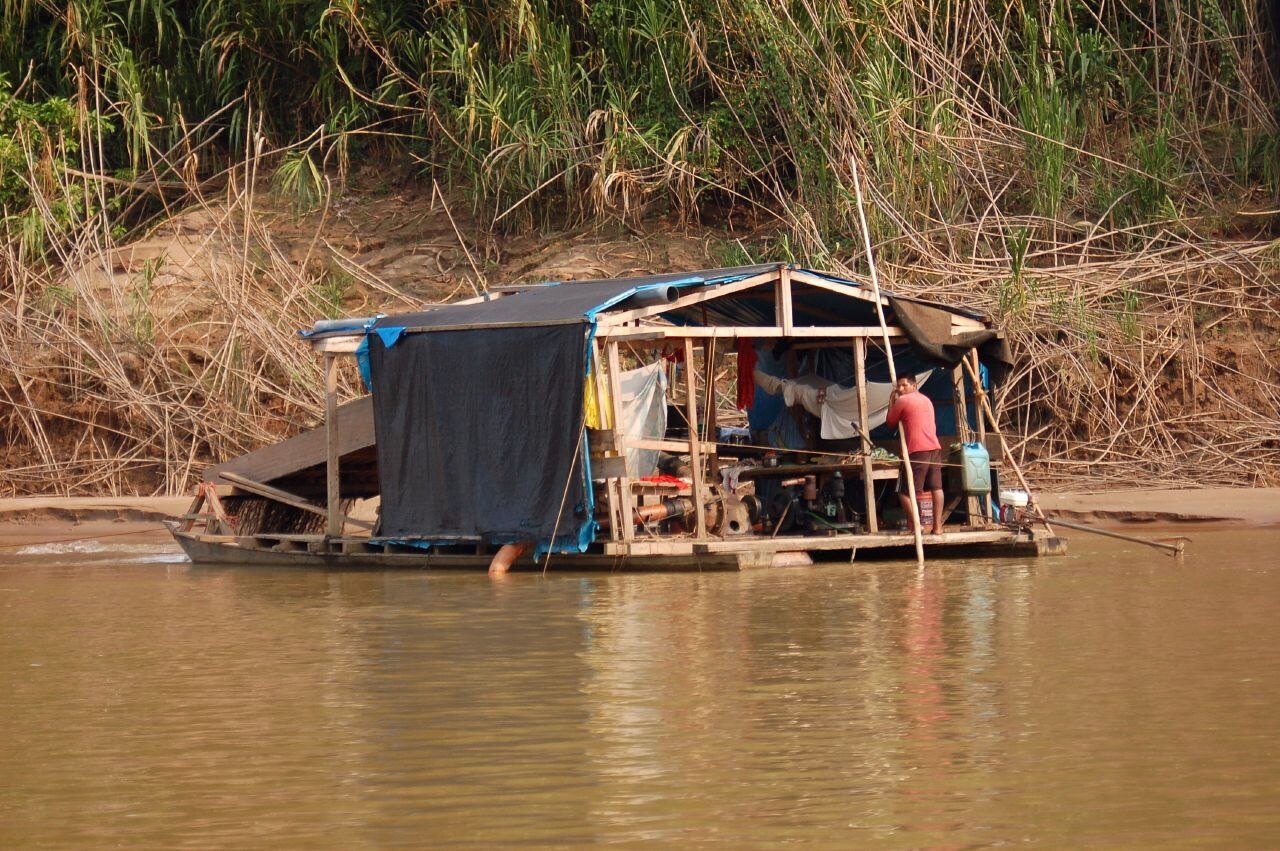
Peruvian soldiers, police and prosecutors destroyed more than 30 illegal gold-mining camps in the Yarinal sector of Madre de Dios, in the buffer zone of the Tambopata National Reserve, RPP reported on 26 October 2026 after joining the operation. They also destroyed 12 dredges and 12 motorcycles and seized a radio the miners used to track the force.
Peru and the United States have been widening cooperation against illegal mining, and the US ambassador and the head of US Southern Command discussed it with Peru’s defence minister on 14 October 2026. The Yarinal raid follows Interior Ministry reports on 22 and 24 October of other operations in the same district of Inambari.
What Was Destroyed
RPP, which took part in the operation, reported that more than 30 camps, 12 dredges, 12 motorcycles and other gold-extraction equipment in Yarinal. The raid took place in the district of Inambari, in Tambopata province, and the report gives no value for the equipment.
The Interior Ministry reported on 24 October that two joint police and army operations destroyed 33 camps, 32 motors, 32 rafts, 32 hoppers, 15 pits and 6,100 gallons of diesel in the sectors of Platanal and Mega 16. It valued the equipment at S/9,573,200 (US$2.78 million at the central bank interbank selling rate of S/3.4487 per US dollar on 23 October).
An earlier operation reported on 22 October in the sectors of Puente Caimito, Rosita and Cantonera destroyed 35 camps, 32 rafts, 32 hoppers, 32 motors and 5,760 gallons of diesel. The ministry valued that equipment at S/7,097,655 (US$2.06 million at the same rate).
Who Led the Operation
Supreme Deputy Prosecutor Ronald Flores, attached to the office of the Prosecutor General, led an operation in Inambari in which two people were arrested in the act and two escaped, RPP reported on 25 October. Frank Almanza Altamirano, national coordinator of the Specialized Environmental Prosecutors’ Offices, took part and told RPP the miners were working a suction pump when they were caught.
In the Yarinal raid, Flores said the suspected miners knew the movements of police and soldiers, surrounded agents to recover their belongings and talked over a radio in Quechua. Several soldiers and the prosecutor leading the operation understand Quechua, and RPP reports they could follow the conversations.
Prosecutor General Tomás Gálvez Villegas has set a goal of removing illegal mining from the Tambopata National Reserve completely by the end of the year, according to the Public Prosecutor’s Office as cited by RPP. Interior Minister César Astudillo heads the ministry behind the Unified Command, which the ministry says will keep running interdiction operations in Madre de Dios and elsewhere.
The US Link
Defence Minister Rafael Belaunde met US Ambassador Bernie Navarro and General Francis L. Donovan, the head of US Southern Command, in Iquitos on 14 October 2026, according to the Defence Ministry. They discussed cooperation against transnational organised crime and illegal mining, including under the Americas Counter Cartel Coalition.
Peru formally joined the Shield of the Americas initiative on 10 September 2026, the Defence Ministry says, and the framework covers intelligence sharing, military cooperation and border security. The earlier talks are covered in Peru and US Step Up Fight on Illegal Mining.
Why the Reserve Matters
Peruvian authorities treat illegal mining in Madre de Dios as an environmental crime, and the Interior Ministry says it destroys seized equipment under legal procedures meant to protect the environment and biodiversity. An earlier clash in the La Pampa mining area is covered in Peru Officer, 3 Suspects Killed in Amazon Mining Clash.
The Interior Ministry says its operations aim to weaken the logistical arm of the criminal organisations that exploit natural resources illegally. Destroying dredges, rafts and fuel hits the equipment that miners need, although the machines can be replaced if the camps are not held.
What It Means for You
For US readers, the raids show Peru and Washington working on the supply side of illegal gold, with the US ambassador and Southern Command already in talks with Lima. Illegal gold mining in the Amazon is a crime the two governments now discuss together, and the reports reviewed give no figures on how much of it reaches US buyers.
The reports reviewed mention no travel restrictions for Puerto Maldonado or the reserve. More Peru news is on the Peru news page.
What Is Not Known
RPP does not give the date of the Yarinal operation or a value for the equipment destroyed, and the sources reviewed do not say how many people were arrested there. It is also not clear whether the Yarinal camps are separate from those counted in the Interior Ministry notes, which name other sectors.
It is not known whether the miners will return once the troops leave, or whether the end-of-year goal for the reserve is realistic. Nor is it known what the US and Peru will do together beyond the talks held on 14 October.
More: Brazil news, every day from The Rio Times.
Frequently Asked Questions
How many illegal mining camps did Peru destroy?
RPP reported on 26 October 2026 that more than 30 camps were destroyed in the Yarinal sector, beside the Tambopata National Reserve. The Interior Ministry reported 33 camps on 24 October and 35 on 22 October in other sectors of the same district.
Where is the Tambopata National Reserve?
It is a protected area in the Madre de Dios region of the southern Peruvian Amazon. The Yarinal sector lies in its buffer zone, in the district of Inambari.
Who carried out the operation?
The Army, the national police and the public prosecutor’s office took part, with prosecutors leading in the field, according to RPP. The Interior Ministry says its Unified Command, which joins police and armed forces, runs such interdiction operations.
Why is the US involved in Peru’s fight on illegal mining?
Peru’s defence minister met the US ambassador and the head of US Southern Command on 14 October to discuss cooperation against illegal mining and organised crime. Peru joined the Shield of the Americas initiative on 10 September 2026.
How much was the destroyed equipment worth?
The Interior Ministry valued the equipment in its 24 October report at about US$2.78 million and in its 22 October report at about US$2.06 million. No value has been given for the Yarinal operation.
Sources: RPP, 26 October 2026; RPP, 25 October 2026; Interior Ministry, 24 October 2026; Interior Ministry, 22 October 2026; Defence Ministry, 14 October 2026; Central Reserve Bank of Peru, interbank exchange rate, 23 October 2026.
This article was produced by The Rio Times’ automated newsroom system. How we use AI · Report an error · Editorial responsibility: Matthias Camenzind, Editor-in-Chief