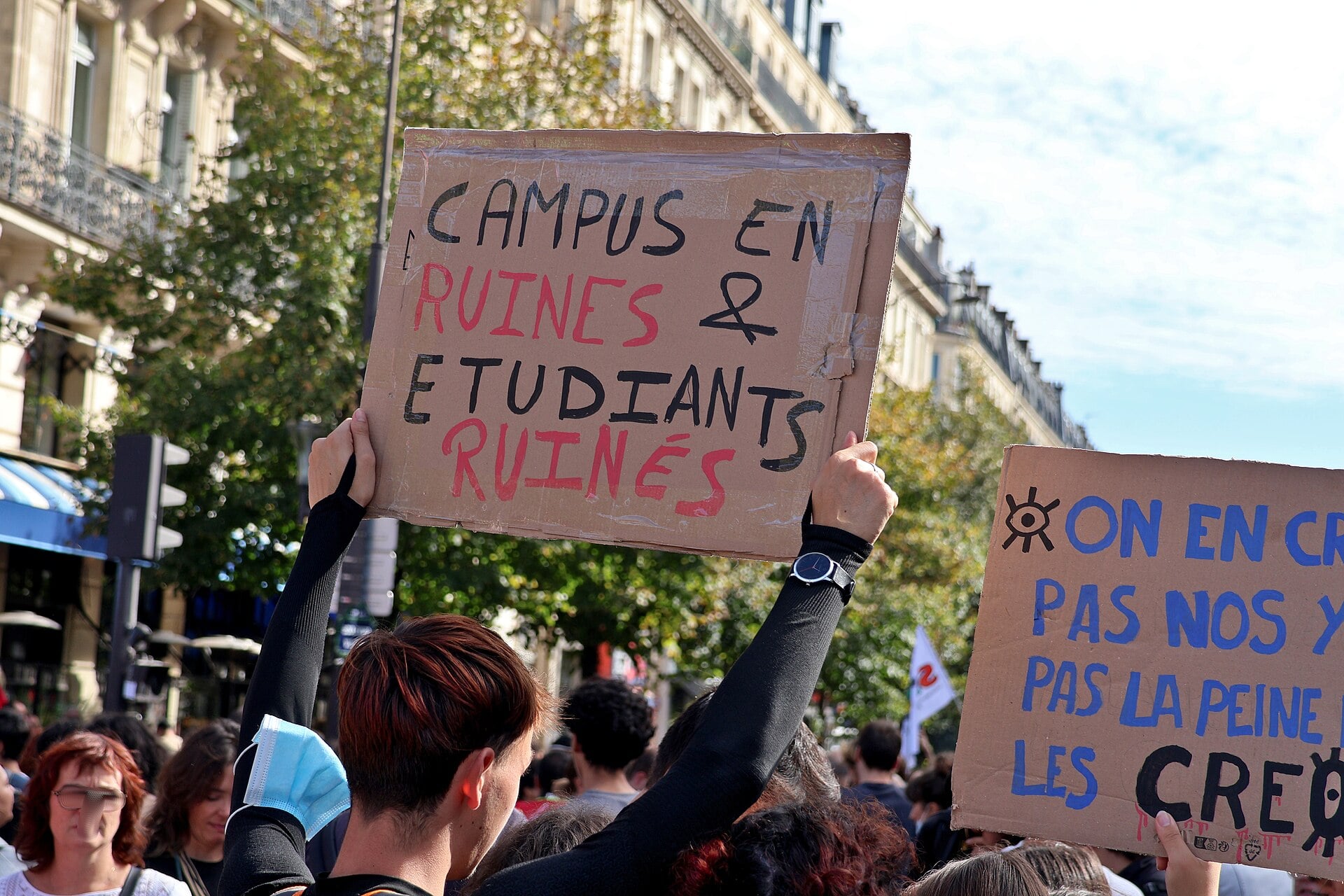
Published Saturday, 31 October, 12:22 p.m. ET (5:22 p.m. Paris) · Source: Council of State, Paris Police Prefecture, French Interior Ministry, unions
Paris police wanted Saturday’s marchers out on the outer boulevards. For one night a judge sided with the unions, and on Saturday morning France’s highest administrative court sided with the police.
The Council of State, which hears appeals against government decisions, banned the march of unions and student groups from Place de la Bastille to Place de la Nation, two landmark squares in eastern Paris. It is the latest turn in the France protests.
Key Facts
- What happened: France’s highest administrative court banned the central Bastille-to-Nation march.
- Who decided: The Council of State overturned a Paris court and backed the police ban on Saturday morning.
- What next: Marchers must use the outer-boulevard route; unions meet to decide their response.
- Prediction markets: Polymarket, a crypto-based betting exchange, prices a French state of emergency by 31 December at 7.5% (12:17 p.m. ET, 31 October).
- Why it matters: Heavy policing and unrest in Paris affect travellers and French political risk.
This story is part of our coverage of the why France is in crisis. Dates, times and how to follow it are in our guide.
In plain English
The Council of State is France’s top court for disputes with the government, and it can rule fast in urgent cases. The CGT, the General Confederation of Labour, is one of the country’s biggest trade unions.
A Night in Court, a Morning Reversal
The Paris police prefect, Patrice Faure, had banned the Bastille-to-Nation route and offered another one. The unions and student groups went to the Paris administrative court, and on Friday, 30 October, it allowed the central march.
The government appealed. On Saturday morning the Council of State cancelled that decision, banned the central route and approved the police alternative from Porte de Bagnolet to Porte de Charenton, two city gates in eastern Paris, along the outer boulevards.
Why the Judges Sided With the Police
In a passage translated from French, the court said banning the route and offering an alternative was “necessary” and “neither inadequate nor disproportionate”.
Interior Minister Laurent Nuñez, who oversees the police, cited serious risks to public order. He pointed to the damage done on 17 October, two weeks before this march.
Live Market IntelligenceCrypto — Live Market Board
Rio Times · Live Market Intelligence
Crypto — Live Market Board
+0.67%
| Instrument | Last | Change | YoY | Prev. | High | Low | Volume |
|---|---|---|---|---|---|---|---|
| BTC | 80,543 | +0.67% | -29.41% | 80,007 | 80,550 | 79,380 | 21,816,416,256 |
| ETH | 2,348 | +1.18% | -43.00% | 2,320 | 2,349 | 2,295 | 8,316,267,520 |
| SOL | 100.98 | +0.22% | -49.19% | 100.75 | 101.04 | 99.17 | 2,110,777,984 |
| XRP | 1.32 | +1.04% | -49.89% | 1.31 | 1.32 | 1.29 | 1,574,615,552 |
| BNB | 750.98 | +1.29% | -34.10% | 741.42 | 751.10 | 733.56 | 1,470,316,160 |
| ADA | 0.21 | -0.30% | -69.21% | 0.21 | 0.21 | 0.20 | 190,120,672 |
| DOGE | 0.08 | +0.78% | -60.98% | 0.08 | 0.08 | 0.08 | 441,746,112 |
| AVAX | 8.84 | -1.36% | -56.54% | 8.96 | 8.96 | 8.67 | 289,961,824 |
| LINK | 11.47 | +0.80% | -37.04% | 11.38 | 11.47 | 11.23 | 248,509,440 |
| DOT | 0.99 | -2.05% | -68.52% | 1.01 | 1.01 | 0.98 | 109,918,912 |
| LTC | 56.59 | -0.13% | -43.06% | 56.66 | 56.87 | 55.70 | 169,852,160 |
| BCH | 290.36 | +3.57% | -47.81% | 280.36 | 292.52 | 277.47 | 195,939,216 |
| TRX | 0.33 | -0.51% | +9.69% | 0.33 | 0.33 | 0.33 | 371,519,040 |
| XLM | 0.17 | +0.21% | -47.60% | 0.17 | 0.17 | 0.17 | 107,134,680 |
| HBAR | 0.08 | -1.56% | -58.82% | 0.08 | 0.08 | 0.08 | 55,674,584 |
| NEAR | 4.62 | +2.60% | +97.50% | 4.50 | 4.64 | 4.39 | 630,712,192 |
| ATOM | 1.61 | -1.48% | -49.28% | 1.64 | 1.64 | 1.60 | 30,012,314 |
| AAVE | 132.37 | -2.36% | -43.78% | 135.57 | 135.87 | 129.56 | 246,790,448 |
How Unions and Students Reacted
The Fage, a national student federation, called the ruling “a new obstacle to the right to protest”. The intersyndicale, the alliance of unions behind the call to march, said it would meet to decide what to do next.
About 70,000 police and gendarmes, France’s military-status police force, are deployed across the country for the day.
What Prediction Markets Say
Polymarket, a crypto-based prediction exchange, runs a market on whether France declares a state of emergency, a legal regime that widens police powers. At 12:17 p.m. ET on 31 October (5:17 p.m. Paris) it priced a declaration by 31 December at 7.5% and by 31 October at 0.4%, with about US$2.69 million traded.
These prices are bets, not polls. Why we show this: prediction markets turn real-money bets into a live probability that moves within minutes of the news, which is why investors, campaigns and newsrooms in the United States now follow them closely. We show them next to polls and official results, never instead of them.
What It Means for US Readers
Americans in Paris on Saturday should expect heavy policing and crowds on the eastern outer boulevards.
For investors, the key risk is a march that spills past the approved route and deepens the political strain; our France 2027 poll tracker follows it.
What Is Not Known
The full text of the ruling has not been published beyond the passages quoted. Turnout, arrests and damage are not yet known. A calm day on the approved route would ease pressure on the government, while scenes like those of 17 October would raise it; the police figures on Saturday evening, 31 October, will show which.
It is also unclear whether organisers will keep to the approved route or call separate gatherings after their meeting. Our explainer on why France is protesting sets out the causes.
Frequently Asked Questions
Which Paris protest route did the court ban?
The Council of State banned the march from Place de la Bastille to Place de la Nation on Saturday, 31 October. It approved the outer-boulevard route instead.
Who asked the court to ban the route?
The government appealed after a Paris administrative court had allowed the central route on Friday, 30 October. Interior Minister Laurent Nuñez cited public-order risks.
Sources: Council of State order of 31 October 2026, Paris administrative court ruling of 30 October 2026, Paris Police Prefecture order, French Interior Ministry statements, statements by the Fage student federation and the intersyndicale, Polymarket.
This article was drafted with automated assistance and reviewed before publication. How we use AI · Report an error · Editorial responsibility: Matthias Camenzind, Editor-in-Chief