Operation Iron in Cali: 1,200 Officers, 101 Raids, 80 Arrests
COLOMBIA · SECURITY
Key Facts
- —Where this is Cali is Colombia’s third-largest city and the capital of Valle del Cauca, in the country’s south-west.
- —What happened More than 1,200 uniformed personnel from the National Police and the Army moved into the city before dawn.
- —The numbers Officials reported 101 planned searches, 83 arrest warrants and 80 people detained.
- —Where exactly Six communes, 15 neighbourhoods and 24 micro-territories, including El Calvario, San Pascual and Sucre in the centre.
- —The catch Arrests are not convictions, and a single night does not dislodge a criminal economy.
- —Why it counts President Abelardo de la Espriella took office in August and has made visible security operations his signature.
Before dawn on Thursday, armoured vehicles went into central Cali — the largest single security push of the new government so far.
Operation Iron in Cali began at about 3.20 a.m. on 24 September 2026. More than 1,200 police and soldiers went into six communes, and officials reported 101 searches and 80 arrests.
What happened before dawn
The operation began at roughly 3.20 a.m. on Thursday 24 September 2026. Armoured vehicles moved into central Cali alongside police and army units.
Officials put the deployment at more than 1,200 uniformed personnel. That is a large number for a single city on a single night.
The searches were executed simultaneously rather than in sequence. That is the standard design when a network is expected to warn its own members.
Reported results were 101 planned searches, 83 arrest warrants and 80 people detained.
Colombian forces call this a simultaneous intervention. The aim is to take a whole set of addresses off the board in one movement.
What Operation Iron in Cali was aimed at
The stated targets were drug-selling points, known in Colombia as ollas, and extortion networks.
Extortion is the part that reaches ordinary people. Shopkeepers, small businesses and young people were named as those affected.
The geography was specific: six communes, 15 neighbourhoods and 24 micro-territories. El Calvario, San Pascual and Sucre, in the city centre, were among them.
Those central neighbourhoods have long been associated with open drug markets. They are also where the city’s commerce is densest.
Extortion in Colombia is often called vacuna, a weekly payment for being left alone. It is the most corrosive of the crimes named.
Breaking the collection is harder than making arrests. The payment survives as long as the threat behind it is credible.
Who Cali is, for readers who do not know it
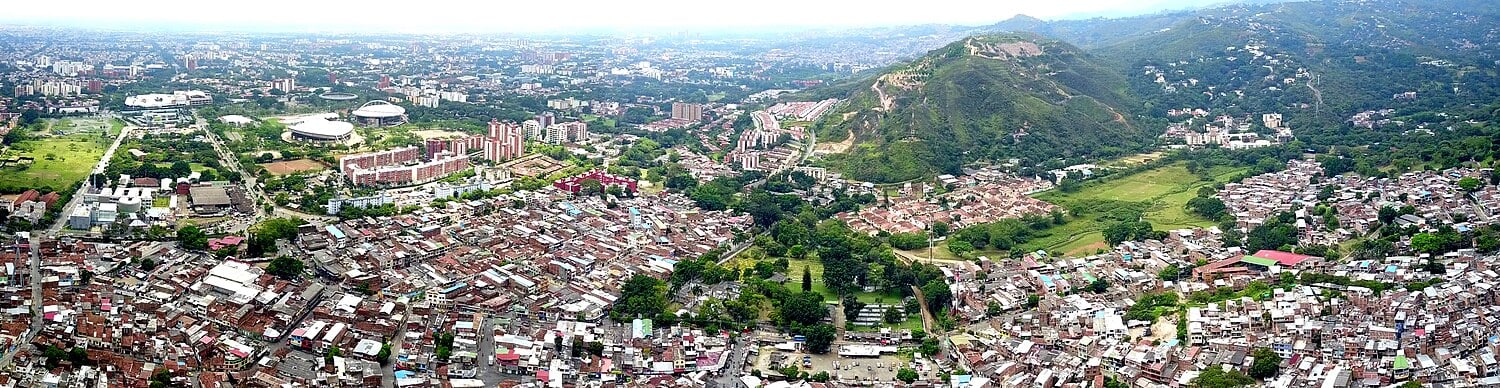
Cali is Colombia’s third-largest city, after Bogotá and Medellín, and the capital of Valle del Cauca department in the south-west.
It sits on the corridor between the Andes and the Pacific coast. That position has made it a logistics hub for legitimate trade and for cocaine alike.
The city is also the centre of Colombia’s Afro-Colombian population and of its salsa culture. Neither fact is decoration here.
Cali’s security problems are concentrated, not general. Most of the city is not a battleground, and visitors rarely see any of this.
About 2.2 million people live in the city. It is a working industrial centre as much as a cultural one.
The political frame
Abelardo de la Espriella became president of Colombia in August 2026. He campaigned on a hard security line and has governed on it.
He announced the Cali operation himself, saying the government would “liberate Cali and the whole country”.
Presidents announcing police operations personally is a choice, not a formality. It ties the government’s standing to what happens next in those neighbourhoods.
That is the risk as well as the point. Visible operations are judged on whether the streets stay changed.
His predecessor pursued negotiated settlements with armed groups. The contrast is the point of operations like this one.
What it does not mean
Eighty arrests is not eighty convictions. Colombian prosecutors must now present cases, and detentions can be overturned at first hearing.
A night of raids does not end an extortion economy. Those networks regenerate unless the prosecutions hold and the corners stay policed.
Nor does the operation say anything about the rest of Colombia. It was designed for six communes of one city.
The honest measure will be arrests that survive court, and whether merchants stop paying.
Colombia has seen large urban operations before, under several governments. Some held, and some did not.
What this means for residents and visitors
For foreign residents in Cali, the immediate effect is disruption rather than danger: closed streets, checkpoints and a visible army presence.
No travel restriction or curfew was reported. The affected areas are central, which is where some hotels and businesses sit.
For businesses, the relevant question is extortion. If the networks that collect from shopkeepers are disrupted, that shows up in operating costs.
For investors watching Colombia, this is a data point about the new government’s method, not about the economy.
Operations of this size usually thin out within days. The checkpoints go, and the question becomes what replaced the corners.
What is still not known
Officials did not publish what was seized during the searches, in drugs, cash or weapons.
No named criminal structure has been given as the principal target in the accounts available.
It is not clear how many of the 83 warrants relate to extortion rather than drug offences.
Nor has the government said what follows the raids in those neighbourhoods, which is the part that decides whether it worked.
Prosecutors have not said how many of those detained will face formal charges at their first hearing.
Frequently Asked Questions
How big was Operation Iron in Cali?
More than 1,200 police and soldiers took part. Officials reported 101 planned searches, 83 arrest warrants and 80 detentions.
Is Cali safe to visit after this?
No travel restriction or curfew was reported. The operation was concentrated in six communes, including central neighbourhoods.
Who ordered the operation?
President Abelardo de la Espriella announced it himself. He took office in August 2026 on a hard security platform.
Sources: https://www.elpais.com.co/cali/en-imagenes-asi-se-llevo-a-cabo-la-operacion-iron-que-se-desplego-en-cali-tanquetas-policia-allanamientos-2407.html; https://www.abc.com.py/internacionales/2026/09/24/colombia-realiza-un-operativo-contra-la-droga-en-cali-con-mas-de-1200-uniformados/
This article was produced by The Rio Times’ automated newsroom system. How we use AI · Report an error
Read More from The Rio Times