MOROCCO · CULTURE
Key Facts
- —The country Morocco is a North African kingdom of 36.8 million people (2024 census) whose 2011 constitution makes both Arabic and Tamazight official languages.
- —The identity The constitution names Arab-Islamic, Amazigh and Saharan-Hassani roots, enriched by African, Andalusian, Hebraic and Mediterranean influences.
- —The music Gnawa, a Sufi trance music born of the slave trade, joined UNESCO’s heritage list in 2019; rappers such as ElGrande Toto play stadium stages at home.
- —The writers and film Tahar Ben Jelloun (1987) and Leïla Slimani (2016) won France’s Prix Goncourt; Maryam Touzani’s Calle Málaga was Morocco’s 2026 Oscar entry.
- —The sport The Atlas Lions reached the 2022 World Cup semi-finals and the 2026 quarter-finals; Morocco co-hosts the 2030 World Cup with Spain and Portugal.
- —Still open The Court of Arbitration for Sport heard the dispute over the 2025 Africa Cup of Nations final on 8 October 2026; its ruling was still pending on 10 October 2026.
Morocco culture reaches Americans more often than they notice, through World Cup football, Cannes films, Goncourt-winning novels and Gnawa trance music. This guide names the musicians, writers, film-makers, artists and athletes shaping the kingdom in 2026, and what they reveal about it.

Who Shapes Morocco Culture in 2026
Morocco is a North African kingdom of 36.8 million people, according to the census taken in September 2024. The count was run by the High Commission for Planning (HCP), the national statistics office.
Its 2011 constitution describes a national identity forged from Arab-Islamic, Amazigh and Saharan-Hassani components. The same preamble adds African, Andalusian, Hebraic and Mediterranean influences.
Amazigh is the name of North Africa’s Indigenous peoples, often called Berbers in English. Article 5 of the constitution makes their language, Tamazight, an official language alongside Arabic.
The same article commits the state to preserving Hassani, the Arabic dialect of the Saharan south. Every name in this guide draws on that layered Morocco culture, part Arab, part Amazigh, part African.
Since a Royal Cabinet decision of 3 May 2023, Yennayer, the Amazigh New Year, has been a paid national holiday. In 2026 it fell on Wednesday 14 January, the third time Moroccans marked it as a day off.
Background on the country sits on the Rio Times Morocco page. Who holds political power is set out in the Morocco politics explainer.
Gnawa, Chaabi and Rap, the Sound of Morocco
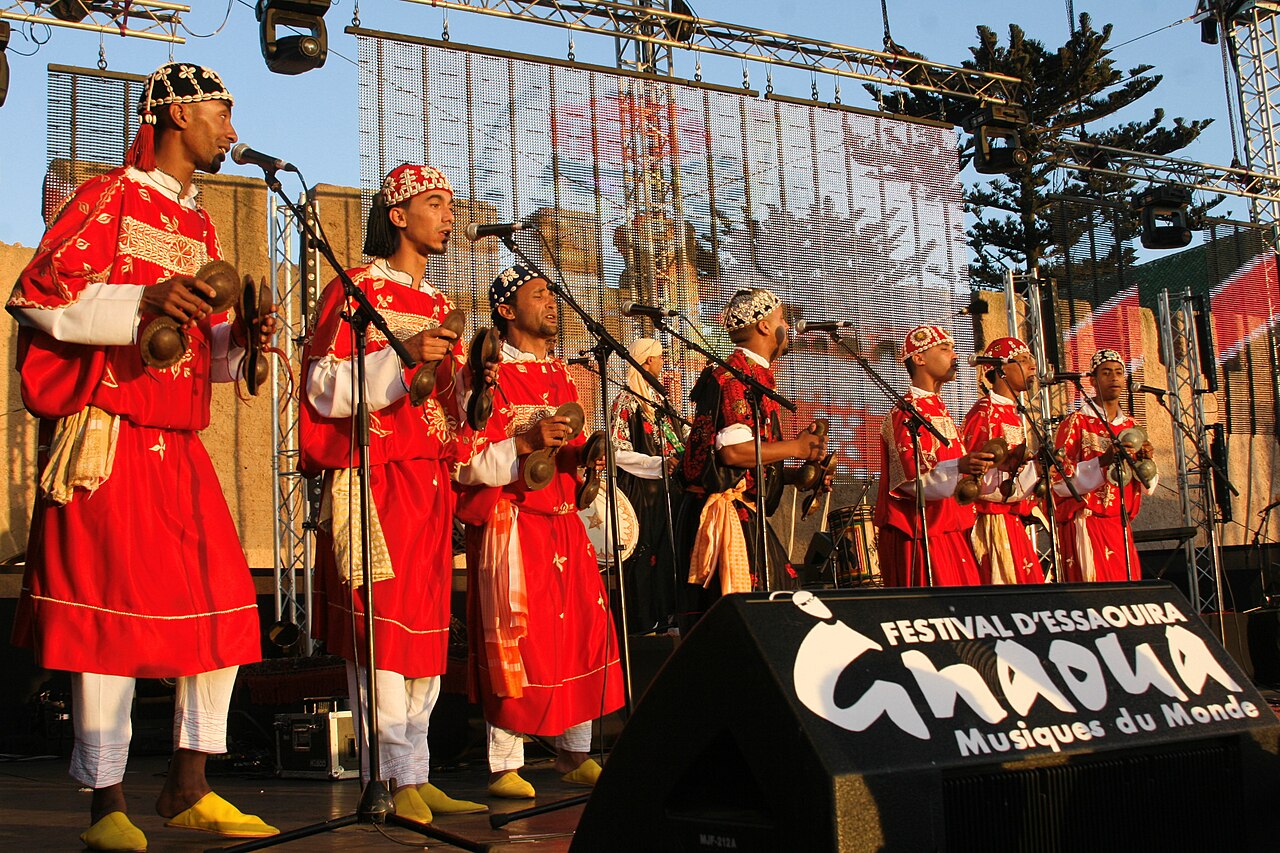
Gnawa is a Moroccan trance tradition with a global following. UNESCO inscribed it in 2019 on its Representative List of the Intangible Cultural Heritage of Humanity.
UNESCO describes Gnawa as Sufi brotherhood music that grew out of the experience of slavery and the slave trade. It traces the tradition back at least to the 16th century.
Its all-night ceremonies use rhythm and trance as a form of therapy. UNESCO notes that the number of master musicians is growing in Morocco’s villages and cities.
The genre’s showcase is the Gnaoua and World Music Festival in Essaouira, an Atlantic port town. Its 27th edition ran from 25 to 27 June 2026, and organisers have set 24 to 26 June 2027 for the next.
The festival is produced by A3 Communication, whose president Neila Tazi is its producer. Since 2024 it has hosted a training programme with Berklee College of Music in Boston, as covered in the Gnaoua festival report.
Mawazine, held in Rabat and neighbouring Salé, is the mass-audience event of Morocco culture. Its organiser, the Maroc Cultures association, counted nearly 3.6 million festivalgoers at the 21st edition in June 2026, Hespress reported.
Moroccan names shared the 2026 bill with global acts such as Tiësto and Malian singer Oumou Sangaré. Rappers ElGrande Toto and Dizzy Dros and singer Douzi all performed.
Chaabi, from the Arabic word for “popular”, is Morocco’s festive popular music. Chaabi star Abdelaziz Stati and Amazigh singer Fatima Tabaamrant played the Salé stage reserved for Moroccan artists.
What the music says about the country is simple: African roots, Arab poetry and Amazigh song sit side by side. Rap now carries the same mix to a younger, urban audience.
Writers Who Carry Morocco to the World
Two Moroccan novelists, both writing in French, have won the Prix Goncourt. The prize is awarded each year by France’s Académie Goncourt.
Tahar Ben Jelloun, born in Fez on 15 December 1947, won it in 1987 for La Nuit sacrée (The Sacred Night). In January 2026 Gallimard published Pigiste au Monde, his account of years writing for the French daily Le Monde.
Leïla Slimani won the 2016 Goncourt for Chanson douce, a novel about a nanny in Paris. She then wrote a trilogy, Le Pays des autres (The Country of Others), published from 2020 to 2025.
In June 2026 France made Slimani a knight of its National Order of Merit. The French embassy in Lisbon said the honour recognised her work for the French language and francophone cultures.
Both write in French, which shows how much of Morocco culture still travels through France. Their novels turn Moroccan and French family life into stories read far beyond North Africa.
Film and Television, From Cannes to Marrakech
Moroccan film-makers are regular guests at the Cannes Film Festival. Nabil Ayouch showed Les Chevaux de Dieu (Horses of God) in the Un Certain Regard section in 2012.
His 2024 film Everybody Loves Touda screened in the Cannes Première section. It follows a village singer who dreams of becoming a cheikha in Casablanca.
Cheikhas are traditional women singers, once admired, whose standing fell after many moved to city cabarets from the 1970s, the festival notes. The festival’s own headline says the film rehabilitates them.
Maryam Touzani, Ayouch’s wife, co-wrote Touda with him. Her own films Adam (2019) and The Blue Caftan (2022) both screened in Un Certain Regard.
Her third feature, Calle Málaga, is set in Tangier and stars Spanish actress Carmen Maura. It won the audience award in the Venice Spotlight section, and Le360 reports it was Morocco’s entry for the 2026 Oscars.
The Marrakech International Film Festival brings world cinema to the city late each year. Its 2025 jury was led by South Korean director Bong Joon Ho, according to Morocco World News.
The 2026 edition, the 23rd, is scheduled for 20 to 28 November, according to La Tribune de Marrakech. Its jury and film selection had not been announced by late September 2026.
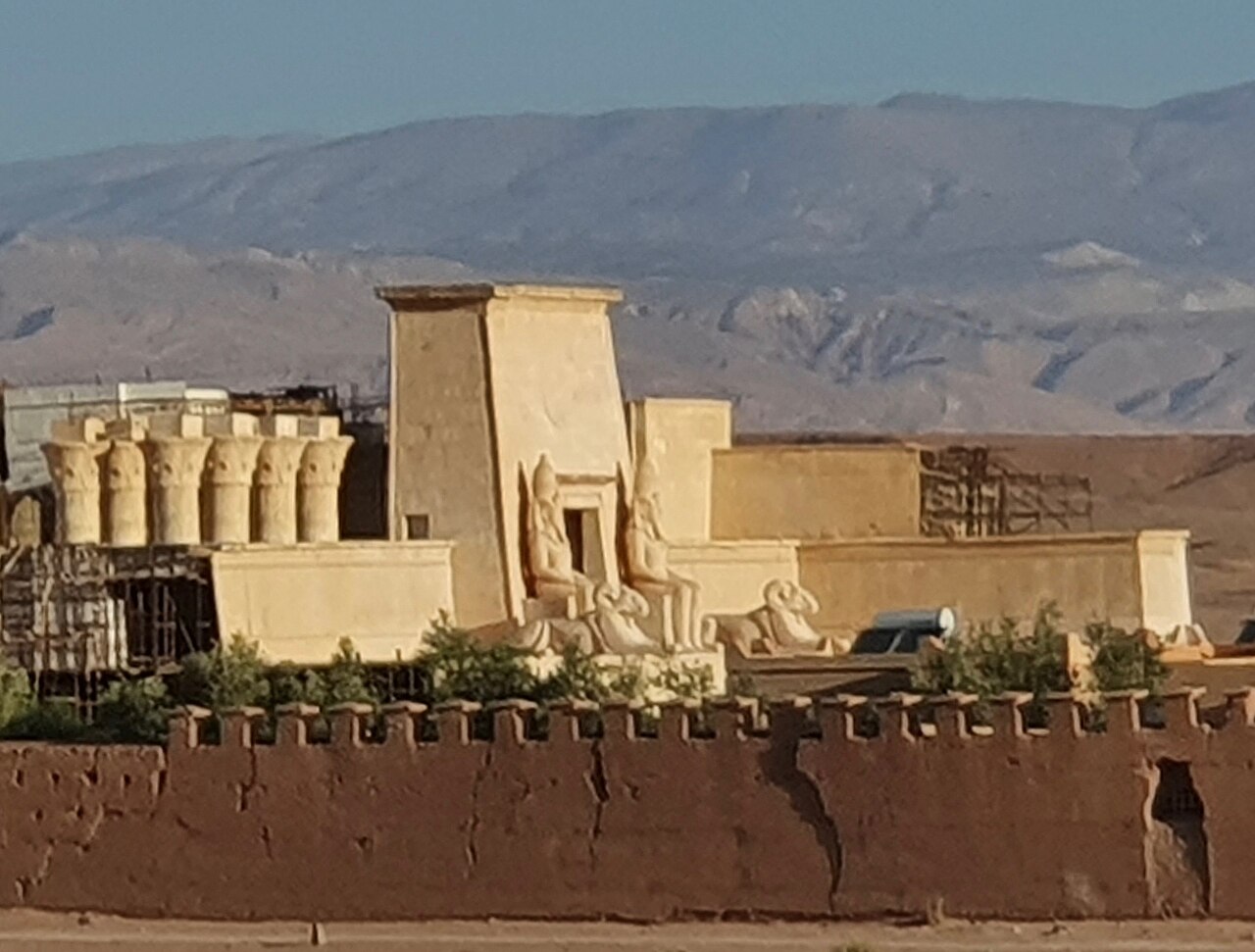
Morocco is also a back lot for foreign crews, including American ones. Foreign productions spent 1.21 billion dirhams (about US$122 million, at 9.95 dirhams to the US dollar) there in 2025.
The figure comes from the Moroccan Cinema Centre (CCM), the state film body, as reported by Le360. Ouarzazate, a desert town south of the High Atlas, has hosted Moroccan and foreign shoots for decades.
In June 2026 work began there on an international cinema city with a budget of 240 million dirhams (about US$24 million). The culture ministry presented it as a complement to the private studios already in the town.
On television, SNRT, the national broadcaster, runs channels including Al Aoula, sports channel Arryadia and the Amazigh-language channel Tamazight.
Visual Artists, From Casablanca to London
Tate, the British national gallery group, links the Casablanca Art School to an intense period of artistic rebirth after independence. Its peak came in the 1960s and 1970s.
The school was led by Farid Belkahia, Mohammed Chabâa and Mohamed Melehi. Tate St Ives showed work by 22 artists from its circle from May 2023 to January 2024.
The pieces ranged from abstract paintings and urban murals to applied arts, typography, graphics and interior design.
The contemporary photographer Hassan Hajjaj was born in Larache in 1961 and has lived in London since his teens. He mixes fashion portraiture, documentary photography and collage.
His portraits of musicians, framed with recycled tin cans, fill My Rock Stars at the Philharmonie de Paris. The show runs from 22 September 2026 to 25 April 2027.
Both generations turn crafts, colour and street life into modern art. That habit of borrowing from everyday objects runs through Morocco culture abroad.
Sport Icons and the Atlas Lions
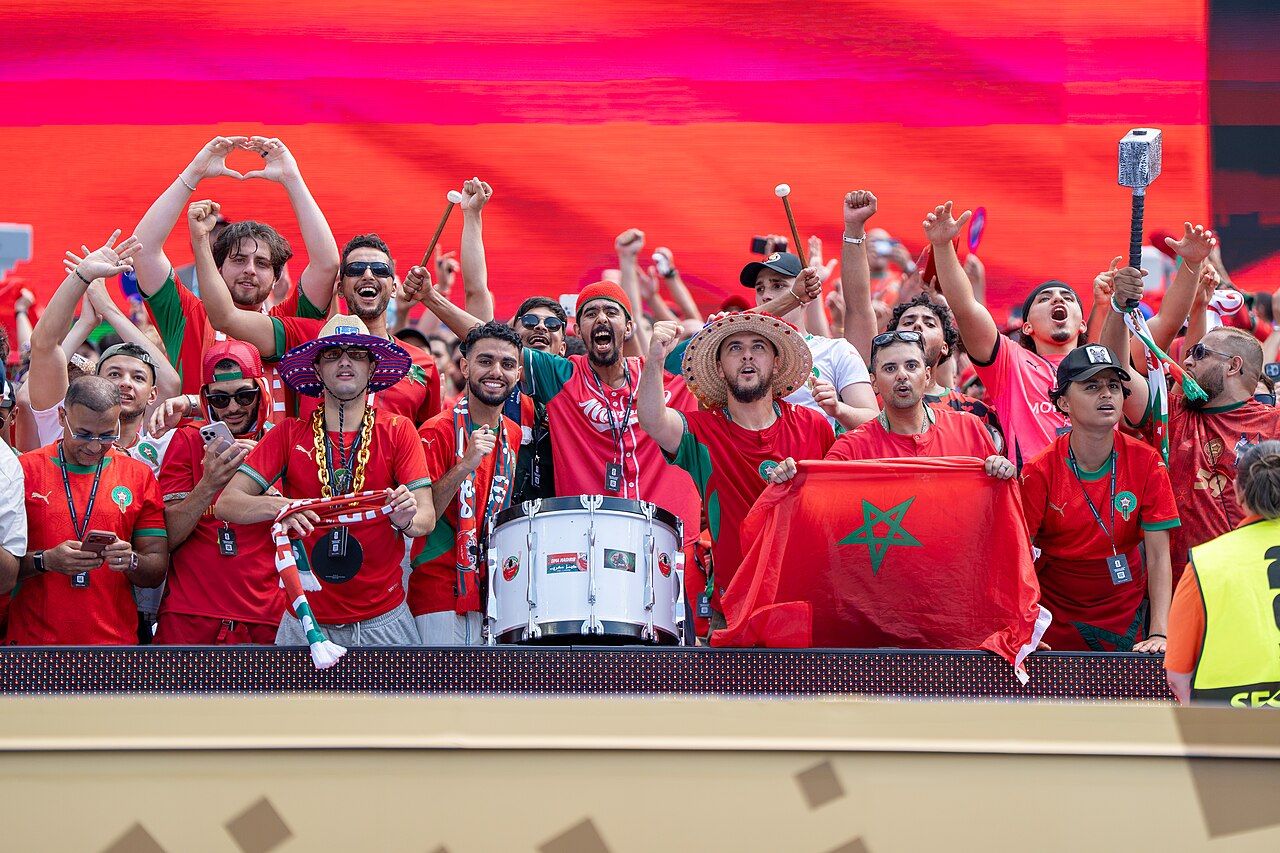
Football is the loudest part of Morocco culture, and the national team is nicknamed the Atlas Lions. In Qatar in 2022, they became the first African nation to reach a World Cup semi-final, Hespress notes.
At the 2026 World Cup, Morocco beat Canada 3-0 in the round of 16, then lost 2-0 to France in the quarter-finals. Morocco World News called it the first Arab and African side to reach back-to-back quarter-finals.
The team’s star is Achraf Hakimi, a defender for Paris Saint-Germain (PSG). He is the first Moroccan named African Player of the Year since Mustapha Hadji in 1998.
CAF, the Confederation of African Football, gave him the 2025 award in Rabat on 19 November 2025. Ghizlane Chebbak took the women’s prize at the same ceremony.
Hakimi, sixth in the 2025 Ballon d’Or vote, is nominated again for the 2026 prize. The winner will be named in London on 26 October 2026.
Morocco’s under-20 team won the 2025 Under-20 World Cup, beating Argentina 2-0 in Santiago, Chile, on 19 October 2025. Le360 called it the country’s first world title.
Morocco then hosted the 2025 Africa Cup of Nations, whose final against Senegal was played in Rabat on 18 January 2026. Senegal won 1-0 on the pitch with an extra-time goal by Pape Gueye.
Senegal’s players had left the field for 16 minutes in protest at a penalty awarded to Morocco. On 17 March 2026 CAF’s appeals committee recorded a 3-0 forfeit win for Morocco, and Senegal appealed.
Nawal El Moutawakel won the 400m hurdles at the 1984 Los Angeles Olympics. She was the first African and first Arab woman to win Olympic gold.
She joined the International Olympic Committee in 1998 and was elected its vice-president in 2012 and again in 2024. Steeplechaser Soufiane El Bakkali won Olympic gold at Tokyo 2020 and Paris 2024, plus world titles in 2022 and 2023.
Morocco will co-host the 2030 World Cup with Spain and Portugal, as FIFA’s Congress decided on 11 December 2024. Three centenary matches will be played in Argentina, Paraguay and Uruguay.
The 2026 run is reviewed in Africa’s World Cup record run. The money behind new stadiums is covered in who runs Morocco’s economy.
Festivals and Media Voices to Follow
Autumn 2026 is busy for visitors who want to see Morocco culture live. Moroccan news sites Hespress and Le360 cover the big events in French and English editions.
La Tribune de Marrakech, a local news site, lists these fixtures:
- Fez Festival of Sufi Culture: 17 to 24 October 2026.
- Marrakech Jazz Experience: 30 October to 1 November 2026.
- Visa for Music, Rabat, 13th edition: 18 to 21 November 2026.
- Marrakech International Film Festival, 23rd edition: 20 to 28 November 2026.
- Trans-Saharan International Film Festival, Zagora: 6 to 11 December 2026.
What It Means for US Readers
For American travellers, the festival dates above offer a planned way to see Morocco culture live. Essaouira’s Gnaoua festival in June and Marrakech’s film festival in November are the two anchors.
Musicians have a direct US link: Berklee College of Music in Boston co-runs a training programme with the Gnaoua festival.
Sports fans met the Atlas Lions at the 2026 World Cup, hosted by the United States, Canada and Mexico. Hakimi plays Champions League football for PSG, which won the competition again in 2026.
The 2028 Olympics return to Los Angeles, where El Moutawakel won gold in 1984. El Bakkali’s renewed sponsorship deal is framed around those Games, Morocco World News reported.
Live events in Casablanca, the business capital, are listed in the Casablanca October 2026 guide. Morocco’s Unity Day holiday on 31 October is set out in the Unity Day explainer.
What Is Not Known
The Court of Arbitration for Sport (CAS), the Swiss-based tribunal for sports disputes, heard Senegal’s appeal on 8 October 2026. Its ruling on who won the 2025 Africa Cup of Nations was still pending on 10 October 2026.
Senegal’s federation asks CAS to declare it the champion; Morocco’s federation and CAF are the other parties. Hespress reported on 10 October 2026 that the ruling could take days or weeks.
The jury and line-up of the 23rd Marrakech film festival had not been published by late September 2026. Whether Hakimi wins the 2026 Ballon d’Or will only be known on 26 October 2026.
Frequently Asked Questions
What is Morocco culture known for?
Morocco culture is known for Gnawa trance music, chaabi and rap, Arab and Amazigh traditions, French-language novels, Cannes-selected films and the Atlas Lions football team.
What is Gnawa music?
Gnawa is a Sufi brotherhood music that grew out of the experience of slavery and dates back at least to the 16th century. UNESCO added it to its intangible heritage list in 2019.
When is the Gnaoua festival in Essaouira?
The 27th edition ran from 25 to 27 June 2026. The organisers have set 24 to 26 June 2027 for the next edition.
Which Moroccan writers have won the Prix Goncourt?
Tahar Ben Jelloun won in 1987 for La Nuit sacrée, and Leïla Slimani won in 2016 for Chanson douce. Both write in French.
Is Tamazight an official language in Morocco?
Yes. Article 5 of the 2011 constitution makes Tamazight an official language alongside Arabic, and the Amazigh New Year has been a paid holiday since 2023.
Who are Morocco’s sport icons?
Footballer Achraf Hakimi, 2025 African Player of the Year, leads the list. Olympic champions Nawal El Moutawakel and Soufiane El Bakkali are the athletics icons of Morocco culture.
Who won the 2025 Africa Cup of Nations?
Senegal won the final on the pitch, but CAF later awarded Morocco a 3-0 forfeit. Senegal’s appeal was heard on 8 October 2026, and the CAS ruling was still pending on 10 October 2026.
Sources: Constitution of Morocco 2011 (Constitute Project translation), 2011; UNESCO, Gnawa, 2019; Gnaoua and World Music Festival, June 2026; Hespress, Mawazine 2026 attendance, 3 July 2026; Académie Goncourt, Tahar Ben Jelloun, accessed October 2026; French Embassy in Portugal, decoration of Leïla Slimani, 23 June 2026; Festival de Cannes, Everybody Loves Touda, 17 May 2024; Le360, Maryam Touzani on Calle Málaga, 18 April 2026; Tate, The Casablanca Art School, 2023; FIFA, Extraordinary Congress appoints 2030 and 2034 hosts, 11 December 2024; CAS media release, AFCON 2025 final hearing, 24 July 2026; Hespress English, CAS ruling pending, 10 October 2026; Le360, AFCON 2025 final CAS hearing, 24 July 2026; Morocco World News, Hakimi Ballon d’Or nomination, 8 September 2026; Le360, foreign film shoots in Morocco in 2025 (CCM figures), 28 July 2026; Barlamane, Ouarzazate international cinema city, 27 June 2026; Le360 Sport, Morocco under-20 world champions, 20 October 2025; Morocco World News, Morocco’s 2026 World Cup campaign, 10 July 2026; Africa24, Nawal El Moutawakel, 1 August 2026; La Tribune de Marrakech, festival calendar 2026-2027, 26 September 2026; CAF, AFCON 2025 final report, 18 January 2026; CAF, CAF Awards 2025, 19 November 2025; UEFA, 2026 Ballon d’Or nominees, 8 September 2026; Le360, 2024 census population, 7 November 2024; Morocco World News, Gnaoua festival and Berklee programme, 12 March 2026; Arts in the City, Hassan Hajjaj at the Philharmonie de Paris, 24 September 2026.
Editorial responsibility: Matthias Camenzind, Editor-in-Chief · Editorial standards · Report an error
Rotate for Best Experience
This report is optimized for landscape viewing. Rotate your phone for the full experience.
You've reached your free article limit
Subscribe to The Rio Times for unlimited access to our reporting from across Africa.