Mexico Markets: IPC & the Peso — September 10, 2026
Key Facts
- The S&P/BMV IPC, Mexico’s main stock index, closed at 65,026, a marginal 0.06% dip that left the market effectively flat for the session.
- The peso strengthened slightly, with USD/MXN falling 0.12% to 16.896 pesos per dollar as traders digested the 2027 budget proposal and softer core inflation.
- Grupo Aeroportuario del Pacífico, the airport operator known as GAP, rose 1.4% to lead the most-traded names, while Walmex and Cemex each dropped 1.2%.
- Alpek, the petrochemicals group, jumped 3.2% to top the day’s gainers, while broadcaster Televisa slumped 3.9%.
- The index sits 9.2% below its 52-week high of 71,601, with the 65,000 level acting as a psychological anchor for traders.
Today’s Focus
Mexico’s benchmark S&P/BMV IPC — the index tracking 35 of the country’s largest listed companies — closed at 65,026 on Tuesday, down a barely perceptible 0.06%. The peso, meanwhile, edged firmer to 16.896 per dollar, a 0.12% gain for the Mexican currency.
The calm session followed the delivery of the 2027 economic package, in which the finance ministry projected growth of 1.5% to 2.1%, inflation of 3.0%, and an exchange rate of 17.9 pesos per dollar. August inflation data also landed at 3.26% annually, with the core component surprising slightly to the downside.
The combination gave investors little reason to chase the index higher, but also no cause for alarm. Defensive names such as airports held firm, while consumer-facing stocks like Walmex slipped on profit-taking.
What matters today. Mexico’s market is priced for a slow-growth, lower-inflation environment, and Tuesday’s session did little to challenge that assumption.

01 The session in one read
Trade date: Wednesday 9 September 2026.
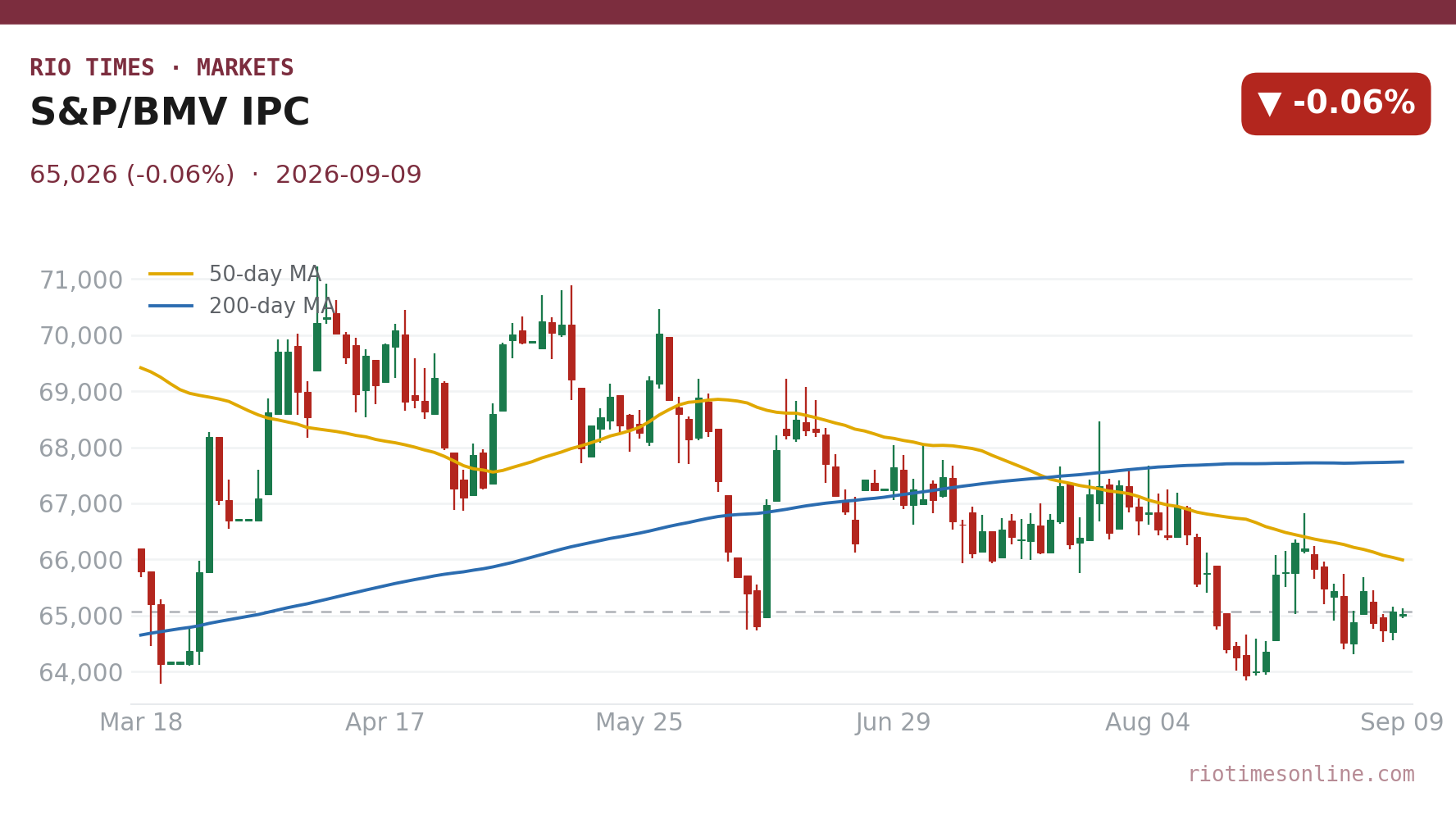
Mexico’s stock market spent Tuesday in a near standstill, with the S&P/BMV IPC closing at 65,026 — a 0.06% dip that is, for all practical purposes, a flat session. The peso, the country’s currency, actually strengthened a touch: one dollar now costs 16.896 pesos, down 0.12% from the previous close.
The backdrop was unusually busy for such a quiet tape. The finance ministry delivered its 2027 budget package to Congress, projecting economic growth of 1.5% to 2.1% and inflation of 3.0%.
At the same time, August inflation figures showed annual price rises at 3.26%, up from 3.12% in July. The core measure, which strips out volatile items, surprised slightly lower — a detail that helped support the peso.
In the wider world, US stocks slipped, with the S&P 500 down 0.48%. That external softness kept Mexican equities from finding any real upward momentum.
The evidence points to a market digesting the 2027 budget framework rather than reacting to it with conviction. The peso’s modest gain against a flat dollar index suggests local factors — the fiscal package and softer core inflation — carried more weight than the US tape, which was modestly lower. The variable to watch is whether the 65,000 level holds through this week’s US inflation readings, which could reset global rate expectations.
02 The day’s numbers
| Measure | Level | Change | Read |
|---|---|---|---|
| S&P/BMV IPC | 65,026 | −0.06% | Flat session; 9.2% below 52-week high |
| USD/MXN | 16.896 | −0.12% | Peso firms; 9.5% below 52-week high |
| S&P 500 (US) | 7,636 | −0.48% | Soft external lead for Mexico |
| Gold | $4,394/oz | +1.00% | Haven bid persists |
| US 10Y yield | 4.844% | +1.04% | Rates still climbing |
The IPC’s 52-week range runs from 60,216 to 71,601, meaning the market is roughly 9.2% below its peak. That is not a distressed level, but it reflects a market that has been drifting rather than charging higher.
The peso’s trading band of 16.89 to 18.68 over the past year shows the currency is sitting very close to its strongest point. That strength is a double-edged sword: it keeps import costs low, but it squeezes exporters’ margins. Rio Times · Live Market Intelligence
Live Market IntelligenceMexico — Live Market Board
Mexico — Live Market Board
Instrument Last Change YoY Prev. High Low Volume
IPC MEX
65,025.71
-0.06%
+12.17%
65,065.56
66,121
65,405
108,886,187
USD/MXN
17.06
-0.24%
-8.58%
17.10
17.08
17.01
—
WALMEX
48.07
-0.62%
-14.38%
48.37
48.65
48.02
10,781,446
GMEXICO
223.28
+0.35%
+73.59%
222.50
226.18
222.17
1,325,556
FEMSA
201.19
-0.24%
+25.67%
201.67
206.71
199.56
750,706
CEMEX
19.32
+0.89%
+19.10%
19.15
19.35
19.04
14,327,054
GFNORTE
193.98
+1.18%
+14.36%
191.71
195.79
191.83
1,579,115
BIMBO
60.98
-0.96%
+11.89%
61.57
61.46
60.29
1,048,115
TELEVISA
9.71
+0.21%
+12.78%
9.69
9.75
9.60
577,851
AMX
19.80
-0.95%
+12.53%
19.99
20.05
19.70
58,058,525
GAP
366.23
+0.43%
-21.21%
364.68
370.85
362.82
226,946
ASUR
275.04
+1.25%
-15.28%
271.64
275.08
271.31
15,451
OMA
233.50
+0.62%
-6.48%
232.06
235.00
230.62
555,693
KOF
188.04
+0.86%
+18.94%
186.44
188.56
185.52
425,273
GRUMA
252.90
+0.11%
-21.85%
252.61
254.74
250.36
90,048
KIMBER
39.74
+0.43%
+8.85%
39.57
40.09
39.33
490,551
AMX ADR
23.38
-0.23%
+22.25%
23.43
23.49
23.06
1,347,445
03 Why it moved — budget, inflation and a firmer peso
The finance ministry’s 2027 package set the tone. Officials project growth of 1.5% to 2.1%, inflation of 3.0%, and a peso at 17.9 per dollar — a level weaker than where the currency actually trades today.
That discrepancy matters. If the peso holds near 16.90, the government’s own revenue assumptions could prove conservative, but so could its growth forecasts if the strong currency hampers exports.
August inflation at 3.26% annual was higher than July’s 3.12%, yet still well within the central bank’s tolerance band. The core measure coming in below expectations gave the peso room to firm, and it did.
The mood on the ground, as reported by local financial press, was cautiously optimistic: the peso “smiled” at the budget proposals, and the central bank’s benchmark interest rates continue to offer attractive real returns for foreign investors.
04 The day’s movers
| Driver | Level / Move | Change | Note |
|---|---|---|---|
| GFNORTEO (Banorte) | $93m traded | −0.6% | Heaviest volume on the day |
| GMEXICOB (Grupo México) | $63m traded | −0.4% | Mining giant slips with metals |
| WALMEX | $39m traded | −1.2% | Consumer staple under pressure |
| CEMEXCPO | $33m traded | −1.2% | Cement maker weakens |
| AMXB (América Móvil) | $29m traded | +0.3% | Telecoms giant edges up |
| GAPB (airport group) | $23m traded | +1.4% | Best performer among heavy names |
| ALPEKA (Alpek) | — | +3.2% | Biggest gainer on the day |
| TLEVISACPO (Televisa) | — | −3.9% | Biggest fall on the day |
The volume picture is telling. Banorte dominated turnover but fell 0.6%, suggesting institutional selling rather than panic. América Móvil, the telecoms powerhouse, managed a small gain on modest volume.
Alpek’s 3.2% surge was the standout, likely tied to petrochemical pricing or corporate news rather than any broad market shift. Televisa’s 3.9% drop made it the day’s worst performer, continuing a difficult run for the broadcaster.
05 The regional scoreboard
| Index | Country | Change |
|---|---|---|
| S&P/BMV IPC | Mexico | −0.06% |
| Ibovespa | Brazil | −0.93% |
| Merval | Argentina | +1.11% |
| IPSA | Chile | −0.39% |
| COLCAP | Colombia | +0.57% |
Mexico was the quietest major market in Latin America on the day. Argentina’s Merval rose 1.11%, continuing its volatile upward path, while Brazil’s Ibovespa — the region’s largest exchange — fell 0.93%.
The lack of synchronised moves across the region suggests local factors dominated. Argentina’s inflation release on Wednesday and Brazil’s IPCA reading will provide the next shared catalysts. The live market board above carries the latest closes.
06 The technical picture
The IPC’s close of 65,026 keeps the index hugging the 65,000 level, which has become something of a psychological anchor. The session range, according to Investing.com data, ran from 64,751 to 65,229 — a tight band by recent standards.
At 9.2% below its 52-week high, the market is not technically stretched in either direction. The 60,216 low from the past year stands as the key support, while 71,601 remains the level bulls would need to recapture to signal a new leg higher.
For the peso, the picture is more one-sided: at 16.896, the currency is within a whisker of its strongest level in the past year. Technical traders will be watching whether 16.89 holds as firm support, or whether the peso can push toward 16.50 or beyond.
07 What to watch
- US inflation data: Due Thursday; could reset global rate expectations and move the peso sharply
- Argentina and Brazil inflation: Wednesday’s IPCA and Argentina’s CPI will set the regional tone
- 65,000 index level: A break below could trigger further outflows from Mexican equities
- Peso strength sustainability: Exporters will struggle if USD/MXN falls toward 16.50
Background: Mexico FDI Record Hides 13.4% Drop in New Investment.
Background: Mexico’s Petrochemical Investment Stalls.
Frequently Asked Questions
What is the S&P/BMV IPC?
It is Mexico’s main stock market index, tracking 35 of the country’s largest and most traded companies, from telecoms to banks to retailers.
Why did the peso strengthen on 9 September?
The 2027 budget package projected stable inflation and growth, while August core inflation came in below expectations, supporting the currency.
Which Mexican stocks moved the most?
Alpek rose 3.2% and Televisa fell 3.9%, the biggest gainer and loser respectively, while GAP led the most-traded names with a 1.4% gain.
How far is the market from its peak?
The IPC closed at 65,026, about 9.2% below its 52-week high of 71,601.
IPC — Market data: RT; exchange figures from BMV
This article was produced by The Rio Times’ automated newsroom system. How we use AI · Report an error
In depth
LatAm Markets: Live Signals → — real-time movers, turnover leaders and FX across Latin America.
Read More from The Rio Times