Haiti’s PM Answers Amnesty on Gang Fight
Haiti's prime minister has answered a human rights group over foreign troops, as questions about who watches the Salvadoran force and what its agreement says stay unanswered.

Politics: Haiti
Haiti’s prime minister said on Tuesday 24 November 2026 that Haitians have a right to “a life without fear, without terror and without domination by gangs.” Alix Didier Fils-Aimé, the interim head of government, was replying on X, the social network, to a message from the Argentine section of Amnesty International, a global human rights group.
The argument is about Salvadoran troops hunting gang leaders around Port-au-Prince, the capital, next to a UN-authorised anti-gang force, the Gang Suppression Force, that the United States backs. American readers have reason to follow it, because Haiti’s gang crisis is tied to that US-backed force and to the migration pressure it creates.
Key Facts
- Who. Haiti's interim Prime Minister Alix Didier Fils-Aimé and Amnesty International, a global human rights group.
- What. He said rights must not be a pretext against protecting Haitians, without naming the operation.
- Why it matters. Most Salvadoran troops sit outside the UN-authorised force; their deal with Haiti is unpublished.
- As of. 25 November 2026, 19:00 GMT
Haiti's prime minister has answered a human rights group over foreign troops, as questions about who watches the Salvadoran force and what its agreement says stay unanswered.
Fils-Aimé wrote in French, and in translation his post said: “Respect for human rights and transparency must accompany any operation, but they must not become a pretext to ignore the right of Haitians to be protected and to regain their freedom.” The reported text of the post does not name the operation.
We do not know what the Amnesty message said, but the group set out its position on Monday 9 November 2026 in a statement titled “Haiti: the governments of Haiti and El Salvador must ensure that the deployment of Salvadoran military personnel respects human rights.” Ana Piquer, Amnesty’s Americas director, said in it that the governments “must ensure that all operations carried out by Salvadoran forces in Haiti respect international human rights law.”
Piquer said that “both governments must make public the agreement governing this deployment.” She added that the response to gang violence “must not reproduce the violations and impunity that have characterised previous interventions in Haiti.”
Amnesty also asked for independent investigations of alleged abuses and for reparations, and said any use of force “must comply with the principles of legality, necessity and proportionality.” It further asked that the fate be established of four Salvadoran military personnel missing since Sunday 18 October 2026.
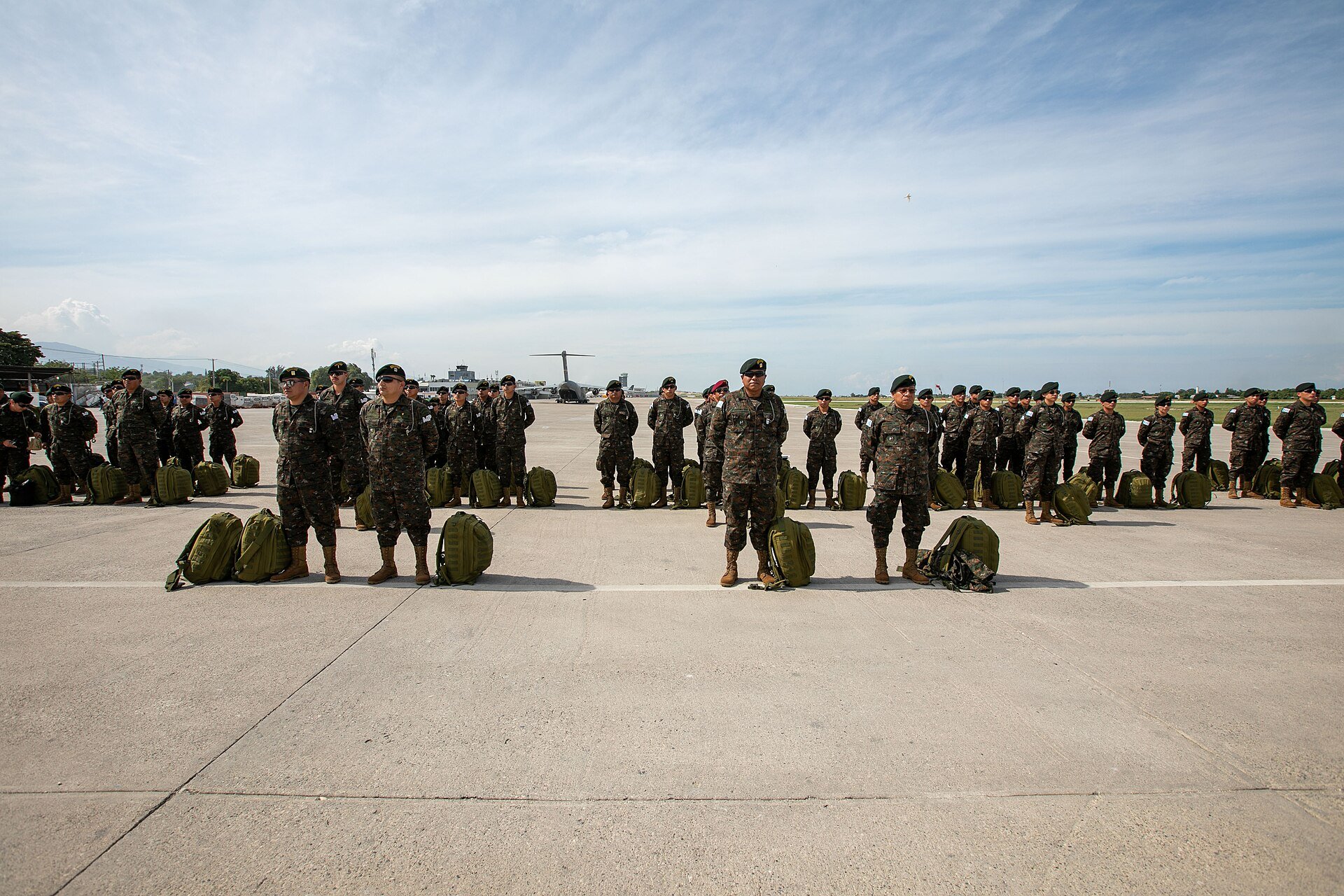
The four, described as aviation technicians serving with the Gang Suppression Force, the UN-authorised multinational force, vanished in a gang ambush in the Croix-des-Bouquets area near Port-au-Prince. El Salvador’s President Nayib Bukele then sent troops, and more than 2,000 are now in Haiti, on top of about 200 Salvadorans, mostly medical staff, who were there before.
Amnesty’s statement followed a clarification by UN spokesman Stéphane Dujarric that most of the recently deployed Salvadoran troops are not part of the Gang Suppression Force. That places them outside the mandate and monitoring of the UN Support Office in Haiti, known as BANUH, the statement says.
Dujarric told reporters on Tuesday 3 November 2026: “People’s rights need to be respected as you conduct security operations.” The same day Fils-Aimé told a news conference that the international force “is not here to replace the state” but is “here to support us.”
On Tuesday 10 November 2026 Bukele announced on X that his troops, supporting Haitian police, had destroyed the house of Lanmò San Jou, a leader of the 400 Mawozo, a gang based east of Port-au-Prince, and the gang’s headquarters in Croix-des-Bouquets. He posted a video of helicopters firing on the site, and no official casualty figure has been published.
On Tuesday 17 November 2026 Haiti’s Council of Ministers, the cabinet, approved a cooperation agreement with El Salvador, the Haitian government said, and as of 25 November we found no published text of it. Romain Le Cour, head of the Haiti Observatory at the Global Initiative Against Transnational Organized Crime, a Geneva-based research network, said on 3 November: “We still do not know the terms of the agreement with the Haitian government, who commands these troops, under which rules of engagement, or for how long.”
Thousands of people marched to back the Salvadoran troops in Port-au-Prince on Tuesday 17 November 2026, many carrying signs thanking Bukele. Haiti has had no elected president since 2021, and the electoral council has set elections for Sunday 18 July 2027.
Fils-Aimé has been interim prime minister since November 2024, and the future of the Salvadoran troops is now a live question in Port-au-Prince. Washington backs the UN-authorised Gang Suppression Force, set up by the Security Council in resolution 2793 of 30 September 2025.
The four missing personnel were still missing when Amnesty published its statement on 9 November, and we found no announcement that they have been found. Our latest report on the Salvadoran deployment covers the continuing search.
No date has been set, that we found, for publishing the agreement with El Salvador. The chain of command over the Salvadoran troops has not been stated publicly.
Frequently Asked Questions
Why is Amnesty International involved?
It wants the governments of Haiti and El Salvador to publish their agreement and to make sure the Salvadoran troops respect human rights law. It also wants independent investigations of alleged abuses.
Are the Salvadoran troops part of the UN-authorised force?
According to the UN spokesman as set out by Amnesty, most of them are not. That leaves them outside the monitoring of the UN office in Haiti.
Has Haiti's government published the agreement?
We found no published text, and no date has been set to publish it. Until it appears, the terms and the chain of command stay unknown.
Haiti
- What Is Happening in Haiti?
- What Is Happening in Haiti?
- Haiti Gang Crisis Explained 2026 Gangs and the UN Force
- Haiti’s July 2027 Vote, What US Travellers Need to Know
Sources
Sources: post by Haitian Prime Minister Alix Didier Fils-Aimé on X, 24 November 2026; Amnesty International statement, 9 November 2026; UN spokesman Stéphane Dujarric, 3 November 2026; Fils-Aimé news conference, 3 November 2026; Bukele post on X, 10 November 2026; Haitian government announcement, 17 November 2026; UN Security Council resolution 2793, 30 September 2025.
This article was produced by The Rio Times’ automated AI newsroom. Editorial responsibility: Matthias Camenzind, Publisher and Editor-in-Chief. The Rio Times also runs Ask Rio Times, which answers from 100,000+ of our own articles, the daily Latin America Power Map, and prediction-market odds on elections and markets.. How we use AI · Report an error
Connected Coverage
Haiti news · Haiti Weighs Future of Salvadoran Troops · Haitians March to Back Salvadoran Troops