US Adds 165,000 Jobs as Dollar and Yields Rise | Global Economy, Nov 7
Rio Times Global Economy Briefing
The Big Three
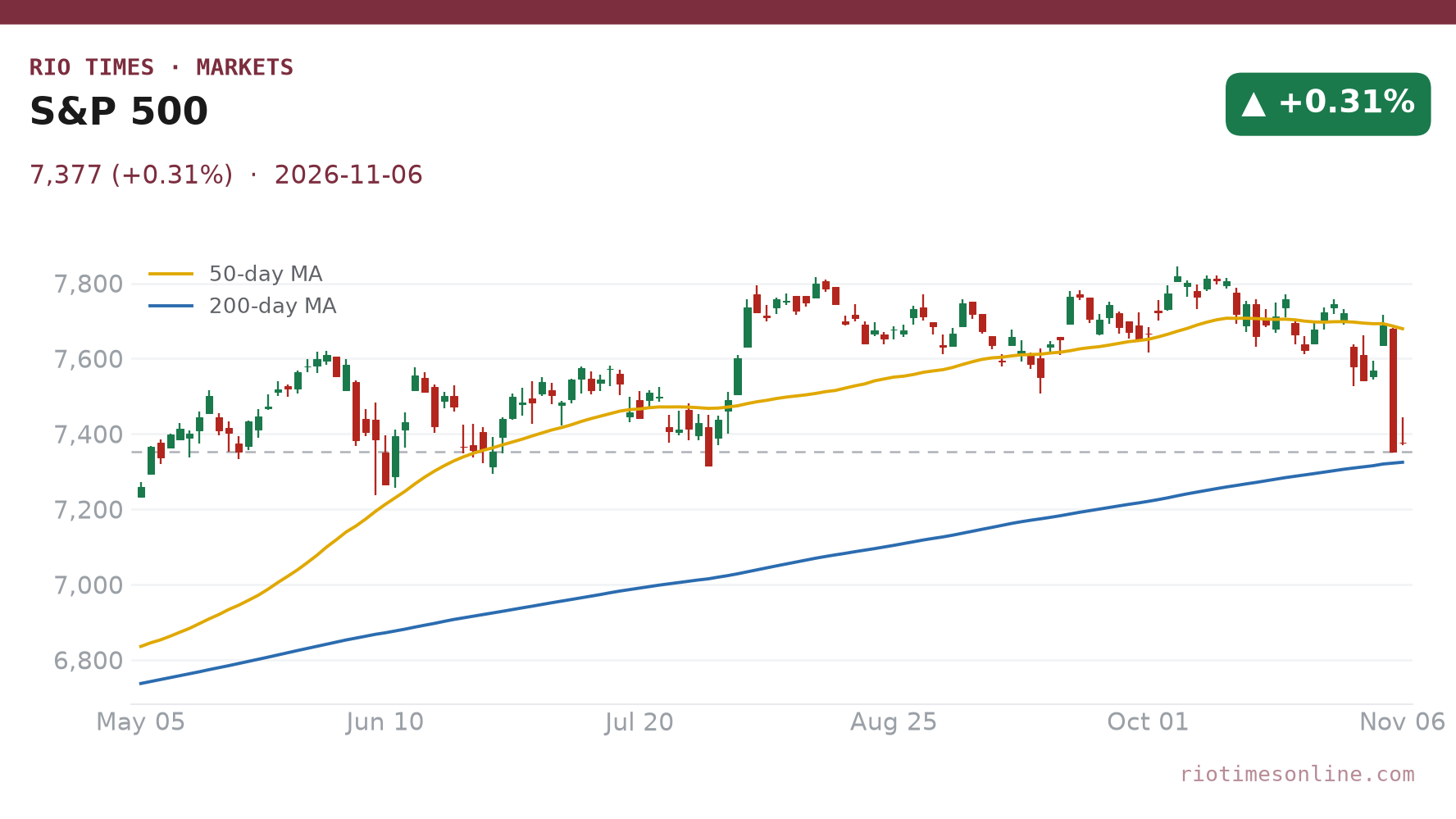
- Wall Street splits as tech surges and the Dow slips The Nasdaq Composite rose 1.09% to 24,579 while the Dow fell 0.46% to 51,286. The S&P 500 added 0.31% to 7,377.
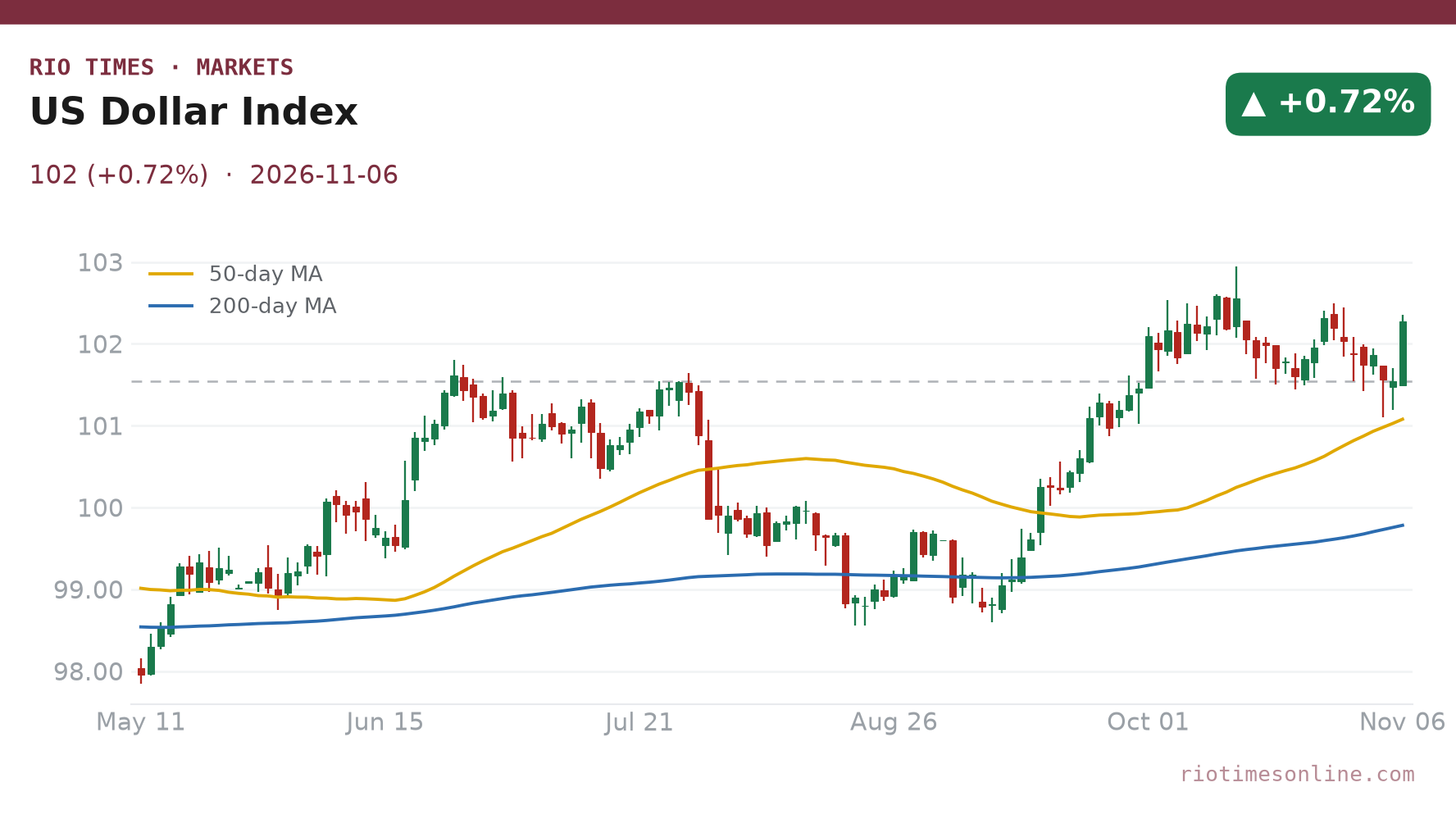
- Yields and the dollar climb together The US 10-year yield rose 0.58% to 4.867% and the dollar index gained 0.72% to 102.279. That combination tightens conditions for emerging markets.
- Brazil holds its benchmark interest rate (the Selic) at 13.75% The central bank paused after five straight quarter-point cuts, with a unanimous vote. A firmer dollar makes any restart of cuts harder to justify.
United States
| Indicator | Actual | Prior | Verdict |
|---|---|---|---|
| Commercial crude stocks (EIA) | 409.8M bbl | about 410.7M | Small draw, mild support for oil |
| Motor gasoline stocks (EIA) | 209.0M bbl | about 209.2M | Marginal draw |
| Distillate stocks (EIA) | 99.3M bbl | about 102.9M | Sharp draw, tight diesel |
| Non-farm payrolls (Oct, BLS) | +165K | +65K expected | Far above forecast; September revised to +60K |
| Unemployment rate (Oct, BLS) | 4.1% | 4.2% expected | Lower than forecast |
| Nonfarm Payrolls Private (Oct, BLS) | +159K | +64K expected | Private hiring led the gain |
| Manufacturing payrolls (Oct, BLS) | +19K | +5K expected | Factories added jobs |
| Government payrolls (Oct, BLS) | +6K | -5K expected | Small gain against a forecast fall |
| Broad U-6 unemployment (Oct, BLS) | 7.9% | 7.6% expected | Wider measure edged up |
| Michigan 1-year inflation expectations (Nov, prelim) | 4.3% | 4.7% expected | Eased from 4.7% in October |
| Michigan 5-year inflation expectations (Nov, prelim) | 3.4% | 3.6% expected | Eased from 3.5% in October |
| US 10-year yield | 4.867% | n/a | Up 0.58% on the day |
Europe & United Kingdom
| Indicator | Actual | Prior | Verdict |
|---|---|---|---|
| Euro area retail sales (Sept, Eurostat) | -0.7% | -0.1% expected | Much weaker than forecast; August was +0.4% |
Asia-Pacific & Emerging Markets
| Indicator | Actual | Prior | Verdict |
|---|---|---|---|
| Japan 3-month bill auction | 1.241 | 1.271 | Lower yield, firm demand |
| China FX reserves (7 Nov) | Est 3.4 trn US$ | 3.4 trn US$ | Flat expected |
| Japan FX reserves (8 Nov, 23:50 Lisbon) | Due | 1178.4 | Watch dollar effect on valuations |
| Brazil Selic (4 Nov) | 13.75% | 14.00% | Held after five cuts |
| Brazil Balance of Trade (Oct, MDIC) | US$9.3B | US$9B expected | Above forecast; September was US$7.74B |
| Brazil CPI, 12 months to Sept | 4.58% | n/a | Above the 4.5% band ceiling |
| Instrument | Level | Session |
|---|---|---|
| S&P 500 (US) | 7,377 | +0.31% |
| Ibovespa (Brazil) | 168,498 | +1.39% |
| USD/BRL | 5.5053 | +0.00% |
Source: market close, 6 November 2026.
Today’s Economic Calendar — Saturday, November 7, 2026
| Time | Country | Event | Consensus | Prior |
|---|---|---|---|---|
| 08:00 | CN | Foreign Exchange Reserves | 3.4 | 3.4 |
| 23:50 | JP | Foreign Exchange Reserves | — | 1178.4 |
Live Market IntelligenceGlobal Markets — Live Board
Rio Times · Live Market Intelligence
Global Markets — Live Board
| Instrument | Last | Change | YoY | Prev. | High | Low | Volume |
|---|---|---|---|---|---|---|---|
| SPX | 7,377 | +0.31% | — | — | — | — | — |
| NDX | 26,990 | +1.35% | — | — | — | — | — |
| DJI | 51,286 | -0.46% | — | — | — | — | — |
| RUT | 2,754 | +0.89% | — | — | — | — | — |
| US10Y | 4.8590 | +0.45% | — | — | — | — | — |
| VIX | 25.64 | -9.01% | — | — | — | — | — |
| DAX | 25,820 | -1.92% | — | — | — | — | — |
| FTSE | 10,674 | -1.01% | — | — | — | — | — |
| CAC | 8,139 | -0.81% | — | — | — | — | — |
| STOXX | 648.33 | -1.00% | — | — | — | — | — |
| NIKKEI | 57,435 | -5.96% | — | — | — | — | — |
| HSI | 24,482 | -1.27% | — | — | — | — | — |
| KOSPI | 5,060 | -6.02% | — | — | — | — | — |
| CSI300 | 4,054 | -1.44% | — | — | — | — | — |
| NIFTY | 25,030 | +2.01% | — | — | — | — | — |
| TSX | 35,789 | +0.52% | — | — | — | — | — |
| GOLD | 4,080 | -0.83% | +2.22% | 4,114 | 4,116 | 4,035 | 166,431 |
| SILVER | 51.97 | -0.51% | +8.73% | 52.23 | 52.38 | 51.20 | 45,936 |
01 A split tape with a nervous undertone
Wall Street ended with two different stories. The Nasdaq Composite rose 1.09% to 24,579, while the Dow Jones Industrial Average fell 0.46% to 51,286.
The S&P 500 gained 0.31% to 7,377. Investors favoured technology growth over the Dow’s older industrial names.
The VIX fell 9.01% to 25.64. That is still a reading that signals real unease beneath the rally.
Bonds and currencies sent a firmer message. The US 10-year Treasury yield rose 0.58% to 4.867%, and the dollar index gained 0.72% to 102.279.
Gold slipped 0.49% to $4,066/oz. Higher yields and a stronger dollar normally cost bullion buyers.
The trigger was the US jobs report from the Bureau of Labor Statistics. Employers added 165,000 jobs in October against a forecast of 65,000, and unemployment fell to 4.1% from 4.2%.
Strong hiring cuts the odds of quick US rate cuts, which explains the firmer yield and dollar. The University of Michigan survey of households showed year-ahead inflation expectations easing to 4.3% from 4.7%.
02 Expensive money, and Brazil feels it first
A higher yield and a stronger dollar on the same day tell a simple story. Markets are pricing money that stays costly for longer.
A 10-year yield at 4.867% lifts borrowing costs for US companies and homebuyers. It also pulls capital away from emerging markets.
Brazil sits right in that line of fire. On 4 November the central bank held the Selic at 13.75%, ending five straight quarter-point cuts, and the vote was unanimous.
Inflation gave the board little room. Consumer prices rose 4.58% in the 12 months to September, according to IBGE, Brazil’s statistics agency, above the 4.5% ceiling of the tolerance band around the 3% target.
A dollar index up 0.72% adds pressure on the real. A weaker real raises import prices and makes cuts harder to defend.
Prediction market Polymarket gave 89.0% odds to no change at the 9 December meeting. It gave 5.7% to a quarter-point cut, as of 6 November, 11 pm ET.
03 Diesel draws and a quiet Asian bid for bills
The US Energy Information Administration reported commercial crude stocks of 409.8 million barrels for the week ending 30 October, down 0.9 million. Gasoline stocks fell 0.2 million to 209.0 million barrels (source: eia.gov, Weekly Petroleum Status Report).
The bigger signal is in distillates. Stocks fell 3.6 million barrels to 99.3 million, which points to tight diesel supply.
Diesel drives freight and farm costs. Brazil imports part of its diesel, so a tight market feeds straight into its inflation debate.
In Japan, the 3-month bill auction cleared at 1.241, against 1.271 previously. A lower yield signals steady demand for short-term paper.
Euro area retail sales fell 0.7% in September, far worse than the 0.1% fall economists expected (source: Eurostat, the EU statistics office). Brazil’s balance of trade showed a surplus of US$9.3 billion in October, a record-sized month for trade flows at US$66.3 billion (source: MDIC, Brazil’s trade ministry).
China’s foreign exchange reserves were due on 7 November, with a consensus of 3.4 trillion US dollars, unchanged. Japan follows on Sunday night at 23:50 Lisbon time, with the previous reading at 1178.4.
What to watch today and this week
- Sunday 8 Nov: Japan foreign exchange reserves at 23:50 Lisbon time, previous 1178.4.
- Monday 9 Nov: Brazil’s Focus survey (the central bank’s weekly poll of economists): do economists still see inflation above the band?
- Next week: Minutes of the Copom, the central bank’s rate committee: how firm is the board on holding the Selic at 13.75%?
- Thursday 12 Nov: IBGE October inflation for Brazil, the key test of the pause.
- 9 December: Next Copom decision, with markets leaning to no change.
Frequently Asked Questions
Why did the Nasdaq rise while the Dow fell?
The Nasdaq Composite gained 1.09% to 24,579 and the Dow fell 0.46% to 51,286. Investors favoured technology growth over the Dow’s industrial mix.
What is the US 10-year Treasury yield now?
It stands at 4.867%, up 0.58% on the day. It sets borrowing costs across the US economy and the global cost of capital.
Why does a stronger dollar matter for Brazil?
The dollar index rose 0.72% to 102.279. A strong dollar weakens the real, lifts import prices and complicates inflation control.
What did Brazil’s central bank decide?
On 4 November it held the Selic at 13.75% by unanimous vote. That ended five consecutive quarter-point cuts.
What is next for the Selic?
The Copom minutes arrive next week, IBGE inflation on 12 November and the next decision on 9 December. Polymarket gave 89.0% odds to no change as of 6 November, 11 pm ET.
This article was produced by The Rio Times’ automated newsroom system. How we use AI · Report an error · Editorial responsibility: Matthias Camenzind, Editor-in-Chief
LatAm Markets: Live Signals → — real-time movers, turnover leaders and FX across Latin America.