Nasdaq Falls 2.9% on Fed Hike Fears | Global Economy, Nov 2
Key Facts
- The Federal Reserve held its benchmark rate at 3.75–4.00% on 28 October but two of its voters dissented in favour of a rise at the 8–9 December meeting
- Prediction markets: Polymarket prices a quarter-point Fed hike in December at 69.5% and no change at 27.5% (US$10.3 million traded, 1 November, 11 pm ET)
- Wall Street’s technology-heavy Nasdaq index closed at 25,437 on Friday, down 2.86% on the session its lowest close in at least 3 months and 7.8% below its 6 October peak, as doubts grew over whether huge artificial-intelligence spending will pay off
- China’s factory survey (the S&P Global manufacturing PMI, where 50 separates growth from shrinkage) came in at 49.7 for October well below the 51.6 analysts expected and down from 52.1 in September, the first sign of contraction in the world’s second-largest economy
- Gold fell 3.31% to $3,875 an ounce and silver fell 5.53% to $49.0705 a sharp reversal for assets usually bought in a panic, because a Fed that may raise rates makes metals that pay no interest less attractive
- The US 10-year Treasury yield, the borrowing cost for the world’s biggest economy, sits at 4.934% while the dollar index is at 101.879 and oil stays near US$100 a barrel on tanker attacks in the Strait of Hormuz
Today’s Focus
The world’s most important central bank has stopped talking about cuts and started talking about a rise. The Federal Reserve held its rate at 3.75–4.00% on 28 October, but Cook and Hammack voted for a quarter-point hike, and the Polymarket betting market now gives a December hike about a 70% chance.
That shift collided with Friday’s tech rout. The Nasdaq, home to the big American technology groups, closed at 25,437, down 2.86% on the session and its lowest close in at least 3 months.
Money that was cheap for years is no longer cheap, and investors are asking harder questions of companies spending heavily on artificial intelligence. A soft China survey and oil near $100 a barrel add to the unease before US midterm elections on 3 November.
What matters today. The rate path has turned from cuts to a possible hike, and expensive technology shares plus oil near $100 are the first to feel it.
| Instrument | Level | Session |
|---|---|---|
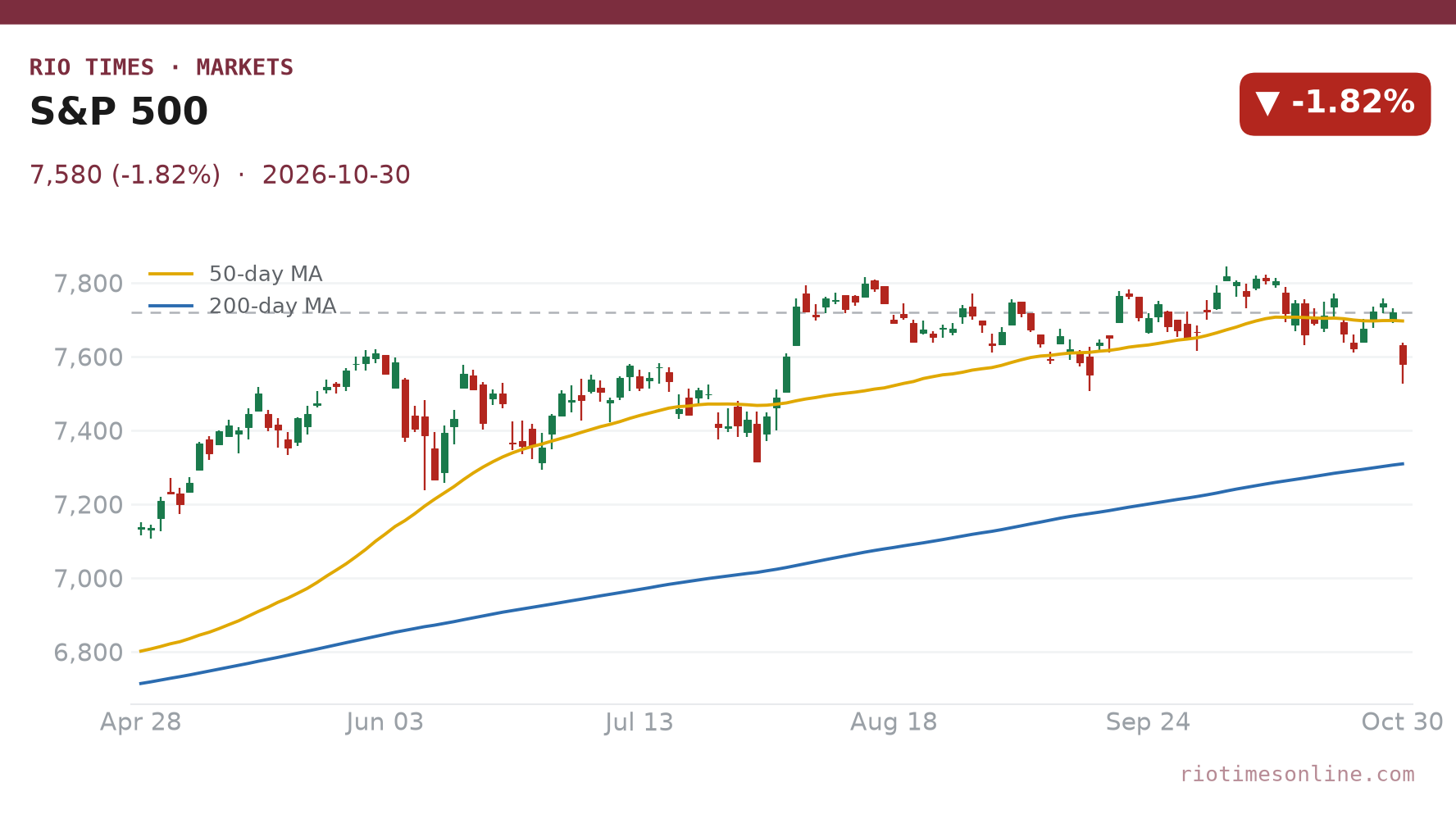
| S&P 500 (US) | 7,580 | -1.82% |
| Ibovespa (Brazil) | 167,922 | -0.75% |
| USD/BRL | 5.4385 | +1.08% |
Source: market close, 30 October 2026.
01 The world in one read
Think of the world economy as a driver who had eased off the brake and now sees the road climb again. The Fed’s 10–2 vote to hold rates on 28 October hid a louder message: two members wanted a rise, and regional Fed presidents said on Friday that the central bank may still need to raise rates.
Technology shares took the first hit, with the Nasdaq closing at 25,437. China’s weak factory survey and a gold and silver rout added to a risk-off mood, though Asian equities fell less than Wall Street today and US stock futures were pointing higher.
The evidence points to a repricing, not a crash: the VIX fear gauge rose to 19.42, well short of crisis levels, and Friday’s drop followed a rally that took the Nasdaq to a peak on 6 October. The ordering of causes is rate expectations first, tech earnings doubts second and China’s slowdown third, though the Fed’s role rests on secondary reports I could not tie to a primary source.
Gold’s fall alongside equities fits a stronger-for-longer rate story rather than a flight to safety. The variable to watch is the US jobs report on 6 November, because a strong number would harden the December hike.
02 The global board
| Instrument | Level | Change | Read |
|---|---|---|---|
| Nasdaq | 25,437 | −2.86% | Lowest close in at least 3 months |
| S&P 500 | 7,580 | −1.82% | 3.1% below its 6 October high |
| VIX fear gauge | 19.42 | +12.91% | Nerves up, not panic |
| US 10-year yield | 4.934% | −0.08% | Borrowing costs stay high |
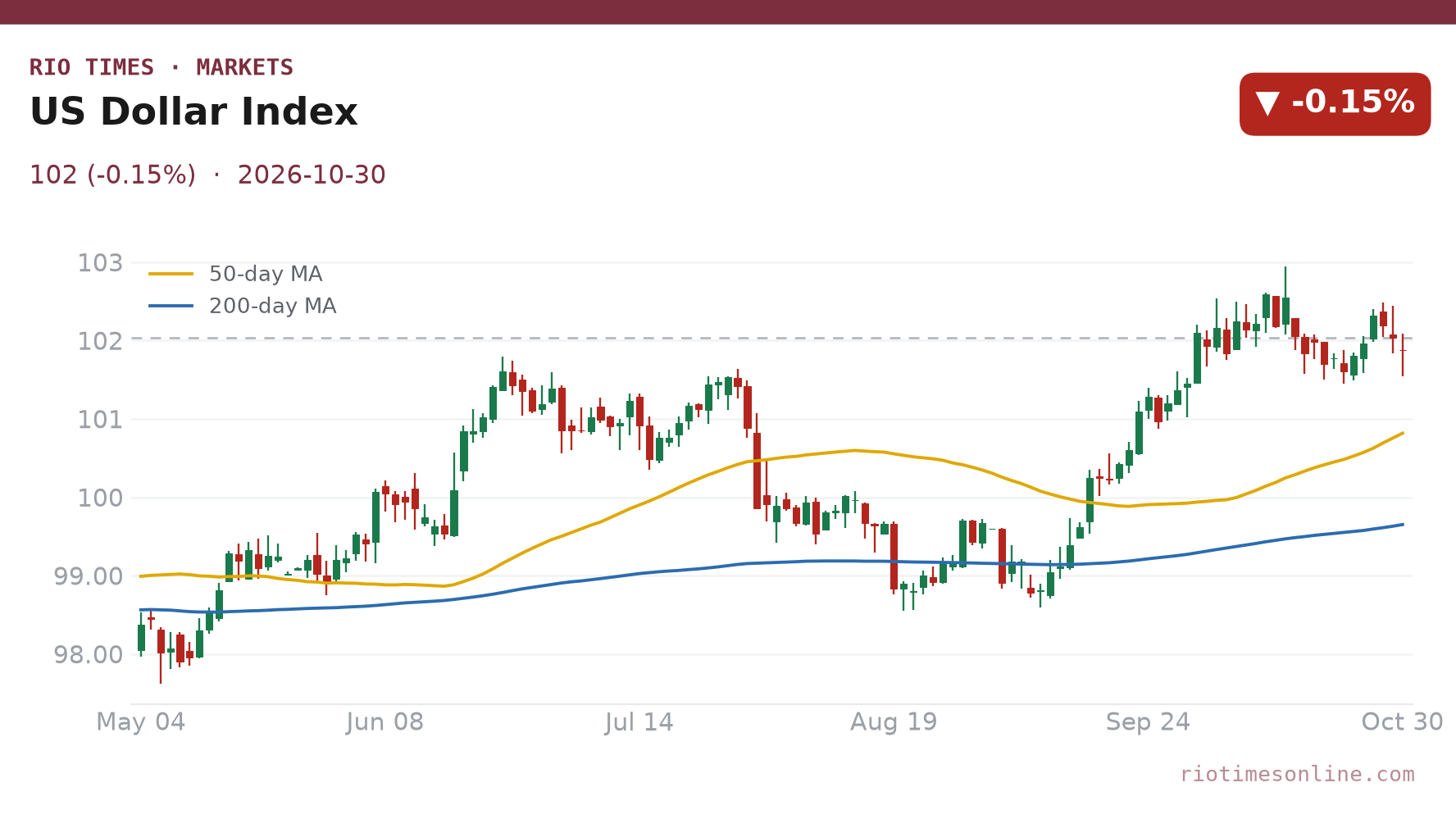
| Dollar index | 101.879 | −0.15% | Little changed on the week |
| Gold | $3,875/oz | −3.31% | Rate-hike fears bite |
The table shows a market under pressure but not in disarray. The dollar and bond yields barely moved, so the damage came from shares and metals rather than a run for cover.
The VIX, Wall Street’s gauge of expected volatility, jumped but stayed under 20. That is a nervous reading, not a frightened one. Rio Times · Live Market Intelligence
Live Market IntelligenceGlobal Markets — Live Board
Global Markets — Live Board
Instrument Last Change YoY Prev. High Low Volume
SPX
7,722
+0.59%
—
—
—
—
—
NDX
29,646
+1.27%
—
—
—
—
—
DJI
52,367
+0.01%
—
—
—
—
—
RUT
2,814
+0.97%
—
—
—
—
—
US10Y
4.9950
+0.18%
—
—
—
—
—
VIX
17.75
-3.48%
—
—
—
—
—
DAX
25,591
+0.71%
—
—
—
—
—
FTSE
10,687
-0.75%
—
—
—
—
—
CAC
7,887
+0.51%
—
—
—
—
—
STOXX
643.68
+0.47%
—
—
—
—
—
NIKKEI
63,268
+1.73%
—
—
—
—
—
HSI
23,041
-0.23%
—
—
—
—
—
KOSPI
5,638
+3.09%
—
—
—
—
—
CSI300
4,050
-1.32%
—
—
—
—
—
NIFTY
22,750
+0.66%
—
—
—
—
—
TSX
36,123
+0.50%
—
—
—
—
—
GOLD
4,073
+0.85%
+1.32%
4,038
4,079
4,002
117,083
SILVER
54.49
+0.70%
+17.02%
54.11
54.64
52.71
34,428
03 The main event — Fed hike talk meets a tech reckoning
The Fed’s pause was hawkish: Cook and Hammack dissented in favour of a quarter-point rise, and Polymarket, a prediction market where traders bet real money, now puts the chance of a December hike near 70% (see the box below).
The second cause is a reckoning over artificial intelligence. Disappointing tech earnings raised doubts about whether huge spending on chips and data centres will pay off, and the Nasdaq fell 2.86% to its lowest close in at least 3 months.
Our own history offers context. The Nasdaq fell 2.9% over 20 sessions, and in the 54 earlier cases with a move that large since 2007, it was higher 20 sessions later in 36 of them, or 67%, with a median gain of 3.9%.
The worst case was a further fall of 20.6%, so history is not a forecast. The 12-month low of 20,795 on 30 March and the October peak of 27,600 frame the chart.
What Prediction Markets Say
Fed, December: a 25-basis-point rise 69.5%, no change 27.5%, a larger rise 1.5% (Polymarket, US$10.3 million traded).
Brazil, November: no change 82.7%, a 25-basis-point cut 17.5% (Polymarket, US$126,000 traded).
Mexico, November: no change 87.0%, a 25-basis-point cut 12.8% (Polymarket, US$180,000 traded).
These prices are bets, not polls, as of 1 November, 11 pm ET. A basis point is one hundredth of a percentage point.
Why we show this: prediction markets turn real-money bets into a live probability that moves within minutes of the news, which is why investors, campaigns and newsrooms in the United States now follow them closely. We show them next to polls and official results, never instead of them.
04 Policy and data
Friday’s data filled in the picture. Euro-area GDP grew 0.4% in the third quarter against 0.2% expected and 0.6% before, while euro-area unemployment held at 6.5% (forecast 6.4%). The Bank of Japan kept its policy rate at 1.25%, as expected. The Chicago PMI, a Midwest business survey, fell to 55.3 from 58.8. Brazil’s unemployment rate was 5.2% in the three months to September, and Mexico’s economy grew 3.2% year on year in the third quarter against 2.5% expected and 2.1% before. Source: RT economic calendar (RT).
The data calendar is crowded. The ISM manufacturing survey, a closely watched US factory gauge, is due today with analysts expecting 54.7 against 54.5 before, and Fed official Goolsbee speaks at 16:15 Lisbon time.
Wednesday’s US midterm elections add political risk, and the US Treasury announces its quarterly refunding plans on Wednesday. In Europe the European Central Bank held rates and the euro touched its lowest level since May 2025, according to secondary reports.
Sweden’s Riksbank decides on 4 November, and the Bank of England and Norges Bank follow on 5 November. The US payrolls report on 6 November is the big one, since a strong jobs number would harden the case for a December rise.
05 Commodities and currencies
Oil is holding around $100 a barrel on Middle East tensions and tanker attacks in the Strait of Hormuz, the narrow sea lane for much of the world’s crude. Official US data from the Energy Information Administration (eia.gov) showed commercial crude stocks at 410.6 million barrels for the week to 23 October, down 1.9 million.
Gold and silver told the opposite story to safety. Gold fell 3.31% and silver 5.53%, because a rate rise raises the appeal of cash and bonds over metals that pay nothing.
The dollar index at 101.879 was almost flat, while the yen trades near 157.5 per dollar. A dollar that stays firm keeps pressure on emerging-market currencies.
06 The Latin American read-through
Latin America feels this as a stronger dollar and dearer money. Brazil’s real weakened, with the dollar up 1.08% to 5.4385 reais, and the Ibovespa, Brazil’s main stock index, closed at 167,922 after five straight falls, 19.7% below its 9 October peak but 14.3% above its 12-month low.
Chile’s IPSA fell 2.76%, Peru’s BVL fell 3.43% and Argentina’s Merval fell 2.59%, while Mexico’s peso gained, with the dollar down 0.41% to 18.7895 pesos. Brazilian steelmakers USIM5 and CSNA3 fell 8.6% and 8.5% on China’s weak factory survey, while miner Vale (VALE3) rose 3.3% on R$2,162m of turnover.
Brazil’s central bank (the Copom committee) decides on 4 November: Brazil’s benchmark Selic rate stands at 13.75%, and Polymarket traders see an 82.7% chance that it stays unchanged. Mexico’s Banxico decides on 5 November at 6.50%, and Polymarket gives about an 87% chance of a hold.
For a traveller or expat paid in dollars, a weaker real stretches the money in Brazil. For a Brazilian borrower, a Fed that hikes shrinks room for domestic cuts.
07 What to watch
- US ISM manufacturing, today: Expected at 54.7 versus 54.5 before; a strong print adds to hike bets.
- US midterms, 3 November: Election results could shift fiscal and tariff expectations and bond yields.
- Copom and Banxico, 4–5 November: Brazil’s 13.75% rate and Mexico’s 6.50% rate show how far Latin America can ignore the Fed.
- US payrolls, 6 November: The jobs report is the last big input before the Fed’s 8–9 December meeting.
Background: Nasdaq Falls 2.9% as Japan Keeps Rates.
Background: Fed Holds US Rate as S&P 500 Gains 0.3%.
Frequently Asked Questions
Will the Fed raise interest rates in December?
The Polymarket prediction market gives about a 70% chance of a quarter-point rise at the 8–9 December meeting. Nothing is decided, and the 6 November jobs report could change that.
Why did the Nasdaq fall?
Disappointing tech earnings and doubts over the payoff from AI spending hit shares on Friday, when the Nasdaq closed at 25,437, down 2.86%. Rate-hike talk made expensive growth shares less attractive.
Why did gold fall as shares fell?
Gold fell 3.31% to $3,875 an ounce because higher interest rates make metals that pay no interest less appealing. Investors sold gold alongside shares rather than buying it as shelter.
What does it mean for Brazil?
A firm dollar weakens the real and weighs on the Ibovespa, and it limits the room for Brazil’s central bank to cut rates. The Copom decision on 4 November is the next test.
Market data: The Rio Times
This article was produced by The Rio Times’ automated newsroom system. How we use AI · Report an error · Editorial responsibility: Matthias Camenzind, Editor-in-Chief
LatAm Markets: Live Signals → — real-time movers, turnover leaders and FX across Latin America.