GAMBIA · NEIGHBOURHOOD
Key Facts
- The country Gambia: 2.8 million people in 2025 and a US$2.6 billion economy, a thin strip of land along the Gambia River.
- Land neighbour Senegal, which wraps around Gambia on every side except its Atlantic coast and has 6.7 times as many people.
- Shared grid A 1,677 km power-line project was designed to link Gambia, Senegal, Guinea and Guinea-Bissau through their river-basin group, the OMVG.
- Regional force An ECOWAS force has stood in Gambia since 2017, and a Senegalese battalion served in it in October 2026.
- Money from abroad Gambians abroad sent home US$617 million in 2025, 23.8% of the economy, the highest share among its neighbours.
Gambia neighbours one country on land, Senegal, which surrounds it on three sides. This guide explains how trade, a shared river, a regional force, refugees and remittances tie Gambia to Senegal and the lands beyond.

Gambia and Its Neighbours in Plain English
Gambia is a small West African country, a narrow ribbon of land along both banks of the Gambia River. Its capital is Banjul.
This guide builds on our Africa hub and our Gambia explainer. It looks at who lives next door and why it matters.
Gambia neighbours Senegal directly. Guinea-Bissau and Guinea lie beyond Senegal to the south, and Mauritania lies beyond it to the north.
- ECOWAS: the Economic Community of West African States, a regional club with 12 member states and its headquarters in Abuja, Nigeria.
- ECOMIG: the ECOWAS Mission in The Gambia, a regional force that has been deployed in the country since 2017.
- OMVG: the Gambia River Basin Development Organization, a group of Gambia, Senegal, Guinea and Guinea-Bissau that manages shared river and power projects.
- UNHCR: the United Nations refugee agency, which counts refugees and asylum seekers country by country.
- World Bank: the global development lender, which publishes population, income, trade and migration data for every country.
One Neighbour on Three Sides
Senegal surrounds Gambia on the north, east and south, so any journey by land from Gambia leads into Senegal. Gambia covers about 11,300 square kilometres, while Senegal covers about 196,700, about 17 times as large (World Bank, 2023).
The gap in people and money is just as wide. In 2025 Senegal had 18.9 million people and a US$37.0 billion economy, against 2.8 million and US$2.6 billion in Gambia (World Bank).
Guinea has 15.1 million people and a US$28.3 billion economy, while Mauritania has 5.3 million people and US$11.7 billion (World Bank, 2025). Guinea-Bissau, with 2.2 million people and US$2.5 billion, is closest to Gambia in size.
Of the five countries compared here, Gambia has the smallest area. Guinea-Bissau has the smallest population.
Gambia’s own income is modest. The Gambia Bureau of Statistics, the national statistics office, put output at US$1,030 per person in 2024.
The same office put the national poverty rate at 53.4% in 2020. Gambia’s economy grew 5.9% in 2025, according to the World Bank.
About 65% of Gambians lived in towns in 2025 (World Bank). Senegal’s economy grew 6.7% that year, so the larger neighbour is not standing still.
Because of that shape, Gambia cannot pursue a foreign policy that ignores Senegal. Our Senegal neighbourhood guide looks at the same relationship from Dakar’s side.
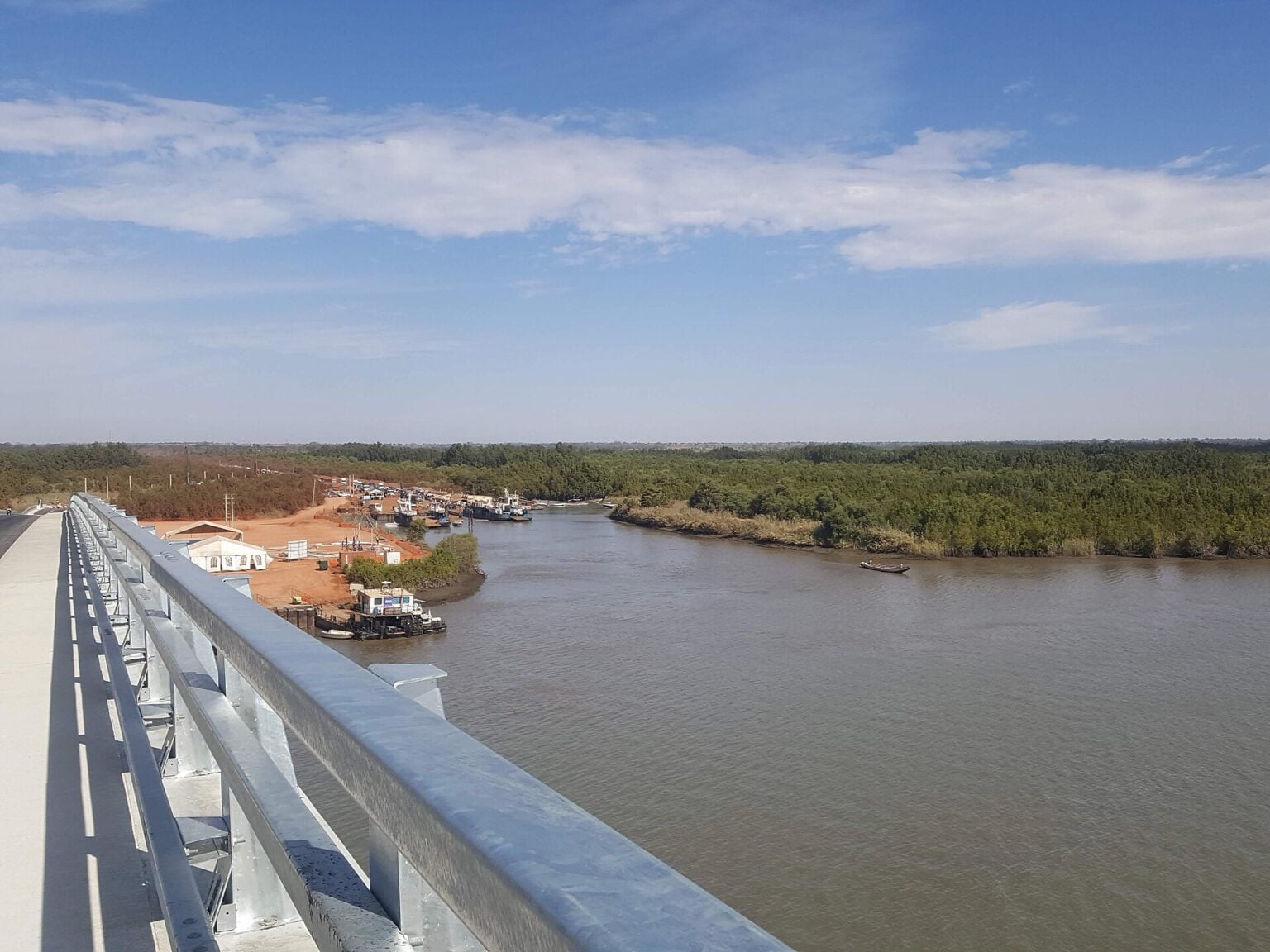
A Regional Force and Shared Border Rules
ECOWAS says its force, ECOMIG, has been in Gambia since 2017 to help keep the peace and support democratic government. Colonel Aliou Tine became Force Commander on 8 January 2026 and pledged to support peaceful elections.
ECOWAS reported on 28 October 2026 that Nigerian, Ghanaian and Senegalese units serve in the mission. From 19 to 22 October they joined Gambia’s army, police and fire service in a breast-cancer awareness week around Banjul.
On 27 October 2026 the ECOWAS Head of Mission, Namizata Sangare, made her first visit to the force headquarters in Bakau. ECOWAS said the talks covered the force’s mandate and its work with Gambian authorities.
Border questions are also discussed by the neighbours themselves. From 6 to 8 October 2026 ECOWAS held the third meeting of West Africa’s national boundary commission heads in Gambia.
A Senegalese major general chaired it, and the host’s own boundary commission chair, Alieu Njie, welcomed the delegates. ECOWAS says they reviewed progress on earlier recommendations and on border governance across the region.
Daily trade often moves through small border markets rather than big ports. On 17 June 2026 ECOWAS and Gambia’s trade ministry commissioned a modernised market at Wellingara-Ba in the Lower River Region.
It has market sheds, a solar-powered borehole and street lights, and ECOWAS says it also serves traders from Senegal and Guinea-Bissau. It was paid for through the ECOWAS Cross-Border Cooperation Support Programme, which runs from 2023 to 2027.
Gambia is one of twelve member states that launched a national platform under that programme. Each of the twelve later received a US$100,000 grant for cross-border projects.
Trade and Money Across the Border
Gambia buys far more than it sells. Its trade data for 2023 show US$2.4 billion of imports and only US$83 million of exports (World Bank trade database, WITS).
Senegal supplied US$140 million, or 5.7%, of those imports. The same data record just US$1 million of Gambian exports to Senegal.
Guinea-Bissau took US$59 million of Gambian exports in 2023, about 71% of the total. That made it by far the largest buyer of Gambian goods that year.
The largest flow of money into Gambia comes from people living abroad rather than from its neighbours. The World Bank counts US$617 million of remittances in 2025, equal to 23.8% of Gambia’s economy, up from US$529 million in 2024.
The latest shares were 10.6% in Senegal (2023), 9.9% in Guinea-Bissau (2024), 2.5% in Guinea (2024) and 0.9% in Mauritania (2024). Our remittances report looks at the record flow in more detail.
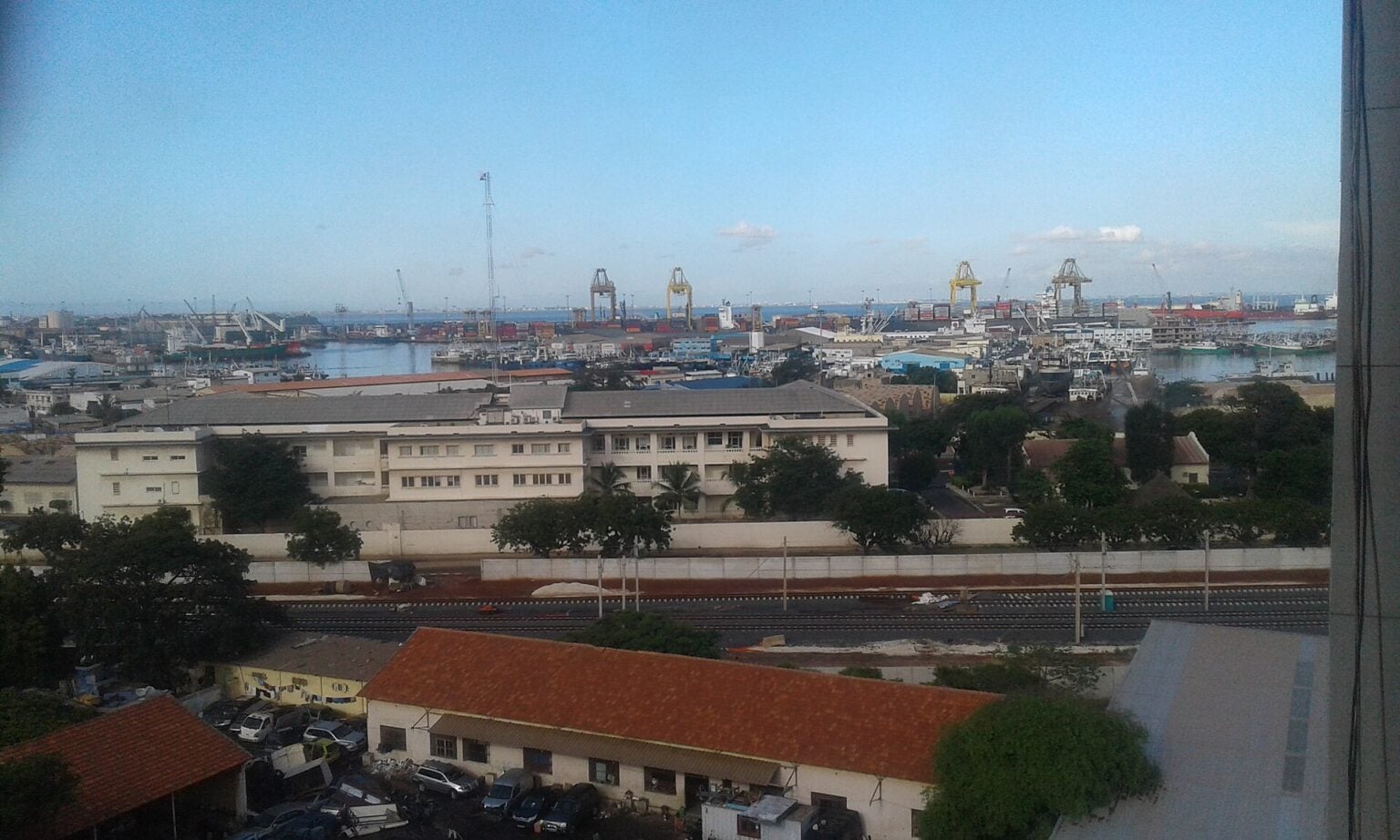
The River and the Power Line
The Gambia River gives the country its name and its shape, and its basin is shared with three neighbours through the OMVG. That river-basin organization links Gambia, Senegal, Guinea and Guinea-Bissau.
The World Bank approved its OMVG Interconnection Project on 29 April 2015 and closed it on 30 June 2025. The aim was to build 1,677 kilometres of 225-kilovolt lines with 800 megawatts of capacity and fifteen substations.
The point of that grid is to let the four countries buy and sell electricity across their borders. The project also paid for technical help to the OMVG itself.
The river and the Atlantic give Gambia a fishing coast, shown in our cover photo of painted boats at Tanji. For a country this narrow, the river shapes almost everything.
People on the Move Between Gambia and Its Neighbours
Gambia shelters a small number of refugees, mostly from Senegal. UNHCR counted 4,214 refugees and 552 asylum seekers there on 31 May 2026.
Of those refugees, 93.7%, or 3,949 people, came from Senegal. Movement in the other direction is far smaller.
UNHCR counted only 20 Gambian refugees and 173 Gambian asylum seekers in Senegal at the end of 2025. Many more Gambians seek protection far from West Africa.
The World Bank counts 236,137 foreign-born residents in Gambia in 2024, against 281,867 in Senegal and 195,937 in Mauritania. Guinea has 117,416 and Guinea-Bissau only 15,064.
The largest groups of Gambian refugees and asylum seekers at the end of 2025 were in Germany, Italy and the United States. Spain, France and Canada follow.
Where Gambia Leads and Where It Follows
Gambia stands out in three ways. It hosts the ECOWAS force and hosted the October 2026 border meeting.
It also relies on remittances more than the four neighbours compared here. On almost everything that depends on size, from population to output, it follows Senegal.
Our stories on a boat that sank off Jinack and a migrant boat from Gambia that reached El Hierro cover sea journeys.
What It Means for US Readers
UNHCR counted 949 Gambian refugees and 998 Gambian asylum seekers in the United States at the end of 2025. That is about ten times the 193 counted in neighbouring Senegal.
For a regional comparison see our guide to Liberia and its neighbours. Liberia, Sierra Leone, Ghana and Nigeria are among the twelve states with a national border platform.
What Is Not Known
An ECOWAS pre-election mission in June 2026 assessed Gambia’s readiness for a presidential election on 5 December 2026. The ECOMIG commander has pledged support for peaceful elections.
The result of that vote is not yet known. How trade and border rules with Senegal develop afterwards is worth following.
Frequently Asked Questions
Which country borders Gambia?
Senegal is Gambia’s only land neighbour and surrounds it on the north, east and south. The Atlantic Ocean forms Gambia’s short western coast.
How big is Gambia compared with Senegal?
Gambia covers about 11,300 square kilometres and had 2.8 million people in 2025. Senegal covers about 196,700 square kilometres and had 18.9 million people.
What is ECOMIG?
It is the ECOWAS Mission in The Gambia, a regional force deployed since 2017. In October 2026 Nigerian, Ghanaian and Senegalese units were serving in it.
What is the OMVG?
It is the Gambia River Basin Development Organization, formed by Gambia, Senegal, Guinea and Guinea-Bissau. A World Bank project backed a power grid to let the four trade electricity.
Does Gambia host refugees?
Yes, a small number. UNHCR counted 4,214 refugees in Gambia on 31 May 2026, and 93.7% of them came from Senegal.
How important are remittances to Gambia?
Very. The World Bank counts US$617 million sent home in 2025, equal to 23.8% of Gambia’s economy.
When is Gambia’s next presidential election?
An ECOWAS mission in June 2026 assessed readiness for a presidential election on 5 December 2026.
Sources: World Bank, World Development Indicators for Gambia, Senegal, Guinea, Guinea-Bissau and Mauritania (population, area, GDP, remittances, migrant stock), 2026-10-29; World Bank WITS, Gambia trade summary 2023, 2026-10-29; World Bank, OMVG Interconnection Project (P146830), 2026-10-29; UNHCR Refugee Data Finder, Gambia as country of asylum and of origin, 2025, 2026-10-29; UNHCR Operational Data Portal, Gambia, data of 31 May 2026, 2026-10-29; Gambia Bureau of Statistics, national data (GDP per person 2024, poverty rate 2020), 2026-10-29; ECOWAS, ECOMIG pink October campaign, 28 October 2026, 2026-10-29; ECOWAS, Head of Mission visit to the ECOMIG force headquarters, 29 October 2026, 2026-10-29; ECOWAS, new ECOMIG Force Commander, 14 January 2026, 2026-10-29; ECOWAS, third meeting of heads of national boundary commissions, 12 October 2026, 2026-10-29; ECOWAS, commissioning of Wellingara-Ba Lumo, 28 June 2026, 2026-10-29; ECOWAS, national platforms for the Cross-Border Cooperation Support Programme, 29 October 2026, 2026-10-29; ECOWAS, pre-election mission to Gambia, 18 June 2026, 2026-10-29.
This article was produced by The Rio Times’ automated newsroom system. How we use AI · Report an error · Editorial responsibility: Matthias Camenzind, Editor-in-Chief
Brazil runoff date: Sunday, October 25, poll closing times and when results start · Brazil runoff polls: Flávio 51%, Lula 49% · Kalshi and Polymarket odds
Rotate for Best Experience
This report is optimized for landscape viewing. Rotate your phone for the full experience.
You've reached your free article limit
Subscribe to The Rio Times for unlimited access to our reporting from across Africa.
Keep reading for free
Your first article was on us. Register with your email address to read 6 free articles every month. You will also receive Africa Intelligence: African markets, politics and business, every weekday morning.