
ESWATINI · EXPLAINED
Key Facts
- —What is happening Eswatini, a landlocked kingdom of about 1.26 million people between South Africa and Mozambique, is ruled by King Mswati III, on the throne since 1986, with Prime Minister Russell Dlamini heading the cabinet in October 2026.
- —Why it matters Eswatini is a close ally of Taiwan, and its king was hosted at a state banquet in Taipei on 9 October 2026. A US law giving duty-free access, the African Growth and Opportunity Act (AGOA), ends on 31 December 2026 unless renewed.
- —The numbers Output was US$5.16 billion in 2025, or US$4,108 per person, and the 2026/27 budget plans spending of E36.92 billion, in emalangeni, the national currency (about US$2.22 billion), with a deficit of 4.9% of GDP.
- —Who is who King Mswati III holds executive authority, Russell Dlamini is prime minister, Pholile Shakantu is foreign minister, Jabulani Mabuza is Speaker of the House of Assembly and Pastor Lindiwe Dlamini presides over the Senate.
- —What to watch Watch whether the United States renews AGOA before 31 December 2026, whether the budget deficit that overshot plan in 2025/26 is brought down, and how the new legal assistance agreement with Taiwan is carried out.
- —What it means for you US goods exports to Eswatini were only US$44.2 million in 2025, so direct trade is small. Check the US State Department travel advisory before you book.
A small kingdom sits between South Africa and Mozambique. Its king holds executive power, and it is a close ally of Taiwan.
Eswatini explained for a newcomer: a landlocked kingdom of 1.26 million people, ruled by King Mswati III since 1986. This guide covers its land, politics, money, society and ties with Taiwan and the United States as of October 2026.
More coverage sits on the Rio Times Eswatini page. Conversions use E16.64 per US$1, the open.er-api.com rate of 27 October 2026 (00:02 UTC).
Eswatini Explained: Land and People
Eswatini sits between South Africa and Mozambique and covers 17,364 square kilometres. Mbabane is the administrative capital, and Matsapha is the main industrial area, the country’s report to the United Nations says.
The country has four regions: Hhohho, Manzini, Shiselweni and Lubombo. Each region is divided into tinkhundla, local constituencies that also elect members of parliament.
The 2017 census counted 1,093,238 people, and 76.2% of them lived in rural areas. The World Bank, a global development lender, put the 2025 population at 1,256,174, with 26.7% in towns.

About 97.8% of people are Emaswati, the name for the people of Eswatini, and Christians made up 89.25% of the 2017 count. The official languages are siSwati and English.
In 2025, 33.0% of people were under 15 and 4.3% were 65 or older, World Bank data show. Life expectancy was 64.3 years in 2024, and fertility was 2.7 births per woman.
How the Kingdom Is Governed
King Mswati III has reigned since 1986, and the constitution vests executive authority in him as head of state. Taiwan’s presidential office noted in April 2026 that the year marks 40 years since his accession.
He renamed the country Eswatini in 2018, replacing Swaziland, says Freedom House, a US rights group. The constitution of 2005, in force since 8 February 2006, still uses the older name.
The king appoints the prime minister from the House of Assembly, on the advice of the King’s Advisory Council. He names ministers on the prime minister’s advice, and at least half must come from the elected House.
Parliament has two chambers, the Senate and the House of Assembly. The constitution allows up to 31 senators, 20 of them named by the king, and up to 76 House members.
Voters elect House members one constituency at a time under the Tinkhundla system, in place since 1978. The constitution stresses individual merit, and political parties cannot register or contest elections, Freedom House says.
In the September 2023 election, 59 House members were elected and the king could name up to 10 more. Only 8 of the 59 elected seats went to women, Freedom House reports.
The group says African Union observers, from the continental bloc, called the vote peaceful but urged a party ban review. The group rated Eswatini Not Free in 2026, with 17 points out of 100.
Riots in June 2021 caused deaths and damage, and a protest ban followed in October 2021. Human rights lawyer Thulani Maseko was killed at home in January 2023, and Freedom House said it was unsolved by year end.
Who Is Who in October 2026
Russell Mmiso Dlamini became prime minister after the September 2023 election, and he received Taiwan’s president on arrival on 2 May 2026. The king appointed him, as the constitution provides.
Foreign Minister Pholile Shakantu signed a customs agreement with Taiwan on 2 May and attended the 9 October Taipei banquet. Justice Minister Prince Simelane and Commerce Minister Manqoba Khumalo attended it too.
Neal Rijkenberg, the finance minister, presented the 2026/27 budget to parliament on 27 February 2026. The budget figures in this guide come from that speech.
Parliament’s website names Pastor Lindiwe Dlamini as Senate president and Jabulani Mabuza as Speaker of the House of Assembly. The courts are the Supreme Court and the High Court, and Roman-Dutch and customary law both apply.
How the Economy Works
The World Bank puts Eswatini’s 2025 output at US$5.16 billion, or US$4,108 per person. It says services make up just over half of output and industry about a third.
Manufacturing was 28.1% of GDP in 2025 and agriculture 6.4%, World Bank data show. The bank says the current account surplus was 2.6% of GDP in 2025.
Exports of goods and services equalled 53.8% of GDP in 2024, so the economy is open and exposed to its neighbours. The World Bank says about 70% of electricity is imported from South Africa.
Growth was 4.8% in 2025, the World Bank says, while the finance ministry’s preliminary figure is 5.6%. For 2026 the World Bank forecasts 3.8% and the finance ministry projects 5.2%.
Inflation was 2.9% in September 2026, and the central bank’s bank rate was 7.0%. The World Bank put average inflation at 3.1% in 2025.
Jobs are the weak point: 52.2% of people aged 15 to 24 are unemployed, the World Bank says. It adds that 54% of people live below US$4.20 a day and that its Gini inequality index is 51.2.
Public Money, Debt and the Rand Link
The 2026/27 budget plans spending of E36.92 billion (about US$2.22 billion) against revenue and grants of E31.90 billion (US$1.92 billion). The planned deficit is E5.02 billion (US$302 million), or 4.9% of GDP.
The finance ministry expects the 2025/26 deficit to reach 6.4% of GDP, against 3.1% budgeted. Receipts from the Southern African Customs Union, a regional customs pool, are projected at E11.74 billion (US$706 million).
The public wage bill is E12.44 billion (US$748 million), about 33% of spending, and the ministry wants it below 30% over time. Education gets E6.4 billion (US$385 million) and health E3.24 billion (US$195 million).
The World Bank puts government debt at about 44% of GDP. It says 2026 interest costs are budgeted above health spending, and reserves cover 2.7 months of imports.
The lilangeni (plural emalangeni) is pegged one to one to the South African rand, the central bank says. On 27 October 2026 the rate was E16.64 per US$.
The central bank says the peg helps import low, stable inflation, because South Africa is the main trading partner. Eswatini’s bank rate stood at 7.0% in September 2026.
Society and Daily Life
Christians were 89.25% of the 2017 census population, and 7.40% reported no religion. Literacy was 96.0% in 2017, and 89.3% of people had electricity in 2024, World Bank data show.
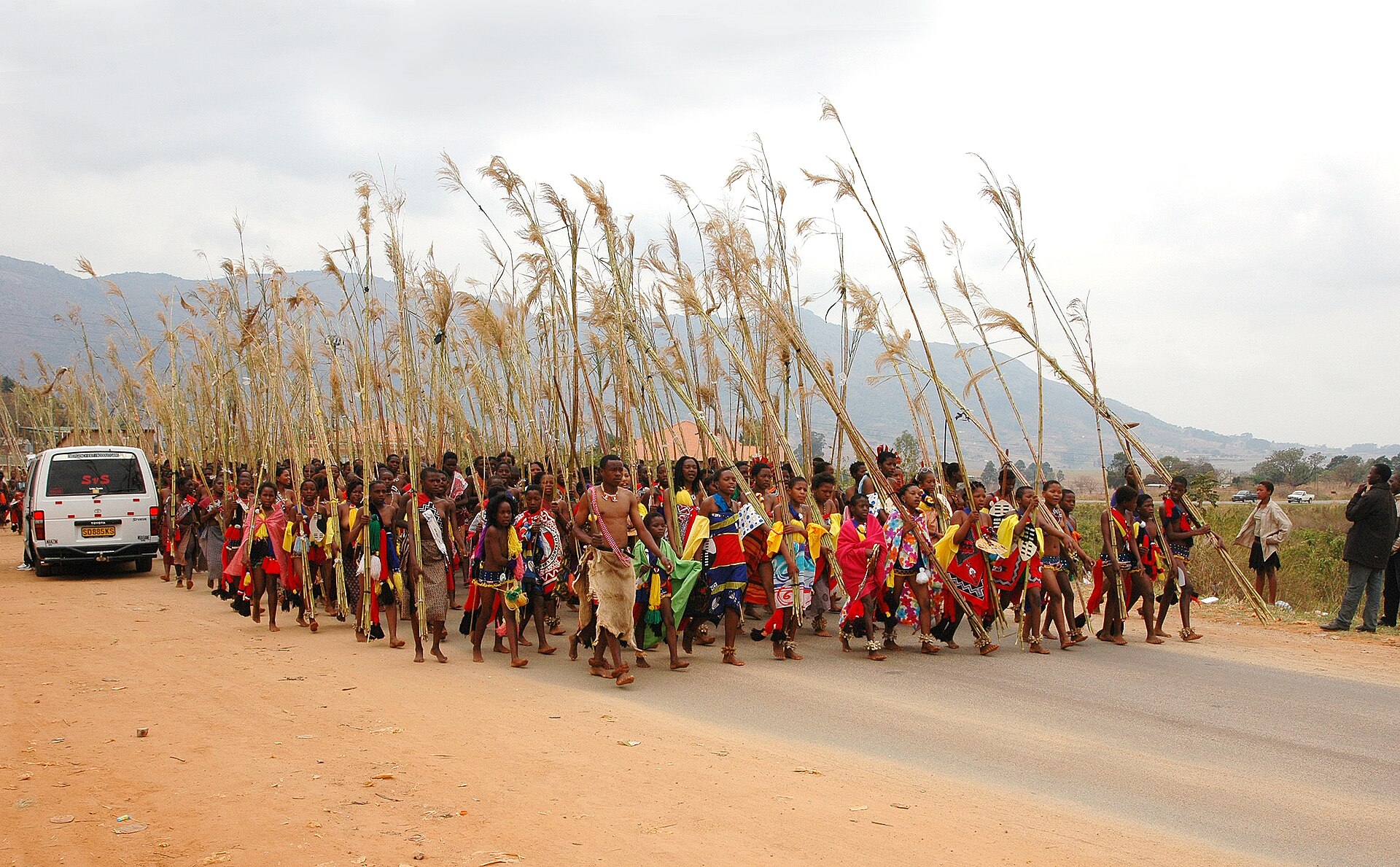
Public ceremonies are part of national life; the picture here shows a Reed Dance procession in 2006. Current dates and attendance were not checked against an official source.
HIV is the great health burden: World Bank data put prevalence among people aged 15 to 49 at 23.4% in 2024. Health spending was 7.5% of GDP in 2023.
Internet use reached 63.4% in 2024, up from 57.3% in 2022, World Bank data show. Women held 17.3% of parliamentary seats after the 2023 election, Freedom House reports.
The 2026/27 budget includes E130.5 million (about US$7.8 million) for a Population and Housing Census. The finance minister said the count is to be held in 2027.
Foreign Friends: Taiwan, South Africa and the United States
Taiwan’s presidential office calls the two countries steadfast allies and noted 58 years of relations in April 2026. President Lai Ching-te visited from 2 to 5 May 2026, after an April postponement his office blamed on unjustified outside interference.
The two governments signed a customs mutual assistance agreement and a joint communiqué on 2 May 2026. On 3 May Lai was briefed on an oil reserve and an industrial park, and toured the International Convention Centre.
King Mswati III then visited Taipei, with a state banquet on 9 October 2026 and a base visit on 11 October. Taiwan’s presidential office says it trained 11 Emaswati pilots and maintenance officers in 2019 and 2020, linked to a UH-1H helicopter transfer.
In Taiwan’s account, the king said every nation has the right to choose its own friends and urged peaceful dialogue. Taiwan’s president called the bond “the most precious asset two nations can share”.
South Africa is the dominant neighbour: it supplies about 70% of electricity and anchors the currency. The central bank calls it Eswatini’s major trading partner.
The US Trade Representative (USTR), the US trade agency, says Eswatini’s customs bloc signed a pact with the US in 2008. Eswatini also belongs to a regional trade bloc that signed a framework deal with the US in 2001.
What It Means for US Readers
Direct trade is small: in 2025 US goods exports to Eswatini were US$44.2 million and imports US$25.2 million. USTR adds that services trade was US$419.0 million.
Eswatini is one of 33 sub-Saharan countries designated for AGOA in 2026, the US law that gives duty-free access to many goods. The programme is set to expire on 31 December 2026 unless it is reauthorised.
Eswatini was not among the 60 economies in the forced-labour Section 301 investigations that USTR opened in March 2026. USTR’s July 2026 tariff action names rates for investigated economies only, so none is stated for Eswatini.
The US State Department’s travel advisory for Eswatini could not be opened for this guide, so check its current rating before booking. Freedom House says security forces used tear gas, rubber bullets and live ammunition on protesters in 2021 and 2022.
Visitors can see nature reserves such as Malolotja and Mlilwane, and the 2026/27 budget sets aside E194.4 million (US$11.7 million) for tourism. Expats can start with the Rio Times guide to living in Eswatini.
Investors face a small market and top-down rule. Rio Times coverage includes the central bank rate decision, the growth forecast and electricity supply.
For the wider region, see the Southern Africa page. Another Rio Times report looks at foreign contractors in Eswatini.
What Is Not Known
The US tariff that applies to Eswatini goods today was not confirmed from a USTR notice. Whether the United States will renew AGOA after 31 December 2026 is unknown.
US deportations of non-citizens to Eswatini are not confirmed here from a government record, so no count is given. Taiwan’s account says an agreement on mutual legal assistance in criminal matters was signed on 9 October 2026, without giving its terms.
Population estimates differ: Freedom House shows 1,202,000 and the World Bank 1,256,174, against 1,093,238 in the 2017 census. Growth for 2025 also differs: the World Bank’s overview says 4.8%, its data series 4.2% and the ministry 5.6%.
Taiwan’s official records place the prime minister in office on 2 and 3 May 2026. No change was found since, but no October government record was opened.
China’s position on the king’s visit was not checked against a Chinese government text. The State Department’s current travel rating was not confirmed.
Frequently Asked Questions
Who rules Eswatini?
King Mswati III has reigned since 1986 and holds executive authority under the constitution. He appoints the prime minister, Russell Dlamini, and the ministers.
Is Eswatini the same country as Swaziland?
Yes. King Mswati III renamed Swaziland as Eswatini in 2018, Freedom House says, though the 2005 constitution still uses the old name.
Where is Eswatini and how big is it?
It is a landlocked country between South Africa and Mozambique. It covers 17,364 square kilometres, and the World Bank estimated its 2025 population at 1,256,174.
What money does Eswatini use?
The lilangeni, plural emalangeni, which is pegged one to one to the South African rand. On 27 October 2026 one US dollar bought E16.64.
Does Eswatini have political parties?
Political parties cannot register or contest elections, Freedom House says. Voters elect individuals in constituencies, and the king appoints the prime minister.
Is Eswatini safe for American visitors?
The current State Department rating was not confirmed, so check its Eswatini travel advisory before booking. Freedom House says security forces used tear gas and live ammunition on protesters in 2021 and 2022.
Sources: World Bank (Eswatini overview); World Bank (open data API for Eswatini, updated 8 October 2026); Central Bank of Eswatini (indicators, September 2026); Central Bank of Eswatini (FAQ on the exchange rate peg); Ministry of Finance, Eswatini (Budget Speech 2026/27, 27 February 2026); Constitution of Eswatini 2005 (text); Eswatini common core document for UN treaty bodies, 2022; Parliament of Eswatini; Freedom House (Freedom in the World 2026); Freedom House (Freedom in the World 2024); USTR (Eswatini trade data, 2025); USTR (60 Section 301 investigations, March 2026); USTR (Section 301 action, 23 July 2026); Federal Register (AGOA eligibility review notice, 30 June 2026); Office of the President, Taiwan (13 April 2026); Office of the President, Taiwan (2 May 2026); Office of the President, Taiwan (customs agreement, 2 May 2026); Office of the President, Taiwan (3 May 2026); Office of the President, Taiwan (bilateral talks, 9 October 2026); Office of the President, Taiwan (state banquet, 9 October 2026); Office of the President, Taiwan (army aviation visit, 11 October 2026); open.er-api.com (exchange rates, 27 October 2026) (all accessed 27 October 2026).
This article was produced by The Rio Times’ automated newsroom system. How we use AI · Report an error · Editorial responsibility: Matthias Camenzind, Editor-in-Chief
Part of our ongoing coverage
Africa: The New Scramble — the great-power contest over the continent.