El Salvador 2027 Budget Bill Seeks US$12.42 Billion, With US$3.42 Billion for Education
ECONOMY · EL SALVADOR
Key Facts
- —The country El Salvador, a dollarised Central American economy, sets its state budget each year through the Legislative Assembly, its single-chamber parliament.
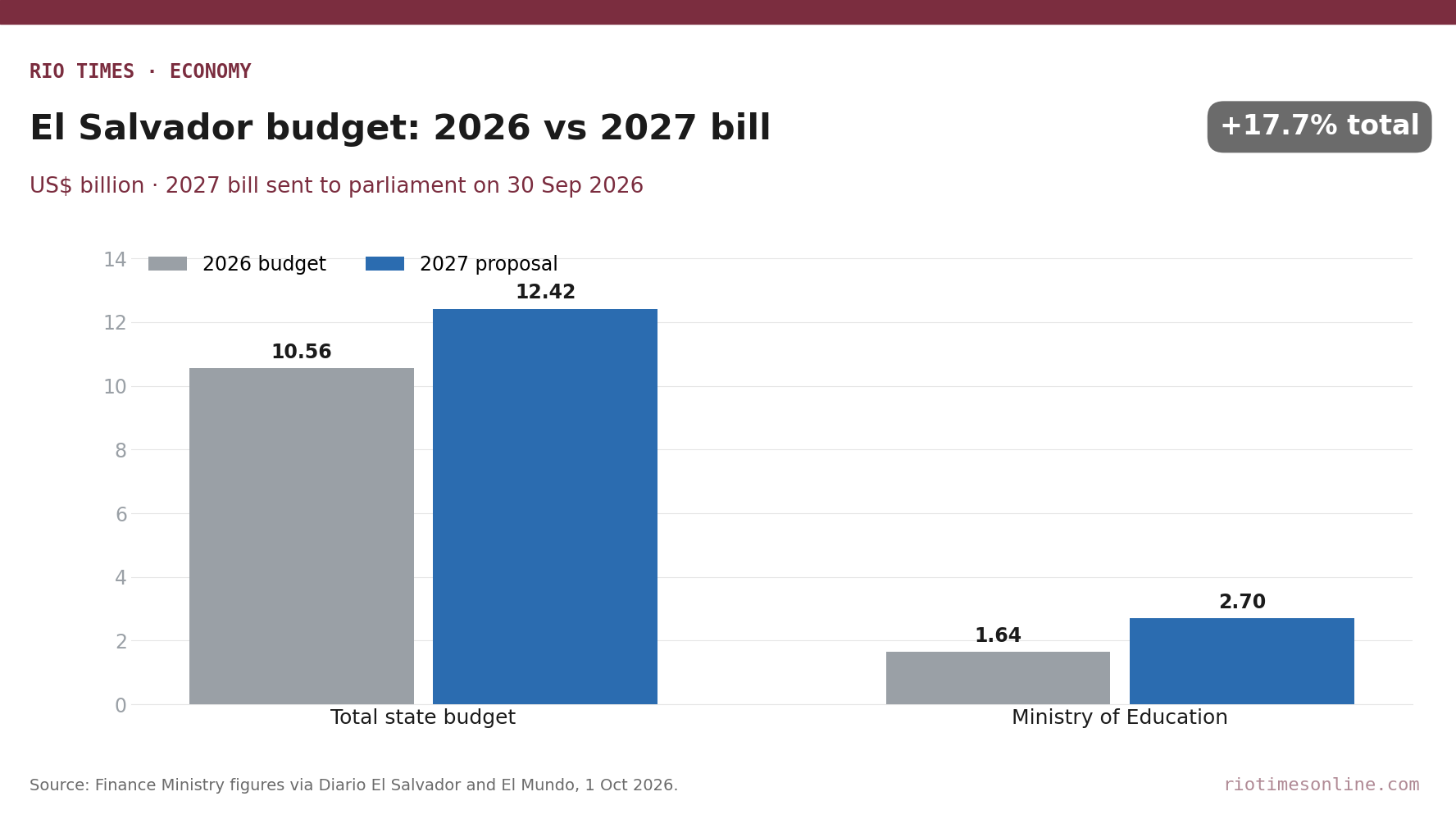
- —What happened On 30 September 2026 the Finance Ministry sent parliament a 2027 budget bill of US$12.42 billion, up 17.7% from US$10.56 billion this year (Diario El Salvador, El Mundo).
- —The numbers Education gets US$3.42 billion across all ministries, which the ministry puts at 8.1% of GDP. The Education Ministry alone gets US$2.70 billion, up from US$1.64 billion (El Mundo, 1 Oct).
- —What it means for you The ministry says there are no new taxes or tax rises. Public-sector pay rises are suspended for 2027, and US$258.9 million is set for subsidies, including gas, power and transport (El Diario de Hoy).
- —Still open How a US$515 million financing gap will be covered, and whether parliament changes the bill before passing it. The ministry’s regional comparisons are not independently verified.
The El Salvador 2027 budget bill asks for US$12.42 billion, with education as its largest single priority. Finance Minister Jerson Posada handed it to the Legislative Assembly, the single-chamber parliament, on Wednesday 30 September.
The total is US$1.87 billion, or 17.7%, above this year’s US$10.56 billion budget, Diario El Salvador reported. El Salvador uses the US dollar, so all figures are in US$.

Total budget versus education share
Two headline numbers are easy to mix up, and they measure different things. US$12.42 billion is the whole state budget; US$3.42 billion is the slice tagged as education spending.
That education figure equals 8.1% of gross domestic product, according to the Finance Ministry. It is a little over a quarter of the total bill, not 8.1% of it.
El Mundo reported that the US$3.42 billion is a consolidated sum spread across several ministries. It counts school building by the Public Works Ministry and the municipal works agency, scholarships and teacher benefits.
The Education Ministry’s own allocation is US$2.70 billion, El Mundo said. That is up US$1.06 billion, or 64%, from US$1.64 billion in 2026.
Where the education money goes
The plan includes US$562 million for school infrastructure, of which US$112 million funds the “Two Schools a Day” building programme. Another US$415 million covers computers, tablets, connectivity and artificial intelligence in classrooms.
US$134 million goes to uniforms, shoes and school supplies, and US$90 million to university scholarships, El Diario de Hoy reported. Posada said the education outlay is three times what earlier governments assigned.
The bill moves US$40 million into education from the Justice and Defence ministries, US$20 million from each. Posada said the money had been earmarked for weapons and ammunition.
How it is paid for
The ministry projects current revenue of US$10.42 billion in 2027, up 13.8%, with tax revenue at US$9.57 billion. It credits electronic invoicing and tighter audits rather than higher rates.
Even so, the bill carries a US$515 million financing gap, El Diario de Hoy and El Mundo reported. Austerity steps continue, including a freeze on public-sector pay rises and new posts.
A ministry technical note puts the 2027 deficit at US$3.21 billion under the method used in El Salvador’s IMF programme. That figure includes US$2.33 billion of accrued interest on pension-fund debt, El Mundo reported.
On a cash basis the gap is far smaller, at about US$882 million, and the primary balance shows a surplus. The economy grew 5.1% in the second quarter, which supports the revenue forecast (El Salvador Economy Grows 5.1% in Second Quarter as Construction Leads).
What Is Not Yet Known
The El Salvador 2027 budget now goes to the Assembly’s finance and budget committee for study, and no vote date has been set. It is not yet clear how the US$515 million gap will be financed.
Posada’s claim that El Salvador will spend more of its economy on education than any Latin American country could not be independently verified. The vote also falls in the run-up to the February 2027 general election (El Salvador Electoral Court Calls 28 February 2027 Vote, Opening Candidate Registration).
Sources: Diario El Salvador (1 Oct 2026); El Mundo (1 Oct 2026, 30 Sep 2026); El Diario de Hoy (30 Sep 2026); Ministry of Finance figures as presented to the Legislative Assembly.
Read More from The Rio Times