Ecuador and US Sign Police Internal Control Agreement

SECURITY · ECUADOR
Key Facts
- —The country Ecuador uses the US dollar and has fought a gang-driven security crisis for several years. Officials say organised crime tries to infiltrate its National Police.
- —What happened On Friday 2 October 2026 the two countries signed the Integridad Policial 360 implementation letter in Quito, EFE reported. It targets internal police controls.
- —The numbers Two regional vetting centres in Guayaquil and Manta, plus a Quito training centre. EFE, citing the US embassy, says 17 police polygraph examiners will be certified.
- —What it means for you Officers face polygraph, psychological, drug and financial checks. Officials say tighter vetting should cut leaks that expose operations against gangs.
- —Still open There is no timeline for the new centres and no published project budget. Rules for officers who fail are not yet public.
Ecuador and the United States signed a police internal control project in Quito on Friday 2 October. Called Integridad Policial 360, it aims to stop organised crime from infiltrating the National Police.
Interior Minister John Reimberg and Lawrence Petroni, the US chargé d’affaires, signed the implementation letter, EFE and El Telégrafo reported. The plan adds vetting centres in Guayaquil and Manta and a training centre in Quito.
What the agreement covers
The project strengthens the police vetting body, the Centro de Control y Confianza, and the Inspectorate General, which handles internal affairs. Officers will face polygraph, psychological, toxicological and financial evaluations, the US embassy said, according to EFE.
The two regional centres in the coastal cities of Guayaquil and Manta will extend vetting beyond the capital. The United States will also supply equipment and help digitise the vetting centre’s processes and case tracking.
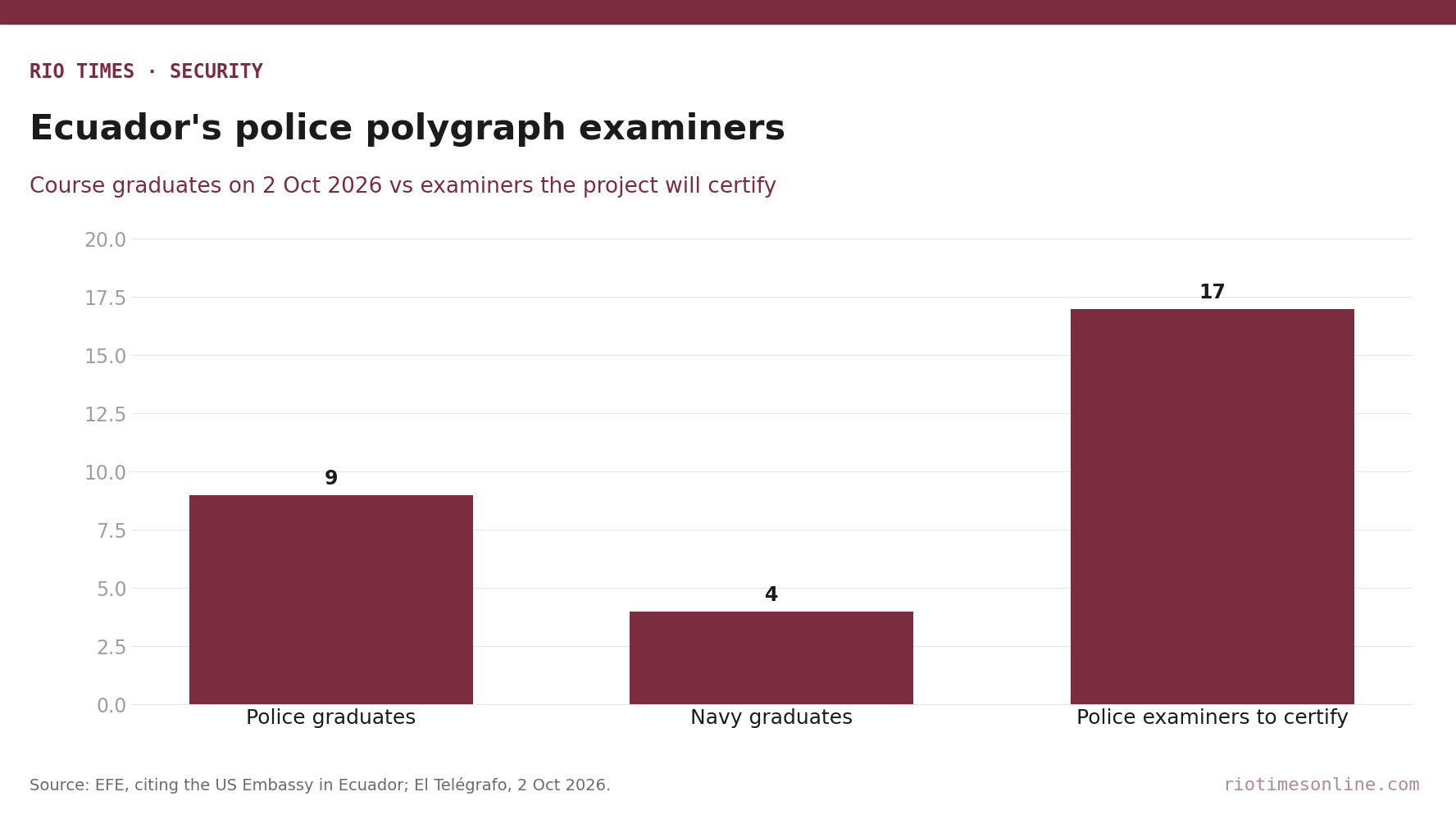
EFE reported that 17 police polygraph examiners will be trained and certified under the plan. The aim is international certification for examiners and standard procedures across the force.
Police commander Pablo Dávila called the signing an important step for the police internal control system. The force must “anticipate” risks and “prevent misconduct”, he said.
Why tighter checks matter now
The signing came two days after a corruption raid inside the force in Guayaquil. Prosecutors detained 12 people on 30 September, reported in Ecuador Anti-Corruption Drive: 12 Held in Guayaquil Over Theft of Impounded Cars.
Reimberg said ten of those held were serving officers and two were retired. They are suspected of selling cars and parts taken from police impound yards.
Petroni said a single leak can compromise operations and put lives at risk, Primicias reported. “Integrity is not a complement to police work. Integrity is its foundation,” he said, as quoted by El Telégrafo.
Reimberg said the goal is to turn bilateral cooperation into concrete capacity against transnational crime. He serves in the government of President Daniel Noboa, profiled in Who Is Daniel Noboa, Ecuador’s President Explained 2026.
Who pays and who trains
Training, buildings and technology will draw on US$45 million in extra US security aid for fiscal 2026. Primicias and El Diario reported the link. Neither outlet said how much of that sum goes to this project.
The signing closed an advanced polygraph course run under the US-Colombia Action Plan, a regional security programme. The US State Department’s anti-narcotics and law enforcement bureau (INL) supported it.
Thirteen people graduated: nine police officers and four members of the Ecuadorian Navy. Colombian instructors taught the course, El Telégrafo reported.
For residents, stronger police internal control could reduce leaks that warn gangs of raids. How much it helps depends on how fast the new centres open.
What Is Not Yet Known
No timeline has been given for opening the Guayaquil and Manta centres or the Quito training centre. The project’s own share of the US$45 million has not been published.
It is also unclear how many officers will be tested, and how often. Officials have not said what happens to officers who fail an evaluation.
What is Integridad Policial 360?
A US-backed project signed on 2 October 2026 to tighten police internal control in Ecuador. It adds polygraph, psychological, drug and financial checks for officers.
Where will the new vetting centres be?
Two regional centres will be equipped in Guayaquil and Manta, on the coast. A training centre for polygraph examiners will open in Quito.
Who funds the project?
The United States, from US$45 million in additional security aid for its 2026 fiscal year, according to Ecuadorian media. The project’s share has not been disclosed.
Sources: EnSegundos (EFE), “Ecuador firma un acuerdo con EE.UU. para reforzar el control interno de la Policía” (2 October 2026); El Telégrafo, “Ecuador y EE. UU. lanzan Integridad Policial 360 para reforzar controles internos” (2 October 2026); Primicias, “Ecuador y Estados Unidos firman el acuerdo Integridad Policial 360 y gradúan a 13 poligrafistas” (2 October 2026); El Diario, “Ecuador y Estados Unidos acuerdan reforzar controles internos de Policía Nacional” (2 October 2026); El Universo, “Policía Nacional fortalece sus controles de integridad con nuevos examinadores de polígrafo” (2 October 2026); US Embassy in Ecuador statement as reported by EFE.
Editorial responsibility: Matthias Camenzind, Editor-in-Chief · Editorial standards · Report an error