Costa Rica Air Ambulance: No Night Plane for Shot Boy, Then State Plane Flew VP

POLITICS · COSTA RICA
Key Facts
- —The country Costa Rica has no army. Its Public Security Ministry (MSP) runs the Air Surveillance Service (SVA), a police air wing that also flies night medical transfers under a joint protocol.
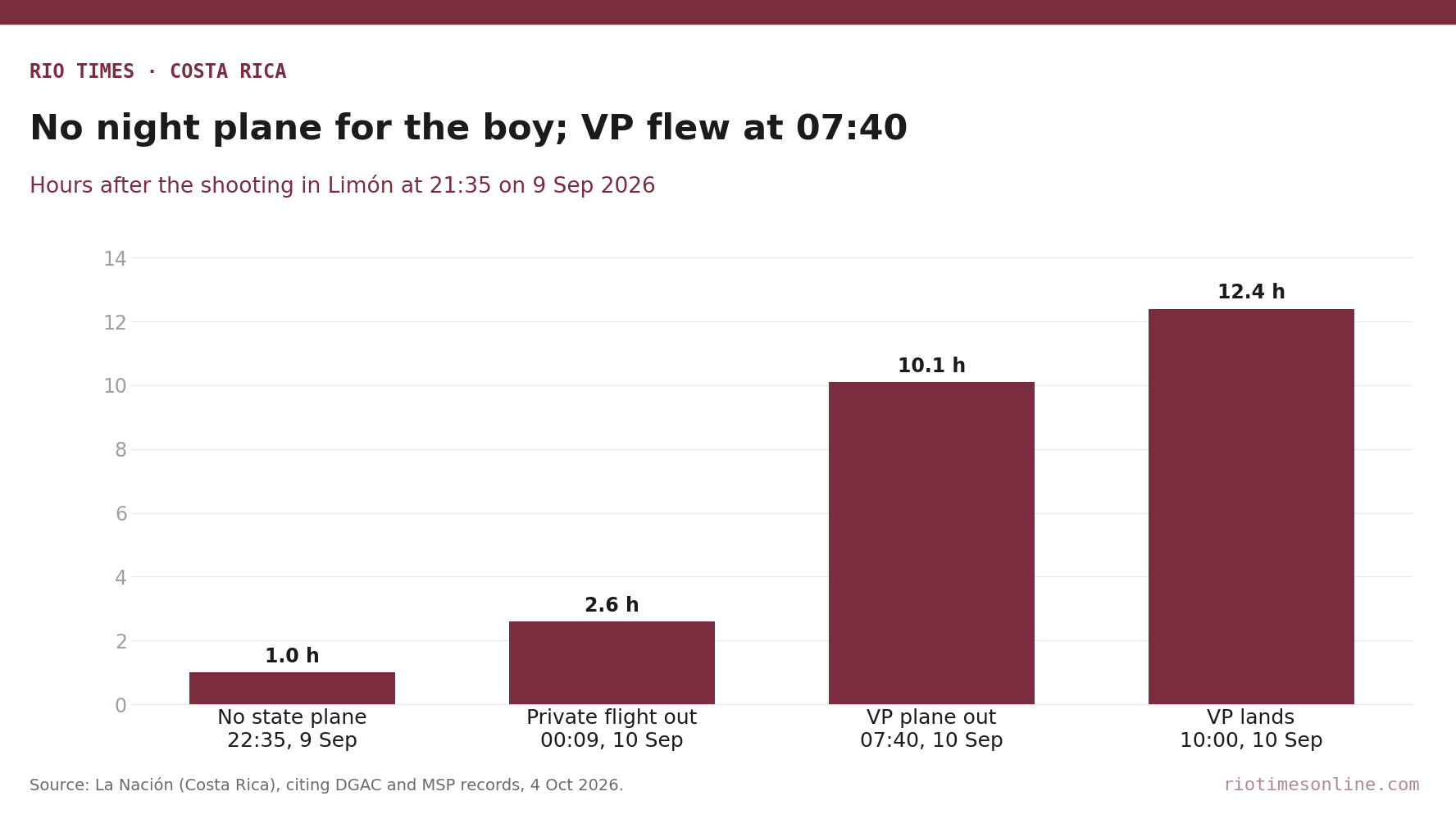
- —What happened At 22:35 on 9 September the SVA said it had no night aircraft for a shot 7-year-old in Limón. At 07:40 next day its plane flew the vice-president, La Nación reported on 4 October.
- —Who is involved Vice-President Francisco Gamboa, Security Minister Gerald Campos, the CCSS social security fund that runs public hospitals, and the DGAC civil aviation authority, which clears private night flights.
- —What it means for you Night air-ambulance cover outside the main airports is thin. Since October 2025 the DGAC has barred night flights at uncontrolled airfields, El Observador reported on 24 September.
- —Still open The MSP and Gamboa’s office had not answered La Nación’s questions by 4 October. Three ministerial reports ordered on 10 September remain unpublished.
Costa Rica air ambulance rules are under new scrutiny after a report published on Sunday 4 October. The state’s police air wing said it had no plane for a shot child, then flew the vice-president hours later.
The daily La Nación, citing flight documents, said the boy, aged seven, was shot in Limón at 21:35 on 9 September. He died shortly after 05:00 the next day after two operations, without ever being moved to the capital.
What the Flight Records Show
According to La Nación, the Air Surveillance Service (SVA) of the Public Security Ministry (MSP) answered the hospital request at 22:35. It told the CCSS, the social security fund that runs Costa Rica’s public hospitals, that it had no aircraft for night work.
The next morning, SVA aircraft MSP024 left Tobías Bolaños airport in Pavas, San José, at 07:40 with Vice-President Francisco Gamboa aboard. It stopped at Parrita and landed in Buenos Aires, Puntarenas, at 10:00.
Gamboa then toured Buenos Aires, Palmar Norte and Coto Brus with the head of the water utility AyA and a ruling-party deputy. La Nación based that account on posts from his own office.
How the Night Protocol Should Work
The Costa Rica air ambulance protocol for night transfers was signed by the security, public works and health ministries and the CCSS. Its first step is a check through the 911 system on whether an SVA aircraft is free.
If the SVA can fly, the mission goes ahead with no further permit. If it cannot, the DGAC civil aviation authority must clear a private flight as an exception.
That night the CCSS hired private operator SAAT instead. Its plane left Pavas at 00:09 with a team from the National Children’s Hospital (HNN), La Nación reported.
The timings differ by source. The CCSS told the paper it requested the transfer at 22:00, while the DGAC log puts the SVA request at 22:35.
The SVA’s night limits were known. In February the then health minister, Mary Munive, said its air-ambulance cover ran only until about 01:00, El Observador reported.
A Dispute Over Delays
On 10 September HNN director Carlos Jiménez told Teletica that outside authorisation came three hours after it was requested. SAAT’s operations director said the DGAC duty officer did not answer calls for over an hour.
The DGAC log also shows the pilot, not the CCSS radio centre named in the protocol, made the first calls at 22:51. The CCSS filed its formal request at 23:11, and a DGAC official approved it at 23:15.
The public works ministry (MOPT), which oversees the DGAC, rejected the delay account. It said the flight was authorised under the protocol and on time, according to Teletica.
Jiménez also said the boy was in critical condition when the medical team arrived. A patient must be stable enough to withstand the journey, he explained.
What the Government Has Done
On 10 September President Laura Fernández ordered three agency heads to report within three days. They were Security Minister Gerald Campos, Public Works Minister Efraím Zeledón and CCSS head Mónica Taylor.
Zeledón said he had delivered his report and wanted the protocol reviewed with the other signatories, El Observador reported on 24 September. He maintained that his agency had followed the rules.
The prosecutors’ anti-corruption office also received a criminal complaint about the case. On 22 September it passed the file to the anti-corruption unit of the OIJ, the judicial police, without naming any targets.
What Is Not Yet Known
The MSP has not explained why no aircraft was free at night while one was ready for the morning tour. La Nación said questions sent on 29 September were still unanswered at publication.
Gamboa’s office has not said whether he knew the plane had been sought for the boy. The presidency asked for more time on 30 September before releasing the three reports.
It is also unclear whether an earlier flight could have saved the child, given his injuries. The details of the vice-president’s flight rest on documents seen by La Nación and are not independently confirmed.
Sources: La Nación, 4 Oct 2026; La Nación, flight logs, 4 Oct 2026; La Nación, 10 Sep 2026; Teletica, 10 Sep 2026; Teletica, 11 Sep 2026; El Observador, 24 Sep 2026; El Observador, 16 Feb 2026.
This article was drafted with automated assistance and reviewed before publication. How we use AI · Report an error · Editorial responsibility: Matthias Camenzind, Editor-in-Chief