Chile Stocks Jump 2.52% as Oil Slumps | Chile Market Report, Nov 4
Key Facts
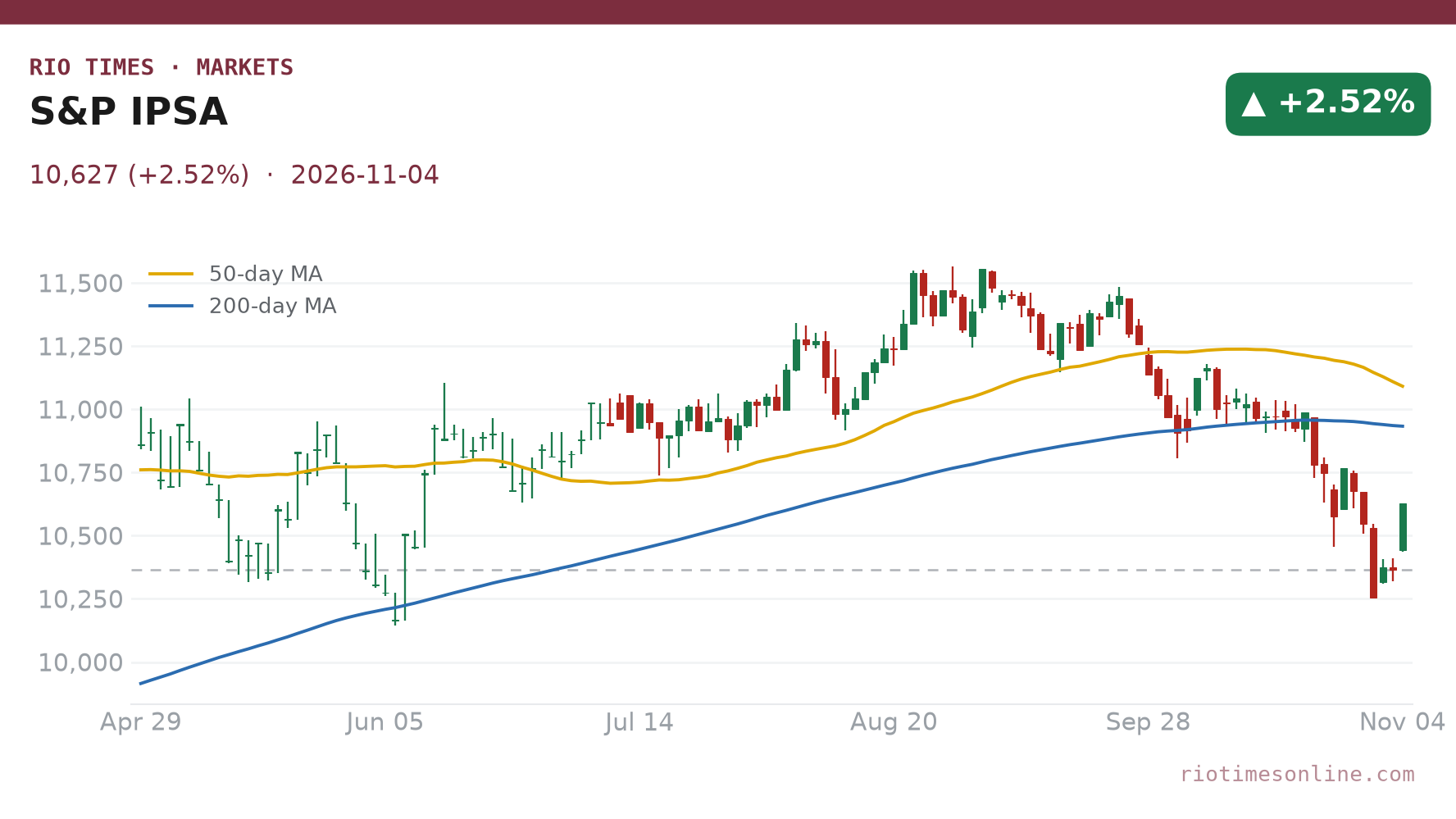
- The S&P IPSA, Chile’s benchmark index of its largest listed companies, closed at 10,627, up 2.52% on the session and a strong day for the index.
- The peso strengthened sharply as USD/CLP, the number of pesos one US dollar buys, fell 1.58% to 965.60, leaving the dollar 3.0% below its 23 October high of 995.39.
- Oil was the biggest cause, with the US oil fund USO down 8.07% as investors bet that a broad Democratic win in the US vote brings peace closer.
- LATAM Airlines led the most-traded list, rising 6.2% on US$36m of turnover, with SQM-B, the lithium producer, up 5.5% on US$13m.
- The rebound is real but incomplete, because the IPSA is still 8.6% below its 12-month high of 11,628 set on 28 January and down 4.81% over 20 sessions.
- Prediction markets: Polymarket puts Chile’s December central bank decision at 48.0% no change and 44.0% a quarter-point rise (US$20,406 traded, 7:42 p.m. ET, 4 November).
Today’s Focus
Chile’s stock market had a strong day on 4 November. The S&P IPSA closed at 10,627, up 2.52%, while the peso gained as USD/CLP fell 1.58% to 965.60.
The spark came from Washington rather than Santiago. Investors read a broad Democratic win in the US vote as a step towards peace in a war that has kept oil expensive, and crude prices dropped sharply.
Chile imports most of the fuel it burns, so cheaper oil is good news for airlines, shops and households. A softer global dollar also tends to help copper-linked currencies such as the peso.
The jump matters, but it is a bounce inside a downtrend. The IPSA remains 8.6% below its 12-month high of 11,628 and is down 4.81% over 20 sessions.
What matters today. A one-day oil and dollar shock has rescued a weak month for Chilean shares, but the index needs to hold 10,000 to prove it is more than a bounce.
01 The session in one read
Chile’s stock market had a strong day on 4 November. The S&P IPSA, the index of the country’s largest listed companies, closed at 10,627, up 2.52%.
The peso gained at the same time. USD/CLP, the number of Chilean pesos one US dollar buys, fell 1.58% to 965.60, so each dollar bought fewer pesos.
The spark came from Washington, not Santiago. Markets read a broad Democratic win in the US vote as a step towards peace in a war that had kept oil expensive, and crude oil fell sharply.
Think of the IPSA as a boat that had been taking on water for a month. One strong tide has lifted it, but the waterline is still below where it stood in January.
For a foreign investor, a stronger peso raises the dollar value of Chilean assets already held. For a visitor, it makes Chile slightly dearer.
Every usual driver pointed the same way: oil fund USO fell 8.07%, the US dollar index fell 0.37%, the 10-year US Treasury yield dropped 5 basis points to 4.90%, and the S&P 500 rose 1.58%. That agreement makes the explanation solid, but it also shows the rally was borrowed from global moves rather than earned by Chilean news. The variable to watch is oil — if crude rebounds, the peso and the index are likely to give back part of this gain.
02 The day’s numbers
| Measure | Level | Change | Read |
|---|---|---|---|
| S&P IPSA | 10,627 | +2.52% | Strong day; the index sits 8.6% below its 12-month high of 11,628 |
| Session range | — | — | Intraday high and low are not in our scan |
| USD/CLP (pesos per dollar) | 965.60 | −1.58% | Peso stronger; the dollar is 3.0% below its 23 October high of 995.39 |
| IPSA 52-week position | 9,323 – 11,628 | — | The index is 14.0% above its 12-month low of 4 November 2025 |
| USD/CLP 52-week position | 851.67 – 995.39 | — | The dollar is 13.4% above its 9 February low, so the peso is still weaker than in February |
| Key technical level | 10,000 | — | Round-number support; resistance is the 11,628 peak of 28 January |
Read the table from the middle outwards. The IPSA has recovered much of its recent damage, yet it is only 14.0% above its 12-month low and 8.6% below its 12-month high — a mid-range index after a hard month.
The currency tells a similar story. The peso has retraced part of its October slide, but with USD/CLP still 13.4% above its February low, the strong-peso days of early 2026 have not returned. Rio Times · Live Market Intelligence
Live Market IntelligenceChile — Live Market Board
Chile — Live Market Board
Instrument Last Change YoY Prev. High Low Volume
IPSA
10,627.00
+2.52%
—
10,366.16
10,722
10,633
—
USD/CLP
983.47
-0.57%
+5.64%
989.13
991.87
979.07
—
COPPER
6.65
+2.24%
+29.44%
6.51
6.66
6.54
37,751
SQM-B
59,350
+5.00%
+41.63%
56,525
59,500
56,800
139,333
COPEC
6,587
+1.26%
-0.72%
6,505
6,678
6,523
651,577
BSANTANDER
78.27
+0.22%
+18.23%
78.10
79.08
78.04
29,319,739
FALABELLA
6,537
+0.57%
+12.38%
6,500
6,569
6,451
521,197
ENELAM
83.60
-0.61%
-7.37%
84.11
85.95
83.33
17,436,403
CENCOSUD
1,818
-0.12%
-37.29%
1,820
1,836
1,810
1,172,754
CMPC
935.00
-0.52%
-28.63%
939.90
939.76
933.04
507,661
BANCO CHILE
192.44
+0.90%
+20.05%
190.73
192.99
190.73
16,978,917
LATAM AIR
22.04
+2.04%
+4.75%
21.60
22.20
21.81
859,178,133
SOUTHERN COPPER
192.19
+3.32%
+50.65%
186.01
193.86
185.75
649,631
03 Why it moved — oil’s slide and a weaker dollar
The first cause, and the heaviest, was oil. Brent, the international oil benchmark, fell sharply, and the US oil fund USO fell 8.07% on the day.
Chile buys most of its fuel abroad, so cheaper crude lowers costs for airlines, retailers and consumers. Confidence in this cause: high.
The second cause was a softer global dollar and lower borrowing costs. The US dollar index, a gauge of the dollar against major currencies, fell 0.37% to 101.49, and the 10-year US Treasury yield fell 5 basis points to 4.90%.
A weaker dollar usually supports the peso, because copper — Chile’s main export — is priced in dollars. The copper fund CPER edged up only 0.21%, so this link was modest; confidence: medium.
The third cause was a broad return of risk appetite. The S&P 500 rose 1.58% to 7,689, and the VIX, Wall Street’s fear gauge, fell 20.26% to 16.61.
04 The day’s movers
| Driver | Level / Move | Change | Note |
|---|---|---|---|
| LATAM Airlines (LTM) | Turnover US$36m | +6.2% | Most traded; cheaper fuel is the likely reason |
| BCI | Turnover US$23m | +0.6% | Second most traded bank |
| SQM-B | Turnover US$13m | +5.5% | Lithium and fertiliser producer; top domestic gainer |
| Banco Santander Chile | Turnover US$10m | +2.1% | Banks followed the broad rally |
| Banco de Chile (CHILE) | Turnover US$10m | +2.6% | Largest banks joined the advance |
| Falabella | Turnover US$6m | +3.0% | Department store and retail group |
| Copec | Turnover US$6m | −0.0% | Fuel and forestry group; flat despite cheaper oil |
| Cencosud | Turnover US$5m | −0.3% | Supermarket and retail group; slightly lower |
| CMPC | — | −2.5% | Biggest domestic loser |
LATAM Airlines was the star of the day, up 6.2% on US$36m of turnover, the most of any name. Fuel is one of an airline’s largest costs, so an oil drop of this size is a direct gift.
SQM-B rose 5.5% and Falabella 3.0%, while Vapores, the shipping line, gained 2.9%. We found no company news behind SQM’s move, so it looks like market-wide buying; confidence: medium.
The losers were few: CMPC, the pulp and paper maker, fell 2.5%, Mallplaza, the shopping-centre owner, fell 2.2%, and Colbun, the power utility, fell 1.2%. Copec ended flat and Cencosud slipped 0.3%.
05 The regional scoreboard
| Index | Country | Change |
|---|---|---|
| S&P IPSA | Chile | +2.52% |
| Ibovespa | Brazil | +1.23% |
| IPC | Mexico | +1.71% |
| COLCAP | Colombia | −0.84% |
Chile led a mostly positive region, which is what a falling dollar and falling oil should deliver. Brazil’s Ibovespa, its main stock index, rose 1.23%, and Mexico’s IPC rose 1.71%.
Currencies echoed the pattern: USD/MXN fell 1.12% to 18.62 and USD/BRL fell 0.56% to 5.4594. Colombia, whose budget leans heavily on oil exports, saw COLCAP fall 0.84%. The live market board above carries the full closes.
06 The technical picture
The nearest floor for the IPSA is the round number of 10,000, just below Wednesday’s close of 10,627. Below that sits the 12-month low of 9,323, set on 4 November 2025.
The ceiling is the 12-month high of 11,628 from 28 January, 8.6% above the close. Before that, traders will watch whether the index can keep its gains after falling 4.81% over 20 sessions.
For the dollar, the resistance is 995.39, the 23 October high, with 1,000 pesos as the psychological line above it. Support lies at 851.67, the February low, a long way down after a 5.6% rise over 60 sessions.
Our own history gives a useful sense of proportion. After 61 earlier falls of this size in the IPSA over 20 sessions, the index was higher 20 sessions later in 35 cases (57%), with a median gain of 1.6%, a worst case of −24.6% and a best case of +14.5%.
That is a record, not a forecast: it says rebounds are slightly more likely than not, and that the bad cases can be very bad.
07 What to watch
- Oil: If crude holds its drop, the airline and retail gains look safe; a rebound would put pressure on the IPSA and the peso.
- IPSA 10,000: A close below this round number would erase the rally; holding above it keeps the path to 11,628 open.
- USD/CLP 995.39: A move back above the 23 October high would signal the peso rally has failed.
- Copper and the dollar: Copper is the anchor for Chile; a steadier US dollar index near 101.49 would help the peso hold its gains.
Background: Chile Stocks Slip 0.09% as Copper Retreats.
Background: Chile Stocks Rise 1.18% as the Peso Gains.
What Prediction Markets Say
Polymarket, a prediction market where users bet real money, shows a 48.0% chance that Chile’s central bank leaves its rate unchanged in December and 44.0% for a quarter-point increase, with US$20,406 traded. Prices were read at 7:42 p.m. ET on 4 November 2026. These are bets, not forecasts.
Why we show this: prediction markets turn real-money bets into a live probability that moves within minutes of the news, which is why investors, campaigns and newsrooms in the United States now follow them closely. We show them next to polls and official results, never instead of them.
Frequently Asked Questions
How did the Chile stock market close on 4 November 2026?
The S&P IPSA, Chile’s benchmark index, closed at 10,627, up 2.52%.
What happened to the Chilean peso?
USD/CLP fell 1.58% to 965.60, meaning the peso strengthened against the US dollar.
Why did Chilean stocks rise?
Oil fell sharply and the global dollar softened after a broad Democratic win in the US vote raised hopes of peace in a war that had kept oil expensive.
Is the rally likely to last?
History offers a mild lean to yes: after 61 earlier falls of this size, the IPSA was higher 20 sessions later in 35 cases (57%), but history is not a forecast.
Market data: The Rio Times; exchange figures from Bolsa de Santiago
This article was produced by The Rio Times’ automated newsroom system. How we use AI · Report an error · Editorial responsibility: Matthias Camenzind, Editor-in-Chief
LatAm Markets: Live Signals → — real-time movers, turnover leaders and FX across Latin America.
Get The Rio Times delivered to your inbox — market intelligence, daily briefs, and breaking analysis across Latin America.
Start for US$1