Chile Stocks Rise 1.18% as the Peso Gains | Chile Market Report, Nov 2
Key Facts
- The S&P IPSA, Chile’s main stock index, closed at 10,375, up 1.18% on the session, after a bruising October.
- The peso strengthened to 977.75 per dollar, a 1.63% fall in the dollar’s price from 994 on Friday, a move of about 16 pesos.
- The index is still 10.8% below its 12-month high of 11,628 set on 28 January, and 11.3% above its 12-month low of 9,323 from 4 November 2025.
- Banks and utilities led the rebound Enel Chile, an electricity utility, rose 3.7%, Banco Santander Chile 2.6% and Banco de Chile 2.2%, while retailers Cencosud and Falabella lagged.
- Wall Street went the other way as the S&P 500 fell 0.51% and the VIX fear gauge rose 8.91%, so this was a local rebound, not a global one.
- Prediction markets: Polymarket, a prediction market, puts 66.5% on the Central Bank of Chile leaving its rate unchanged in December and 18.5% on a quarter-point rise, as of 2 November 2026, 9:04 pm ET.
Today’s Focus
Chile’s stock market bounced on Monday 2 November, the latest settled session, as the S&P IPSA closed at 10,375, up 1.18%. It was a relief after a rough October and a Friday drop of 2.76%.
The peso did the heavy lifting. It strengthened to 977.75 per dollar, a 1.63% fall in the dollar’s price, or about 16 pesos from Friday’s 994.
The bounce is real but small against the damage. The index remains 4.96% lower than 20 sessions ago and 10.8% below its January peak.
What matters today. A stronger peso and a bank-led rebound steadied Chile, but the index is still far below its January high, so this is a pause in the slide, not yet a recovery.
01 The session in one read
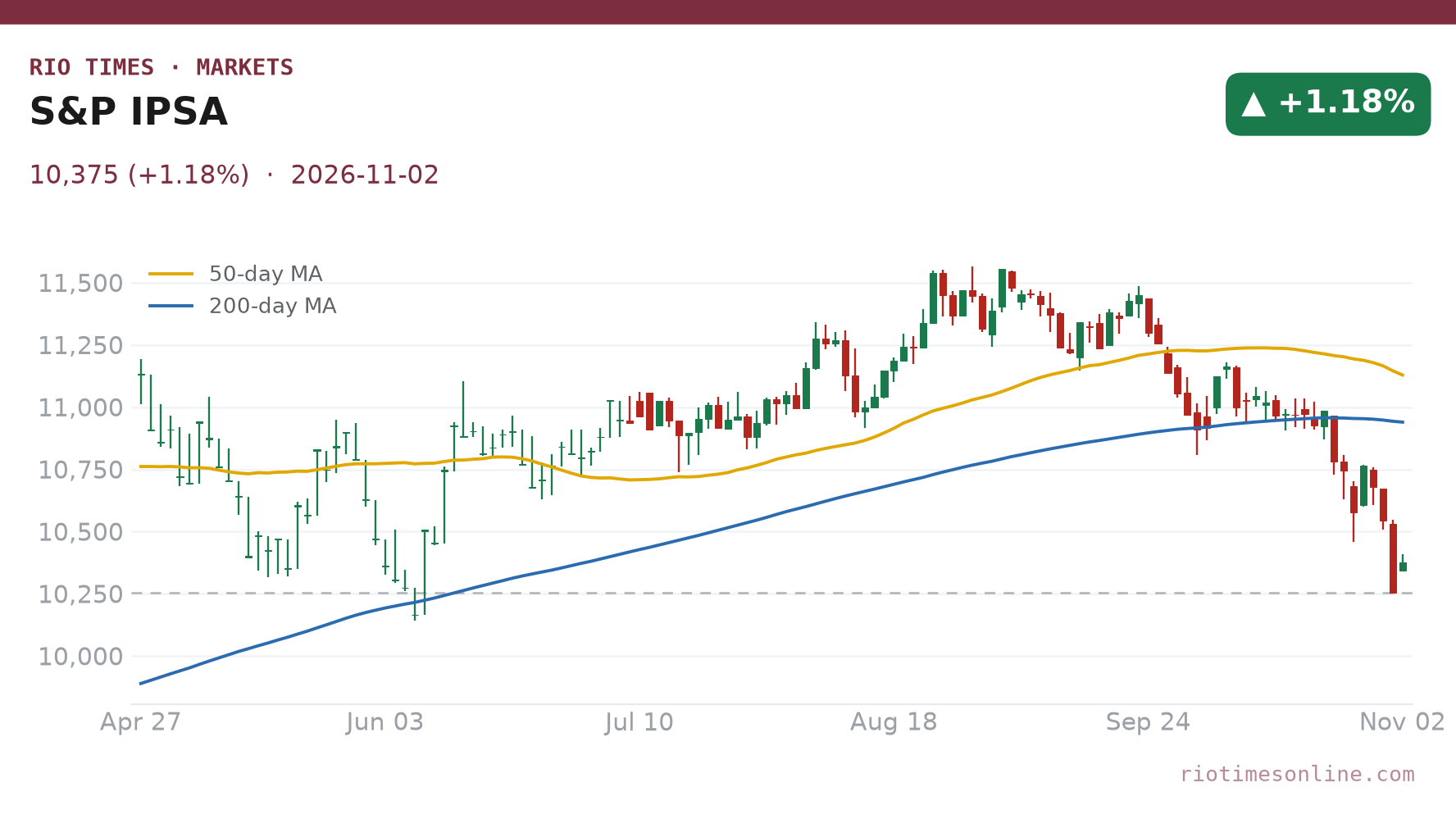
After a bruising week, Chile finally caught its breath. The S&P IPSA — the index of Chile’s 30 most-traded listed companies — closed at 10,375, up 1.18%.
Friday’s slide of 2.76% had been a hard knock, so the bounce had room to run. Even so, the index is 1.90% lower than five sessions ago.
The peso was the other half of the story. One US dollar now buys 977.75 pesos, 1.63% fewer than the session before, as the dollar retreated across much of the region.
The evidence points to a local, peso-led rebound rather than a global one: the S&P 500 fell 0.51% and the VIX rose 8.91%, yet Chilean banks and utilities rose. The index is still 8.0% lower than 60 sessions ago, so one good day has not changed the trend. The variable to watch is the peso: if USD/CLP stays below its 23 October high of 995.39, stocks have room to steady.
02 The day’s numbers
| Measure | Level | Change | Read |
|---|---|---|---|
| S&P IPSA (index close) | 10,375 | +1.18% | First gain after a hard run; still below its 20-session level |
| Session range | — | — | Not available in our scan |
| USD/CLP (pesos per US dollar) | 977.75 | −1.63% | Stronger peso; dollar 1.8% below its 12-month high |
| 52-week positioning, IPSA | Range 9,323–11,628 | — | 10.8% below the high; 11.3% above the low |
| 52-week positioning, USD/CLP | Range 851.67–995.39 | — | 14.8% above its February low |
| Key technical level | 10,000 / 9,323 | — | Round number, then the 12-month low |
Read the table as a story of distance. The index sits 10.8% below its 28 January high of 11,628, yet 11.3% above its 4 November 2025 low of 9,323.
The currency tells the other side. A dollar at 977.75 pesos is 1.8% below its 23 October high of 995.39, but it is still 14.8% above the 9 February low of 851.67 — a much weaker peso than in the spring. Rio Times · Live Market Intelligence
Live Market IntelligenceChile — Live Market Board
Chile — Live Market Board
Instrument Last Change YoY Prev. High Low Volume
IPSA
10,374.91
+1.18%
—
10,254.15
10,722
10,633
—
USD/CLP
983.47
-0.57%
+5.64%
989.13
991.87
979.07
—
COPPER
6.65
+2.24%
+29.44%
6.51
6.66
6.54
37,751
SQM-B
59,350
+5.00%
+41.63%
56,525
59,500
56,800
139,333
COPEC
6,587
+1.26%
-0.72%
6,505
6,678
6,523
651,577
BSANTANDER
78.27
+0.22%
+18.23%
78.10
79.08
78.04
29,319,739
FALABELLA
6,537
+0.57%
+12.38%
6,500
6,569
6,451
521,197
ENELAM
83.60
-0.61%
-7.37%
84.11
85.95
83.33
17,436,403
CENCOSUD
1,818
-0.12%
-37.29%
1,820
1,836
1,810
1,172,754
CMPC
935.00
-0.52%
-28.63%
939.90
939.76
933.04
507,661
BANCO CHILE
192.44
+0.90%
+20.05%
190.73
192.99
190.73
16,978,917
LATAM AIR
22.04
+2.04%
+4.75%
21.60
22.20
21.81
859,178,133
SOUTHERN COPPER
192.19
+3.32%
+50.65%
186.01
193.86
185.75
649,631
03 Why it moved — a stronger peso and a bargain-hunting bounce
First, the peso, with medium-to-high confidence. The dollar fell from 994 to 977.75 pesos, about 16 pesos, after two days of gains. A stronger peso makes Chilean shares worth more to foreign buyers, which is why it matters for the stock market, though we could not confirm a single cause for the move.
Second, a rebound in beaten-down banks and utilities, with medium confidence. Enel Chile rose 3.7%, Banco Santander Chile 2.6%, Banco de Chile 2.2% and Colbún, a power generator, 1.8%. After October’s rout, buyers returned to the sectors with steady earnings.
Third, lower oil prices, with lower confidence. The USO oil fund fell 7.08%, and Chile imports almost all its fuel, so cheaper oil eases the import bill. Copec, the fuel and forestry group, barely moved, down 0.1%.
The usual drivers did not agree with the move. The S&P 500 fell 0.51%, the VIX fear gauge rose 8.91% to 21.15, and the US 10-year yield sat at about 4.89%. The best-supported reading, at medium confidence, is a local rebound after a washout rather than a global rally.
Copper, Chile’s macro anchor, is the weak spot to watch: the CPER copper fund rose 0.97% on Monday, but Chilean mine supply remains tight.
04 The day’s movers
| Driver | Level / Move | Change | Note |
|---|---|---|---|
| Falabella | Turnover $14m | −0.1% | Retail and banking group; most traded |
| Banco de Chile (CHILE) | Turnover $13m | +2.2% | Largest bank by market value among the leaders |
| SQM-B | Turnover $13m | +0.0% | Lithium miner; flat after a sharp fall on Friday |
| Banco Santander Chile | Turnover $7m | +2.6% | Second-biggest bank gain |
| Enel Chile | — | +3.7% | Biggest gainer; electricity utility |
| Cencosud | — | −2.7% | Supermarkets and malls; biggest large-cap loser |
| Entel | — | −3.2% | Telecoms; the weakest name on the board |
| Copec | Turnover $5m | −0.1% | Fuel and forestry group; little changed |
The leaders were the defensive names. Banks and a utility rose, while consumer companies that depend on a healthy shopper fell: Cencosud lost 2.7%, Forus, a footwear and apparel retailer, 2.6%, and Ripley, a department store, 2.1%.
SQM, one of the world’s largest lithium producers, was flat at +0.0% on $13m of turnover. That is a pause, not a recovery, after the sharp drop reported for Friday.
05 The regional scoreboard
| Index | Country | Change |
|---|---|---|
| S&P IPSA | Chile | +1.18% |
| Ibovespa, IPC and COLCAP | Brazil, Mexico, Colombia | Closed |
Chile was the only one of the five large Latin American markets in this series with a verified close on Monday. Brazil, Mexico and Colombia were closed for All Souls’ Day and All Saints’ holidays, and we do not have a verified Merval close for Argentina.
Currencies still traded. The dollar fell 1.13% against the Mexican peso and was almost unchanged against Brazil’s real (-0.02%); it rose 0.63% against the Argentine peso, to 1,545.25.
06 The technical picture
The nearest support is the round 10,000 mark, then the 12-month low of 9,323 from 4 November 2025. The 12-month high of 11,628, set on 28 January, is the distant resistance.
The history is mildly encouraging. In our archive since 2007, the S&P IPSA fell 5.0% in 20 sessions; in the 59 earlier cases with a move at least that large, it was higher 20 sessions later in 35 of 59 cases (59%).
The median gain was 1.5%, the best case 14.5% and the worst a fall of 24.6%. History is not a forecast.
For the peso, 995.39 per dollar (23 October) is resistance for the dollar and 1,000 is the psychological ceiling. The next floor is the 20-session context of a currency still 6.6% weaker than 60 sessions ago.
For Latin America, a steadier peso eases Chile’s import bills and helps its dollar debt. Cheaper oil helps neighbours too, though Argentine ADRs, shares traded in New York, fell sharply on the day.
What Prediction Markets Say
On Polymarket, a prediction market, traders put the chance that the Central Bank of Chile leaves its rate unchanged in December at 66.5%, a 25 basis point increase at 18.5% and a rise of 50 basis points or more at 7.9%. About US$10,500 has been traded on the market, as of 2 November 2026, 9:04 pm ET.
Prices on prediction markets are bets, not polls or forecasts by officials.
Why we show this: prediction markets turn real-money bets into a live probability that moves within minutes of the news, which is why investors, campaigns and newsrooms in the United States now follow them closely. We show them next to polls and official results, never instead of them.
07 What to watch
- The peso: Whether USD/CLP holds below the 23 October high of 995.39 and stays well clear of the 1,000 mark.
- Support at 10,000: A close under this round number would put the 12-month low of 9,323 back in view.
- US midterm elections on 3 November: A US political event that can move the dollar and global risk appetite, and so the peso.
- US data this week: The ISM and ADP releases and the 3 November US election set the tone for the dollar and risk appetite.
Background: Chile Stocks Fall 2.76% on Wall Street Rout.
Background: Chile Stocks Fall 1.25% as SQM Drops 3.3%.
More: Chile news in English, every day from The Rio Times.
Frequently Asked Questions
How did the Chile stock market close?
The S&P IPSA closed at 10,375 on Monday 2 November, up 1.18%, the latest settled session.
What happened to the Chilean peso?
The peso strengthened to 977.75 per US dollar, a 1.63% fall in the dollar, as the dollar retreated.
Why did Chilean shares bounce?
Banks and utilities rebounded after a rough October, and a stronger peso made Chilean assets more attractive.
Is the Chilean market still weak?
Yes. The IPSA remains 10.8% below its 12-month high of 11,628 and 4.96% lower than 20 sessions ago.
Market data: The Rio Times; exchange figures from Bolsa de Santiago
This article was produced by The Rio Times’ automated newsroom system. How we use AI · Report an error · Editorial responsibility: Matthias Camenzind, Editor-in-Chief
LatAm Markets: Live Signals → — real-time movers, turnover leaders and FX across Latin America.
Get The Rio Times delivered to your inbox — market intelligence, daily briefs, and breaking analysis across Latin America.
Start for US$1