Chilean Peso Falls 1.8% as Stocks Edge Up | Chile Market Report, Nov 10
Key Facts
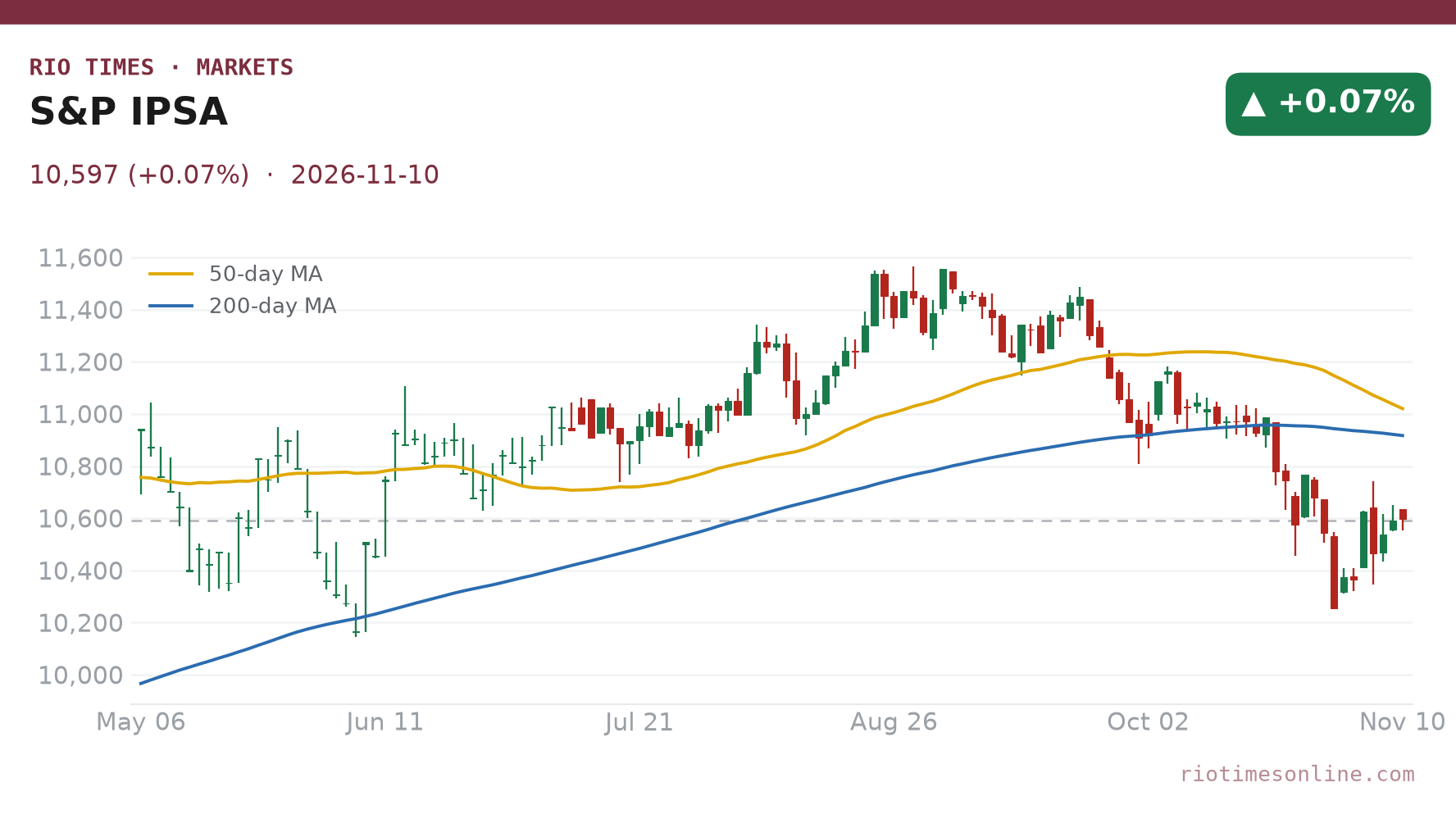
- The S&P IPSA, Chile’s main stock index, edged up 0.07% to 10,597, its third gain in a row, but it still sits 8.9% below its 28 January 2026 high of 11,628.
- The peso fell sharply, with the dollar rising 1.76% to 984.23 pesos, after US consumer prices rose faster than forecast and revived talk of a Federal Reserve rate rise.
- US borrowing costs did the damage as the 10-year Treasury yield climbed 10 basis points to 4.99% and the dollar index rose 0.55% to 102.22.
- Under the calm surface, the board split in two with phone company Entel up 5.1%, retailer Cencosud up 2.6% and LATAM Airlines up 1.7%, while lithium producer SQM-B fell 2.4%.
- The 20-session picture is still heavy as the IPSA is down 3.84% over 20 sessions and the dollar is up 6.1% against the peso over 60 sessions.
Today’s Focus
Chile’s stock market barely moved on Tuesday, but its currency did. The S&P IPSA, the index of the country’s largest listed companies, rose 0.07% to 10,597, while the dollar jumped 1.76% to 984.23 pesos.
The cause sat in Washington, not Santiago. US consumer prices rose 0.4% in October, more than forecasters expected, and traders began to price in a possible rate rise by the Federal Reserve, the US central bank.
That pushed the 10-year US Treasury yield, the return on US government borrowing, up 10 basis points to 4.99%. A basis point is one hundredth of a percentage point, and money chasing that yield tends to leave emerging markets such as Chile.
What matters today. A stronger dollar makes imports, fuel and foreign holidays dearer for Chileans, while the stock index held up only because domestic names offset the pressure.

01 The session in one read
Think of Tuesday as a quiet room with a loud street outside. The IPSA rose 0.07% to 10,597, a rounding error in most weeks, while the peso fell sharply.
The index has now risen for three sessions in a row and is 2.23% higher than five sessions ago. Yet it remains 3.84% lower than 20 sessions ago and 8.9% below its January high of 11,628.
So the day was a pause inside a weak month, not a change of direction. Chile’s market is still working off a long slide rather than starting a new rally.
The evidence points to a US-rates shock reaching Chile through the currency rather than through company earnings. The dollar index rose 0.55%, the US yield jumped 10 basis points, and Wall Street’s S&P 500 slipped 0.38%, all pointing the same way as the peso’s fall.
The IPSA’s small gain reflects a rotation inside the market, with phone and retail shares rising against lithium and utilities. The variable to watch is the 10-year US yield, because another jump above 4.99% would test the peso’s recent high of 995.39 per dollar.
02 The day’s numbers
| Measure | Level | Change | Read |
|---|---|---|---|
| S&P IPSA close | 10,597 | +0.07% | Third gain in a row, a small one |
| Session range | — | — | High and low were not in the verified scan |
| USD/CLP (pesos per US dollar) | 984.23 | +1.76% | A weaker peso |
| IPSA vs 12-month high | 11,628 (28 Jan 2026) | −8.9% | The index sits this far below the high |
| IPSA vs 12-month low | 9,603 (14 Nov 2025) | +10.4% | The index is this far above the low, so it is mid-range |
| Dollar vs 12-month high | 995.39 (23 Oct 2026) | −1.1% | The dollar is only this far below its recent peak |
| Key technical level | 11,000 and 10,000 | — | Round-number ceiling and floor for the IPSA |
The table shows a market near the middle of its yearly range, with a currency near the weak end of its own. The dollar at 984.23 pesos is 15.6% above its February low of 851.67 and just 1.1% below its 23 October high of 995.39.
Over 60 sessions the dollar has gained 6.1% on the peso, while the IPSA has lost 4.0% over the same stretch. Foreign money has been quietly leaving, and Tuesday added to the pattern. Rio Times · Live Market Intelligence
Live Market IntelligenceChile — Live Market Board
Chile — Live Market Board
Instrument Last Change YoY Prev. High Low Volume
IPSA
10,597.06
+0.07%
—
10,589.65
10,635
10,554
—
USD/CLP
983.69
+1.70%
+4.93%
967.23
985.56
963.98
—
COPPER
6.30
-0.44%
+23.85%
6.33
6.31
6.26
2,321
SQM-B
53,500
-2.36%
+9.88%
54,795
54,795
53,500
137,902
COPEC
6,329
-0.86%
-7.87%
6,384
6,475
6,230
916,335
BSANTANDER
79.50
+0.19%
+13.73%
79.35
79.91
78.84
64,609,897
FALABELLA
6,620
-0.14%
+10.52%
6,629
6,672
6,561
1,053,369
ENELAM
83.00
+0.48%
-6.74%
82.60
83.79
82.00
15,320,838
CENCOSUD
1,745
+2.65%
-39.83%
1,700
1,745
1,700
2,392,912
CMPC
890.00
+0.68%
-34.08%
884.03
906.27
875.00
1,970,395
BANCO CHILE
192.97
+1.14%
+13.50%
190.80
192.98
190.30
69,665,732
LATAM AIR
24.51
+1.70%
+18.01%
24.10
24.78
24.34
1,404,204,268
SOUTHERN COPPER
170.36
-3.22%
+29.00%
176.02
174.01
168.50
930,785
03 Why it moved — a hot US inflation reading
First and heaviest cause: US inflation. The US Bureau of Labor Statistics (bls.gov) reported that consumer prices rose 0.4% in October, above forecasts, and that made a Federal Reserve rate rise a live possibility. Confidence: high.
Second cause: the yield and the dollar. The 10-year US Treasury yield rose 10 basis points to 4.99% and the dollar index gained 0.55% to 102.22, so every emerging-market currency felt the squeeze.
Chile was not alone. The Brazilian real weakened 1.36% to 5.5833 per dollar, the Mexican peso 0.50% to 18.6255, and the Colombian peso about 0.9% to 3,297. Confidence: high.
Third cause: fear and commodities were calm, so they did not rescue the currency. The VIX, Wall Street’s fear gauge, eased 2.31% to 19.46, and an oil fund slipped 0.85%, which helps a fuel importer like Chile slightly.
Copper, Chile’s main export and the macro anchor, has no settled price in our verified scan, so we cannot say it helped or hurt. China’s October imports rose 41.6% year on year against a 32% forecast, a hopeful sign for metals demand. Confidence: medium.
04 The day’s movers
| Driver | Level / Move | Change | Note |
|---|---|---|---|
| LATAM Airlines (LTM) | US$35m traded | +1.7% | Among the busiest names; the airline earns much of its revenue in dollars |
| Entel | Telecoms group | +5.1% | Top domestic gainer |
| Cencosud Shopping (CENCOMALLS) | Mall owner | −0.1% | Little changed |
| Cencosud | Supermarkets and retail | +2.6% | Retail strength despite the weaker peso |
| Aguas Andinas (AGUAS-A) | US$36m traded | +1.1% | Most traded name; a water utility, a classic defensive pick |
| SQM-B | US$8m traded | −2.4% | Lithium producer; the biggest domestic loser |
| Copec | US$6m traded | −0.9% | Fuel and forestry group |
| Falabella | US$7m traded | −0.1% | Retailer, little changed |
Money moved towards telecoms and retail, and away from lithium. Cencosud’s 2.6% gain shows that shoppers’ stocks held up even as the currency sank.
SQM-B fell 2.4%, and with the lithium price tied to Chinese demand, its move offset much of the gain elsewhere. Parque Arauco, a mall owner, lost 1.7%, Ripley, a retailer, lost 1.6%, and Enel Chile, a power company, lost 1.3%.
On the other side, Banco de Chile rose 1.1% on US$14m traded, Mallplaza, a mall operator, rose 1.5% on US$12m, and BCI, another bank, slipped 1.0% on US$7m. The banks, which benefit when interest rates stay high, stayed steady.
05 The regional scoreboard
| Index | Country | Change |
|---|---|---|
| S&P IPSA | Chile | +0.07% |
| Ibovespa | Brazil | −0.52% |
| IPC | Mexico | −0.42% |
Chile’s IPSA edged higher while Brazil’s Ibovespa and Mexico’s IPC fell. We have no verified closes for Argentina, Colombia or Peru.
For a reader in São Paulo, Mexico City or Lima, the lesson is that a US inflation surprise hits every local currency at once. Chile’s peso fell most, at 1.76%, followed by Brazil’s at 1.36% and Colombia’s at about 0.9%, so imported goods and dollar debts get dearer from Bogotá to Santiago.
The live market board above carries the full closes for each index.
06 The technical picture
On the chart, the IPSA is stuck between two round numbers. Resistance, the ceiling the index keeps bumping into, sits at 11,000, and support, the floor that catches falls, at 10,000.
Further down, the 12-month low of 9,603 from 14 November 2025 is the line that would signal real stress. The 28 January high of 11,628 is the ceiling that would mark a full recovery.
For the currency, the 23 October peak of 995.39 and the round 1,000 mark are the levels to watch. A dollar close above them would be the weakest peso of the year.
07 What to watch
- US yields: Whether the 10-year Treasury yield keeps climbing above 4.99%, which would pressure the peso further.
- Chile’s central bank: The Banco Central de Chile, the country’s central bank, makes its next interest-rate decision in December, and its tone on the weaker peso is the next policy signal.
- Copper: Any move in the copper price, since Chile’s income and the peso follow it closely.
- IPSA levels: A close above 11,000 or below 10,000 would end the current range.
Background: Chile Stocks Rise 0.5% as Peso Gains 1%.
Background: Chile Stocks Rise 0.68% as Retailers Lead.
Frequently Asked Questions
How did the Chile stock market close on Tuesday?
The S&P IPSA rose 0.07% to 10,597, its third gain in a row. It remains 8.9% below its 28 January 2026 high of 11,628.
Why did the Chilean peso fall?
Hotter-than-expected US consumer prices lifted US yields and the dollar. The dollar rose 1.76% to 984.23 pesos.
Which Chilean stocks moved most?
Entel rose 5.1% and Cencosud 2.6%, while the lithium producer SQM-B fell 2.4%.
What does it mean for travellers and expats?
A weaker peso makes foreign holidays and imports dearer for Chileans. Visitors paying in dollars get more pesos for each dollar.
Market data: The Rio Times; exchange figures from Bolsa de Santiago
This article was produced by The Rio Times’ automated AI newsroom. Editorial responsibility: Matthias Camenzind, Publisher and Editor-in-Chief. The Rio Times also runs Ask Rio Times, which answers from 100,000+ of our own articles, the daily Latin America Power Map, and prediction-market odds on elections and markets.. How we use AI · Report an error
LatAm Markets: Live Signals → — real-time movers, turnover leaders and FX across Latin America.
Get The Rio Times delivered to your inbox — market intelligence, daily briefs, and breaking analysis across Latin America.
Start for US$1