Chile Stocks Rise 0.68% as Retailers Lead | Chile Market Report, Nov 6
Key Facts
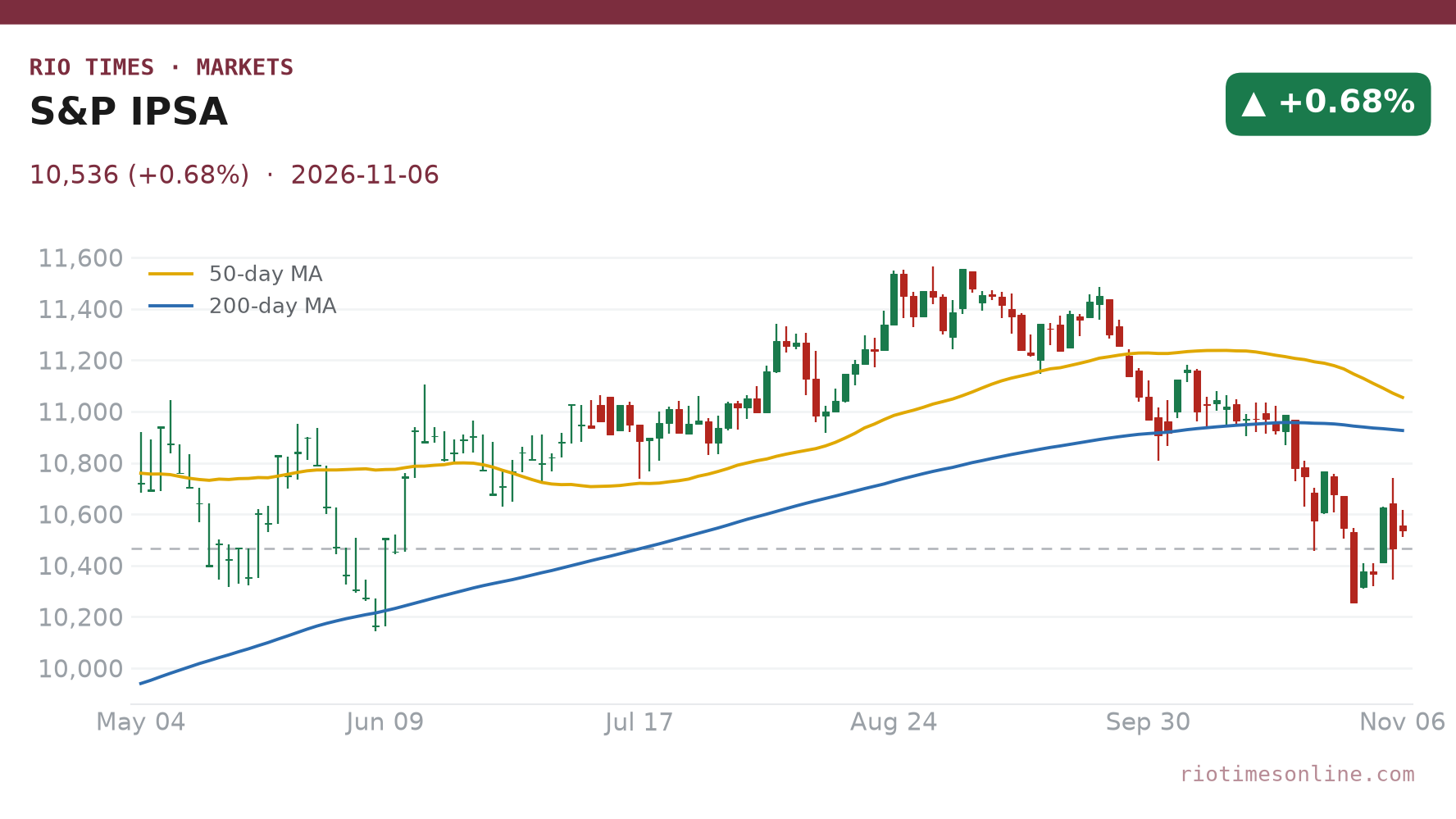
- Chile’s S&P IPSA, the main index of the Santiago stock exchange, gained 0.68% to close at 10,536, yet it still sits 9.4% below its 12-month high of 11,628, set on 28 January.
- The dollar slipped 0.29% to 975.74 Chilean pesos, which leaves it 1.84% lower over five sessions but 6.6% higher over 60 sessions, so the peso is still weaker than three months ago.
- Retailers and mall owners led the board, with supermarket and department-store group Cencosud up 3.1%, mall operator Parque Arauco up 3.1% and Ripley up 2.8%.
- Wall Street’s technology rebound set the tone, with the Nasdaq up 1.09% and the VIX, Wall Street’s fear gauge, down 9.01% to 25.64.
- Our own price history since 2007 offers a calm note: after 67 earlier falls as large as the IPSA’s 4.4% drop over 20 sessions, the index was higher 20 sessions later in 38 cases, or 57%.
Today’s Focus
Santiago caught its breath on Friday. The S&P IPSA, the benchmark index of Chile’s biggest listed companies, rose 0.68% to 10,536, while the dollar fell 0.29% to 975.74 pesos.
The cause sat mostly abroad. A technology sell-off on Wall Street had pushed investors into the dollar the day before, and Friday’s rebound in chip and software shares reversed some of that flight.
The recovery is real but small against the damage. The IPSA is 9.4% below its 12-month high of 11,628, and it lost 4.42% over 20 sessions, so one good day has not yet repaired the month.
What matters today. Friday was a relief bounce driven by global risk appetite, and the IPSA needs to hold above 10,500 to show it is more than that.
01 The session in one read
Friday 6 November, the latest settled session, was a day of relief in Santiago. The S&P IPSA, the index of the exchange’s biggest companies, closed at 10,536, up 0.68%.
The Chilean peso also firmed. The dollar fell 0.29% to 975.74 pesos, so each dollar bought slightly fewer of them.
Thursday had been the nervous day. A sell-off in US technology shares sent money into the dollar, and the Chilean peso weakened with other emerging-market currencies.
On Friday, Wall Street’s tech rebound took the pressure off. The Nasdaq rose 1.09% and the VIX fell 9.01% to 25.64, a sign that investors were paying less for protection.
The evidence for a lasting recovery is mixed. The index is up 2.75% over five sessions and the peso is firmer, but the 20-session and 60-session trends both remain negative.
The unusual part is that the dollar index rose 0.72% on the day and the peso still strengthened, which tells us Chile-specific buying and a calmer global mood outweighed broad dollar strength. The variable to watch is copper, Chile’s biggest export and the real anchor for both the peso and the stock market.
02 The day’s numbers
| Measure | Level | Change | Read |
|---|---|---|---|
| S&P IPSA close | 10,536 | +0.68% | Back above the 10,500 mark that traders watch |
| Session range | — | — | Not in our scan |
| USD/CLP (pesos per dollar) | 975.74 | −0.29% | Dollar lower, peso firmer |
| IPSA 52-week range | 9,432 – 11,628 | — | 9.4% below the high, 11.7% above the low |
| USD/CLP 52-week range | 851.67 – 995.39 | — | 2.0% below the high, 14.6% above the low |
| Key technical level | 10,500 / 10,250 | — | Hold above 10,500; 10,250 is the support below |
Read the table as a recovery inside a damaged trend. The index sits 11.4% above its 12-month low of 9,460 from 6 November 2025, but it is 9.4% under its January peak.
The currency tells a similar story. At 975.74 the dollar is 2.0% below its 12-month high of 995.39 from 23 October, yet it is 14.6% above its February low of 851.67. Rio Times · Live Market Intelligence
Live Market IntelligenceChile — Live Market Board
Chile — Live Market Board
Instrument Last Change YoY Prev. High Low Volume
IPSA
10,536.40
+0.68%
—
10,465.25
10,617
10,511
—
USD/CLP
975.74
-0.29%
+3.43%
978.59
983.51
973.55
—
COPPER
6.26
+0.18%
+26.58%
6.25
6.29
6.19
72,116
SQM-B
56,400
+1.95%
+27.31%
55,320
57,399
55,850
140,429
COPEC
6,375
+0.55%
-6.66%
6,340
6,484
6,375
309,623
BSANTANDER
79.42
+0.40%
+15.13%
79.10
79.80
78.68
50,779,737
FALABELLA
6,504
+0.08%
+10.15%
6,499
6,638
6,490
1,013,398
ENELAM
83.00
+1.84%
-7.57%
81.50
83.30
81.51
17,256,424
CENCOSUD
1,670
+3.09%
-42.21%
1,620
1,745
1,646
4,439,480
CMPC
898.00
-0.77%
-33.54%
905.00
909.16
888.78
1,783,541
BANCO CHILE
189.10
-0.31%
+11.24%
189.69
193.80
189.10
26,679,905
LATAM AIR
23.36
+1.79%
+12.69%
22.95
23.60
22.35
1,230,444,191
SOUTHERN COPPER
167.27
+1.14%
+28.43%
165.38
168.83
164.77
1,127,963
03 Why it moved — Wall Street’s tech rebound and a calmer peso
The first cause, and the heaviest, was the global mood. After Thursday’s technology sell-off, chip and software shares bounced, with Nvidia rising 5.64% after losing 9% the day before, according to local press reports.
The S&P 500 gained 0.31% and the Nasdaq 1.09%. Confidence in this explanation is high, because Chile’s stock market tends to follow global risk appetite on days like this.
The second cause was the peso. The dollar fell 0.29% even though the US dollar index rose 0.72%, which points to local support: exporters selling dollars and a pause in the copper slide that had weighed on the currency earlier in the week.
Confidence is medium, because we have no settled copper price for the day. A firmer peso also lowers the cost of imported goods, which helps retailers.
The third cause was a stronger US jobs report. The US Bureau of Labor Statistics put the American unemployment rate at 4.1%, down from 4.2%, with 165,000 jobs added against about 65,000 expected, and the US 10-year Treasury yield, the benchmark cost of long-term borrowing in dollars, edged up 3 basis points to 4.87%.
That would normally hurt emerging markets. It did not on Friday, which suggests investors read the data as a sign of a healthy US economy rather than a reason to fear higher rates.
Oil gave a quiet tailwind. Chile imports most of its fuel, and the oil fund USO is down 12.10% over five sessions after rising 0.13% on the day.
Official US data from the Energy Information Administration (eia.gov) showed commercial crude stocks at 409.8 million barrels, down 0.9 million on the week.
04 The day’s movers
| Driver | Level / Move | Change | Note |
|---|---|---|---|
| Cencosud (supermarkets, department stores) | $8m traded | +3.1% | Biggest gainer; benefits from a firmer peso |
| Parque Arauco (shopping malls) | — | +3.1% | Mall owners rallied with retail |
| Ripley (department stores) | — | +2.8% | Consumer names led |
| SQM-B (lithium and fertilisers) | $8m traded | +2.0% | Lithium bellwether rose in light turnover |
| LATAM Airlines (LTM) | $29m traded | +0.0% | Most traded, but flat |
| Quinenco (holding group) | $15m traded | −0.4% | Second most traded |
| Mallplaza (shopping malls) | $14m traded | +0.1% | Quiet despite sector gains |
| Falabella (retail and banking) | $7m traded | +0.1% | Barely moved |
| Banco de Chile (CHILE) | $5m traded | −0.3% | Largest bank slipped |
| Andina-B (soft-drink bottler) | — | −2.2% | Among the biggest losers |
| Entel (telecoms) | — | −2.0% | Defensive stock gave back ground |
| Itaú Chile (bank) | — | −1.2% | Weakest of the banks in the scan |
Consumer shares did the heavy lifting. Cencosud, which runs the Jumbo supermarkets, and the mall owners Parque Arauco and Ripley gained between 2.8% and 3.1%, a pattern consistent with a firmer peso and calmer markets.
The laggards were defensive. Telecoms group Entel fell 2.0%, drinks bottler Andina-B fell 2.2%, and the banks slipped, with Banco de Chile down 0.3% and Itaú Chile down 1.2%.
Falabella, the retail-and-banking group, rose only 0.1% on $7m of turnover. Traders did not treat the whole retail sector as one trade.
05 The regional scoreboard
| Index | Country | Change |
|---|---|---|
| S&P IPSA | Chile | +0.68% |
| Ibovespa | Brazil | +1.39% |
| IPC | Mexico | +0.43% |
| Merval | Argentina | −0.6% |
| COLCAP | Colombia | +0.03% |
Chile’s gain sat in the middle of the region. Brazil’s Ibovespa, the main index of the São Paulo exchange, led with 1.39%, while Argentina’s Merval, its main index, fell 0.6% in thin holiday trading.
Currencies split too. The Mexican peso strengthened, with the dollar down 0.79% to 18.607 pesos, while the Colombian peso weakened, with the dollar up 0.34% to 3,238 pesos.
The Brazilian real was flat at 5.5053 per dollar. Chile’s firmer peso therefore stood out from Colombia’s, even though both countries sell commodities.
For a reader in São Paulo, Mexico City or Lima, the lesson is that the tech rebound helped risk appetite broadly, but country stories still decided the winners. Cencosud and Falabella both run stores across several Latin American countries, so their share prices carry a regional stake as well as a Chilean one.
The live board above carries the full closes.
06 The technical picture
The nearest support is 10,500, which the index reclaimed on Friday, and below it a level near 10,250, where one market analyst said the index found a floor earlier this week. Below that the 12-month low of 9,432 is the last line of defence.
The nearest resistance is the round 11,000 mark, then the January high of 11,628. The IPSA is 9.4% below that high, so it needs a gain of roughly a tenth to get back.
For the dollar, 995.39, set on 23 October, is the ceiling traders remember. A move through it would signal real peso stress; the round 950 and the February low of 851.67 are far below.
Our own history gives some perspective. The IPSA fell 4.4% over 20 sessions, and in the 67 earlier cases with a fall at least that large, it was higher 20 sessions later in 38 of them, or 57%.
The median gain was 1.6%, the best case was 14.5% and the worst was a loss of 24.6%. History is not a forecast, but it says deep dips have often healed — and sometimes have not.
07 What to watch
- Copper: The metal behind Chile’s exports and the peso; a renewed slide would undo Friday’s peso gain and pressure miners.
- 10,500 on the IPSA: A close below it would put the 10,250 support back in play; holding above keeps the recovery alive.
- Wall Street technology shares: The sell-off and rebound set the mood for emerging markets; a second reversal would hit Chile’s risk assets again.
- Chile’s inflation and the central bank: October prices feed into the UF, the inflation-linked unit used for mortgages and rents, and shape rate expectations for banks and property companies.
Background: Chile Stocks Fall 1.5% as Wall Street Slumps.
Background: Chile Stocks Jump 2.52% as Oil Slumps.
Frequently Asked Questions
How did the Chile stock market close in the latest session?
The S&P IPSA, the main index of the Santiago exchange, rose 0.68% to close at 10,536 on Friday 6 November.
What did the Chilean peso do?
The dollar fell 0.29% to 975.74 pesos, so the peso strengthened slightly. The dollar is still 6.6% higher than 60 sessions ago.
Why did Chilean stocks rise?
Mainly a rebound in US technology shares that eased fear in global markets, plus a steadier peso that helped retailers such as Cencosud, up 3.1%.
Is the IPSA near its high?
No. It is 9.4% below its 12-month high of 11,628 from 28 January, though 11.4% above its low of 9,460 from 6 November 2025.
Market data: The Rio Times; exchange figures from Bolsa de Santiago
This article was produced by The Rio Times’ automated newsroom system. How we use AI · Report an error · Editorial responsibility: Matthias Camenzind, Editor-in-Chief
LatAm Markets: Live Signals → — real-time movers, turnover leaders and FX across Latin America.
Get The Rio Times delivered to your inbox — market intelligence, daily briefs, and breaking analysis across Latin America.
Start for US$1