Chile Stocks Rise 0.5% as Peso Gains 1% | Chile Market Report, Nov 9
Key Facts
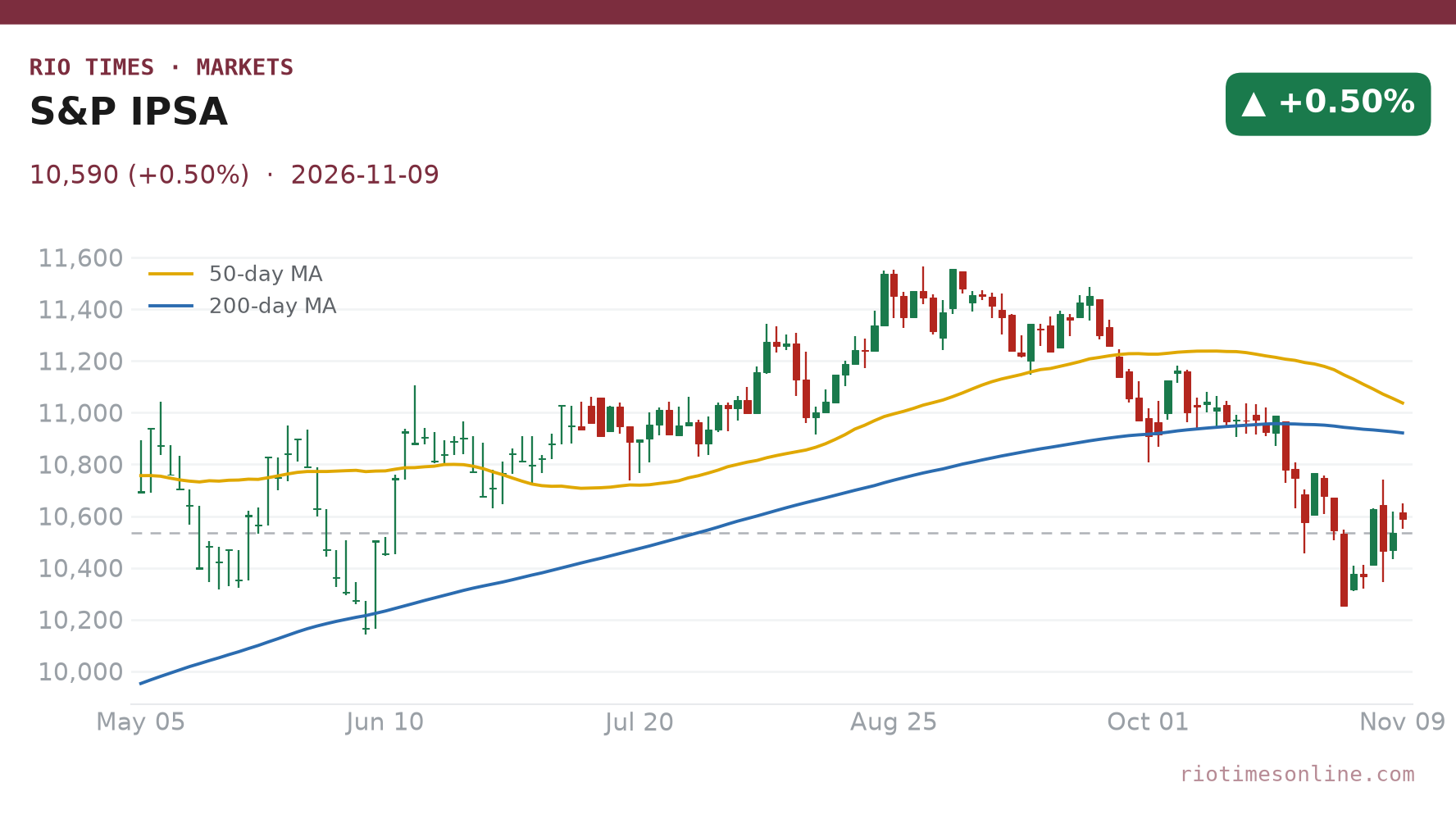
- The S&P IPSA, Chile’s main stock index, closed at 10,590, up 0.50% for a second straight gain, but still 8.9% below its 12-month high of 11,628 set on 28 January 2026.
- The Chilean peso strengthened 0.96%, with one US dollar costing 967.23 pesos, as the global dollar index slipped 0.61%.
- Wall Street did the heavy lifting the S&P 500 jumped 2.35% and the VIX fear gauge fell 22.31% to 19.92, which calmed investors everywhere.
- Retailers led while the lithium name lagged Falabella rose 1.9% and Cencosud 1.8%, while SQM-B, the lithium producer, fell 2.8% on $8m of turnover.
- The month is still negative the IPSA is down 4.11% over 20 sessions, so this looks like a pause in a slide rather than a new uptrend.
Today’s Focus
Chile’s main stock index, the S&P IPSA, rose 0.50% to close at 10,590 — its second gain in a row. The peso also had a good day, strengthening 0.96% to 967.23 per US dollar.
The cheer needs context, because the index is down 4.11% over 20 sessions and sits 8.9% below its 12-month high of 11,628, reached on 28 January 2026. It is also 11.9% above its 12-month low of 9,460 from 6 November 2025, so the market is stuck in the middle of its yearly range.
The push came from abroad. The S&P 500, the benchmark for large US companies, rose 2.35%, the VIX fear gauge fell 22.31% to 19.92, and the dollar index weakened 0.61%.
For an ordinary reader, a stronger peso makes imported goods and foreign travel slightly cheaper for Chileans, and it makes Chilean assets a little more expensive for visiting investors. Santiago’s rise was modest next to Brazil’s 2.22%.
What matters today. A weaker global dollar and a calmer Wall Street lifted the peso more than the shares, so the rebound is real but small against a month-long slide.
01 The session in one read
Think of Chile’s stock market as a small boat on a big ocean: when Wall Street swells, it rises, but not by as much. On this session the S&P IPSA closed at 10,590, up 0.50%.
The IPSA tracks the country’s most heavily traded listed companies, from supermarkets and banks to a lithium miner. Its two-day winning run follows a rough month in which it fell 4.11% over 20 sessions.
The peso did better than the shares. One US dollar cost 967.23 pesos, which is 0.96% fewer pesos than the session before, so the Chilean currency gained.
The evidence points to an outside push: US shares surged, fear eased and the dollar softened, and all three usually help Chile. But the IPSA gained only 0.50% against 2.35% for the S&P 500, which says local buyers are cautious and lithium-linked SQM-B fell 2.8%. The variable to watch is whether the dollar keeps falling against the peso, because a move back toward 995.39 would erase the relief.
02 The day’s numbers
| Measure | Level | Change | Read |
|---|---|---|---|
| S&P IPSA close | 10,590 | +0.50% | Second straight gain |
| Session range | — | — | Not available in our scan |
| USD/CLP (pesos per US dollar) | 967.23 | −0.96% | Peso stronger |
| IPSA vs 12-month range | 8.9% below the 11,628 high; 11.9% above the 9,460 low | — | Middle of the yearly range |
| USD/CLP vs 12-month range | 2.8% below the 995.39 high; 13.6% above the 851.67 low | — | Peso weak versus February |
| IPSA over 20 sessions | 10,590 | −4.11% | Month still negative |
| Key technical level | 11,000 resistance, 10,000 support | — | Round numbers traders watch |
The table tells two stories. In the short run the index is rising, but over 20 sessions it is still lower, so one good day has not repaired the month.
The peso sits 13.6% weaker than its February low of 851.67 per dollar, though 2.8% stronger than its 23 October high of 995.39. In plain terms, the currency has recovered a little of its autumn slump but not much. Rio Times · Live Market Intelligence
Live Market IntelligenceChile — Live Market Board
Chile — Live Market Board
Instrument Last Change YoY Prev. High Low Volume
IPSA
10,589.61
+0.50%
—
10,536.54
10,650
10,550
—
USD/CLP
966.96
-0.99%
+3.97%
976.64
975.74
966.06
—
COPPER
6.38
+2.65%
+25.48%
6.22
6.40
6.36
1,897
SQM-B
54,795
-2.85%
+12.54%
56,400
56,380
54,325
142,456
COPEC
6,384
+0.14%
-7.07%
6,375
6,498
6,370
649,983
BSANTANDER
79.35
-0.09%
+13.52%
79.42
80.27
78.70
63,262,149
FALABELLA
6,629
+1.92%
+10.67%
6,504
6,629
6,504
786,847
ENELAM
82.60
-0.48%
-7.19%
83.00
83.59
82.51
8,994,622
CENCOSUD
1,700
+1.80%
-41.38%
1,670
1,720
1,681
4,767,545
CMPC
884.03
-1.56%
-34.52%
898.00
895.99
882.01
1,308,336
BANCO CHILE
190.80
+0.90%
+12.22%
189.10
192.38
189.55
24,042,908
LATAM AIR
24.10
+5.01%
+16.03%
22.95
24.16
23.61
1,119,365,790
SOUTHERN COPPER
176.02
+5.23%
+32.36%
167.27
178.46
174.04
866,245
03 Why it moved — a weaker dollar and a Wall Street rally
The biggest cause was the global mood, with high confidence. The S&P 500 gained 2.35%, the Nasdaq (the US technology-heavy index) gained 2.74%, and the VIX, Wall Street’s fear gauge, fell 22.31% to 19.92.
The second cause was a softer dollar, with high confidence. The dollar index, which measures the US currency against its main trading partners, fell 0.61% to 101.68, and that gave the peso room to climb to 967.23.
The third cause was cheaper oil, with medium confidence. An oil fund fell 3.87% over the session, and Chile imports most of its fuel, so lower prices ease the import bill. Official US data show commercial crude stocks of 409.8 million barrels in the week ending 30 October (US Energy Information Administration, eia.gov), a cushion that fits a softer oil price.
The signals were not all neat. US 10-year government borrowing costs, the yield that guides world interest rates, edged up three basis points (0.03 percentage points) to 4.89%, and a gold fund still rose 1.88%, so some investors stayed defensive.
Copper, Chile’s economic anchor, has no settled price in our scan, so we do not quote one. Trade data show Chile’s copper exports totalled US$54.655bn in January to October, up 15.8% and the highest for that period in the records cited, though October shipments themselves fell.
At home, the Budget Law debate in Congress turned heated and public-sector unions asked for a 6.3% nominal pay rise, about 2% after inflation. Both items matter for government spending, but we see them as background noise for this session.
Chile’s trade balance for October (forecast about US$2.09 billion, previous US$2.05 billion) was due at 11:30 Lisbon time, according to the RT economic calendar. Exports and imports were in line with forecasts in our calendar, but the balance figure was not available when we published, so we do not quote it.
04 The day’s movers
| Driver | Level / Move | Change | Note |
|---|---|---|---|
| SQM-B | $8m turnover | −2.8% | Lithium producer; lagged a rising market |
| Falabella | $5m turnover | +1.9% | Department stores and retail; helped by a stronger peso |
| Cencosud | $8m turnover | +1.8% | Supermarkets and shopping; also gained from the peso |
| Enel Chile | $7m turnover | +1.4% | Electricity company |
| Quinenco | $14m turnover | −1.1% | Most traded; holding company |
| Mallplaza | $12m turnover | −0.4% | Shopping-centre operator |
| Banco de Chile | $5m turnover | +0.9% | Largest bank by trading in the scan |
| Banco Santander Chile | $5m turnover | −0.1% | Flat bank day |
| CAP | — | −4.0% | Steel and iron-ore group; biggest faller |
| CMPC | — | −1.6% | Pulp and paper exporter |
Retailers were the clear winners, and the reason is the peso. A stronger currency lowers the cost of imported goods that Falabella and Cencosud sell, so their profit margins can improve.
SQM-B, the share class of the lithium giant SQM, fell 2.8% on $8m of turnover while the wider market rose. Our scan gives no lithium-specific trigger, so the best-supported reading is stock-specific selling, with low confidence. CAP fell 4.0%, the day’s worst drop.
05 The regional scoreboard
| Index | Country | Change |
|---|---|---|
| S&P IPSA | Chile | +0.50% |
| Ibovespa | Brazil | +2.22% |
| IPC | Mexico | +1.00% |
Chile finished behind its larger neighbours. Brazil’s Ibovespa (its main index) rose 2.22% and Mexico’s IPC gained 1.00%, while Argentina’s stock market was closed for a national holiday. Peru’s BVL index rose 1.68%. The live market board above carries the full closes.
For Latin America, the weaker dollar mattered most. The Mexican peso firmed 0.40% to 18.5545. The Brazilian real was the exception, slipping 0.10% to 5.5117 per dollar.
06 The technical picture
Charts are maps of where buyers and sellers have fought before. The IPSA’s nearest ceiling is the round number 11,000, with the 12-month high of 11,628 behind it. Its floor is 10,000, with the 12-month low of 9,460 below.
For the peso, the ceiling on the dollar is its 23 October high of 995.39. A dollar below 950 would be a clear sign of a stronger peso, with the February low of 851.67 far below.
Our own history gives some comfort without making a promise. Since 2007, the IPSA fell 4.1% in 20 sessions in 74 earlier independent cases, and it was higher 20 sessions later in 43 of them (58%), with a median gain of 1.3%.
The worst case was a fall of 24.6% and the best a rise of 16.7%. History is not a forecast, but it says that slumps like this one more often fade than deepen.
07 What to watch
- US inflation data: Consumer-price figures are due on 10 November, with the headline rate expected at 3.9% against 3.7% before. A hotter reading could lift US yields and strengthen the dollar against the peso.
- The dollar index: It stands at 101.68. A rebound would pressure the peso, while a further fall would extend the relief.
- Copper and lithium: SQM-B fell 2.8% while the index rose, so watch lithium prices and copper shipments for signs of what miners and exporters face.
- Chile’s Budget and pay talks: The government is due to answer public-sector unions’ 6.3% nominal pay request this week, and the Budget Law debate continues.
Background: Chile Stocks Rise 0.68% as Retailers Lead.
Background: Chile Stocks Fall 1.5% as Wall Street Slumps.
Frequently Asked Questions
How did the Chilean stock market close?
The S&P IPSA, Chile’s main stock index, closed at 10,590, up 0.50%. It is 8.9% below its 12-month high of 11,628.
What happened to the Chilean peso?
The peso strengthened 0.96%, and one US dollar cost 967.23 pesos. That is 2.8% below the 23 October high of 995.39.
Why did Chile’s market rise?
Mostly because Wall Street rallied, with the S&P 500 up 2.35%, and because the global dollar index fell 0.61%. Falling oil prices also helped.
Is the Chilean stock market in a downtrend?
Over 20 sessions the IPSA is down 4.11%, so the month is negative. Two straight gains suggest a pause rather than a confirmed recovery.
Market data: The Rio Times; exchange figures from Bolsa de Santiago
This article was produced by The Rio Times’ automated AI newsroom. Editorial responsibility: Matthias Camenzind, Publisher and Editor-in-Chief. The Rio Times also runs Ask Rio Times, which answers from 100,000+ of our own articles, the daily Latin America Power Map, and prediction-market odds on elections and markets.. How we use AI · Report an error
LatAm Markets: Live Signals → — real-time movers, turnover leaders and FX across Latin America.
Get The Rio Times delivered to your inbox — market intelligence, daily briefs, and breaking analysis across Latin America.
Start for US$1